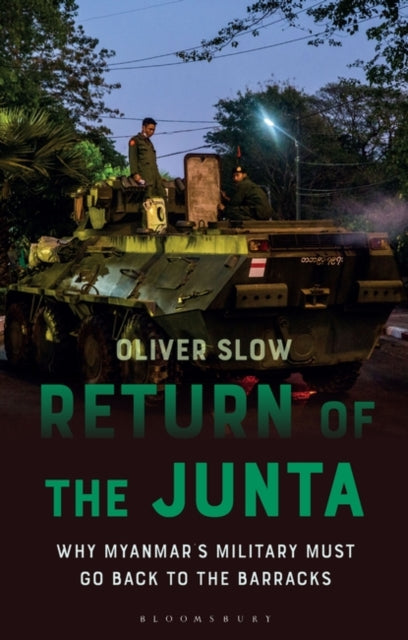
Oliver) Slow
Return of the Junta: Why Myanmar's Military Must Go Back to the Barracks
Return of the Junta: Why Myanmar's Military Must Go Back to the Barracks
💎 Earn 94 Points (£0.94) on this item.
YOU SAVE £4.00
- Condition: Brand new
- UK Delivery times: Usually arrives within 2 - 3 working days
- UK Shipping: Fee starts at £2.39. Subject to product weight & dimension
Bulk ordering. Want 15 or more copies? Get a personalised quote and bigger discounts. Learn more about bulk orders.
Couldn't load pickup availability
- More about Return of the Junta: Why Myanmar's Military Must Go Back to the Barracks
Return of the Junta is a detailed account of the ways that Myanmars military has maintained control over its people despite a decade of supposed reform, drawing on first-hand accounts from activists, journalists and politicians. It asks what needs to be done to remove the military from power in Myanmar once and for all.
Format: Paperback / softback
Length: 256 pages
Publication date: 23 February 2023
Publisher: Bloomsbury Publishing PLC
On the first day of February 2021, Myanmar's military seized power in a coup d'état, putting an end to a decade of reforms aimed at breaking the shackles of military rule in the country. Protests across the country were met with a brutal crackdown that shocked the world, but it was a familiar response from an institution that had ruled the country with violence and terror for decades. Return of the Junta is a detailed account of the ways in which Myanmar's military, known as the Tatmadaw, has maintained control over its people despite a decade of supposed reform. In this detailed account, drawing on first-hand accounts from activists, journalists, and politicians, Oliver Slow explores the measures the military has used to keep hold of power and the motivations of those now rising up against its rule. The book asks the question: what needs to be done to remove the military from power in Myanmar once and for all?
The Tatmadaw's grip on power in Myanmar has been strengthened by a combination of factors, including a lack of political will among the civilian population, a history of military rule, and the use of violence and intimidation to suppress dissent. The military has also benefited from the support of powerful regional actors, such as China and Russia, who have provided financial and military assistance to the regime.
One of the key strategies used by the Tatmadaw to maintain control is through the use of propaganda. The military has controlled the media, and has used it to spread false information and to discredit opposition groups. This has been particularly effective in rural areas, where many people rely on the media for their news. The military has also used social media to spread its message, and has been able to mobilize support for its cause by using hashtags and other online tools.
Another strategy used by the Tatmadaw is to use violence and intimidation to suppress dissent. The military has been known to use torture, rape, and murder to intimidate opposition groups and to silence critics. This has been particularly prevalent in ethnic minority areas, where the military has been accused of committing genocide.
Despite these measures, there have been several attempts to remove the military from power in Myanmar. In 2011, a popular uprising known as the Saffron Revolution was sparked by the military's brutal crackdown on protesters. The uprising was eventually suppressed by the military, but it led to the formation of a civilian-led government that was supposed to bring about reform.
However, the civilian-led government was unable to make any significant changes to the military's grip on power. The military continued to control the media, and to use violence and intimidation to suppress dissent. In 2015, the military launched a new offensive against the Rohingya minority, which resulted in the displacement of over 700,000 people.
In response to these events, the international community has imposed sanctions on Myanmar. These sanctions have had a significant impact on the military's ability to operate, but they have not been enough to remove the military from power. The military has continued to receive support from regional actors, and has been able to use its resources to maintain its grip on power.
One of the challenges facing the international community in removing the military from power in Myanmar is the lack of political will among the civilian population. Many people in Myanmar are afraid of the military, and are reluctant to speak out against its rule. This has been exacerbated by the military's use of violence and intimidation, which has made it difficult for opposition groups to organize and to mobilize support.
Another challenge facing the international community is the lack of international cooperation. Many countries have been reluctant to impose sanctions on Myanmar, and have instead chosen to engage in dialogue with the military. This has been ineffective, as the military has used these dialogues to further its own agenda.
In order to remove the military from power in Myanmar, the international community needs to take a more aggressive approach. This should include imposing sanctions on the military, providing support to opposition groups, and engaging in dialogue with the military. The international community should also work to promote human rights and democracy in Myanmar, and to address the underlying causes of the conflict.
One of the key challenges facing the international community in promoting human rights and democracy in Myanmar is the lack of access to information. The military has controlled the media, and has been able to use it to spread false information and to discredit opposition groups. This has been particularly prevalent in ethnic minority areas, where the military has been accused of committing genocide.
To address this challenge, the international community should work to promote access to information in Myanmar. This should include providing funding to local media organizations, and to training journalists and activists. The international community should also work to promote the use of social media and other online tools to spread information and to mobilize support for opposition groups.
Another challenge facing the international community in promoting human rights and democracy in Myanmar is the lack of political will among the civilian population. Many people in Myanmar are afraid of the military, and are reluctant to speak out against its rule. This has been exacerbated by the military's use of violence and intimidation, which has made it difficult for opposition groups to organize and to mobilize support.
To address this challenge, the international community should work to promote political participation in Myanmar. This should include providing funding to political parties, and to training political leaders. The international community should also work to promote the use of peaceful protests and other forms of political expression.
In addition to promoting human rights and democracy, the international community should also work to address the underlying causes of the conflict in Myanmar. This should include addressing the issue of ethnic minority rights, and working to promote economic development in the country.
One of the key challenges facing the international community in addressing the issue of ethnic minority rights in Myanmar is the lack of recognition of these rights. The military has been accused of committing genocide against the Rohingya minority, and has been accused of committing other human rights violations against other ethnic minority groups.
To address this challenge, the international community should work to promote the recognition of ethnic minority rights in Myanmar. This should include providing funding to local organizations that work to promote these rights, and to working to promote the inclusion of ethnic minority groups in the political process.
In addition to promoting ethnic minority rights, the international community should also work to address the issue of economic development in Myanmar. This should include providing funding to local businesses, and to working to promote the development of infrastructure in the country.
One of the challenges facing the international community in addressing the issue of economic development in Myanmar is the lack of access to capital. Many businesses in Myanmar are small and informal, and are unable to access the capital they need to grow and to create jobs.
To address this challenge, the international community should work to promote access to capital in Myanmar. This should include providing funding to local banks, and to working to promote the development of the financial sector in the country.
In conclusion, the return of the junta in Myanmar has been a significant setback for the country's efforts to break the shackles of military rule. The military has used a combination of factors, including a lack of political will among the civilian population, a history of military rule, and the use of violence and intimidation to suppress dissent, to maintain control over its people. The international community needs to take a more aggressive approach to remove the military from power in Myanmar, including imposing sanctions on the military, providing support to opposition groups, and engaging in dialogue with the military. The international community should also work to promote human rights and democracy in Myanmar, and to address the underlying causes of the conflict in the country. By doing so, we can help to ensure that Myanmar becomes a more peaceful and prosperous country for all of its people.
Weight: 328g
Dimension: 138 x 216 x 16 (mm)
ISBN-13: 9781350289659
This item can be found in:
UK and International shipping information
UK and International shipping information
UK Delivery and returns information:
- Delivery within 2 - 3 days when ordering in the UK.
- Shipping fee for UK customers from £2.39. Fully tracked shipping service available.
- Returns policy: Return within 30 days of receipt for full refund.
International deliveries:
Shulph Ink now ships to Australia, Belgium, Canada, France, Germany, Ireland, Italy, India, Luxembourg Saudi Arabia, Singapore, Spain, Netherlands, New Zealand, United Arab Emirates, United States of America.
- Delivery times: within 5 - 10 days for international orders.
- Shipping fee: charges vary for overseas orders. Only tracked services are available for most international orders. Some countries have untracked shipping options.
- Customs charges: If ordering to addresses outside the United Kingdom, you may or may not incur additional customs and duties fees during local delivery.