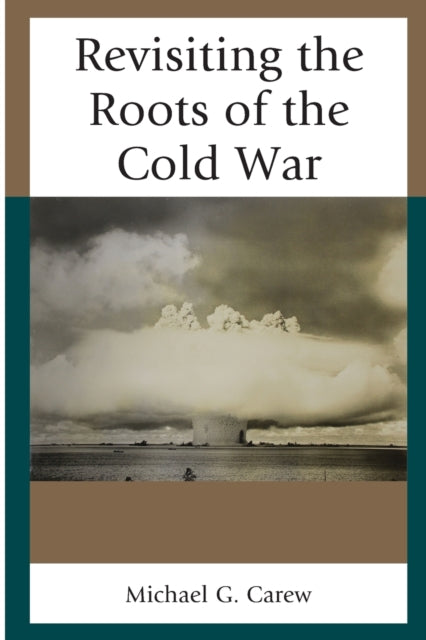
Michael G. Carew
Revisiting the Roots of the Cold War
Revisiting the Roots of the Cold War
💎 Earn 191 Points (£1.91) on this item.
We can order this item for you. Delivery usually takes about 4 to 6 weeks.
This item is not held in our immediate stock. We will order it for you after checkout.
Estimated delivery: About 4 to 6 weeks
- Condition: Brand new
- UK Delivery times: Usually arrives within 2 - 3 working days
- UK Shipping: Fee starts at £2.39. Subject to product weight & dimension
Bulk ordering. Want 15 or more copies? Get a personalised quote and bigger discounts. Learn more about bulk orders.
Couldn't load pickup availability
- More about Revisiting the Roots of the Cold War
Revisiting the Roots of the Cold War examines the emergence of the Cold War from 1944-1948, highlighting Soviet scholarship and other archives. It provides a more realistic appraisal of U.S. policy than previous works, which ignored the effects of American demobilization and restructuring.
Format: Paperback / softback
Length: 282 pages
Publication date: 23 June 2021
Publisher: Lexington Books
Revisiting the Roots of the Cold War is a comprehensive history of the emergence of the Cold War from 1944 to 1948, with a particular emphasis on the recently available Soviet scholarship and information from other archives. Prior scholarship on the origins of the Cold War laid the foundation for the final works of James Gaddis, George Kennan, and Ernest May in the 1980s. However, these works, lacking access to Soviet materials, ignored the significant effects of American demobilization and the major restructuring of the State and Defense Departments. This study presents a more realistic appraisal of the formulation of U.S. policy during this critical period.
The Cold War emerged as a complex and multifaceted phenomenon during the years 1944 to 1948, marked by a series of political, economic, and military developments that had far-reaching consequences for the world. The roots of the Cold War can be traced back to the aftermath of World War II, when the United States and the Soviet Union emerged as the two dominant superpowers. Tensions between the two nations began to escalate as they competed for influence and power in the post-war world, leading to a series of conflicts and confrontations that would shape the course of history for decades to come.
One of the key factors that contributed to the emergence of the Cold War was the ideological divide between the United States and the Soviet Union. The United States, led by President Franklin D. Roosevelt and his administration, advocated for a liberal democratic system that promoted individual rights, free markets, and international cooperation. In contrast, the Soviet Union, led by Soviet leader Joseph Stalin, advocated for a communist system that aimed to establish a socialist state and spread its influence throughout the world.
Another factor that contributed to the Cold War was the territorial expansion of the Soviet Union. Following the end of World War II, the Soviet Union occupied a large portion of Eastern Europe, including the countries of Poland, Hungary, and Czechoslovakia. This expansion alarmed the United States and other Western nations, who feared that the Soviet Union was attempting to expand its influence and control over the region.
The Cold War also had significant economic consequences. The two nations engaged in a fierce competition for resources and markets, leading to a series of trade wars and economic sanctions. This competition was particularly intense in the field of technology, where the United States and the Soviet Union were both developing advanced weapons and military technologies.
The Cold War also had a profound impact on international relations and security. The two nations engaged in a constant state of brinkmanship, with each side threatening the other with nuclear war and other forms of military aggression. This led to a buildup of military arsenals and a proliferation of nuclear weapons, which created a sense of urgency and fear among the international community.
Despite the many challenges and complexities of the Cold War, there were also periods of cooperation and dialogue between the United States and the Soviet Union. For example, the two nations signed the Marshall Plan, which provided economic assistance to Western Europe in order to help rebuild the region and promote economic cooperation.
In conclusion, the Cold War was a complex and multifaceted phenomenon that emerged as a result of a series of political, economic, and military developments. The roots of the Cold War can be traced back to the ideological divide between the United States and the Soviet Union, the territorial expansion of the Soviet Union, and the economic competition between the two nations. The Cold War had significant consequences for international relations and security, and it shaped the course of history for decades to come. While there were periods of cooperation and dialogue, the Cold War ultimately ended with the collapse of the Soviet Union in 1991.
Weight: 413g
Dimension: 218 x 154 x 21 (mm)
ISBN-13: 9781498578189
This item can be found in:
UK and International shipping information
UK and International shipping information
UK Delivery and returns information:
- Delivery within 2 - 3 days when ordering in the UK.
- Shipping fee for UK customers from £2.39. Fully tracked shipping service available.
- Returns policy: Return within 30 days of receipt for full refund.
International deliveries:
Shulph Ink now ships to Australia, Belgium, Canada, France, Germany, Ireland, Italy, India, Luxembourg Saudi Arabia, Singapore, Spain, Netherlands, New Zealand, United Arab Emirates, United States of America.
- Delivery times: within 5 - 10 days for international orders.
- Shipping fee: charges vary for overseas orders. Only tracked services are available for most international orders. Some countries have untracked shipping options.
- Customs charges: If ordering to addresses outside the United Kingdom, you may or may not incur additional customs and duties fees during local delivery.