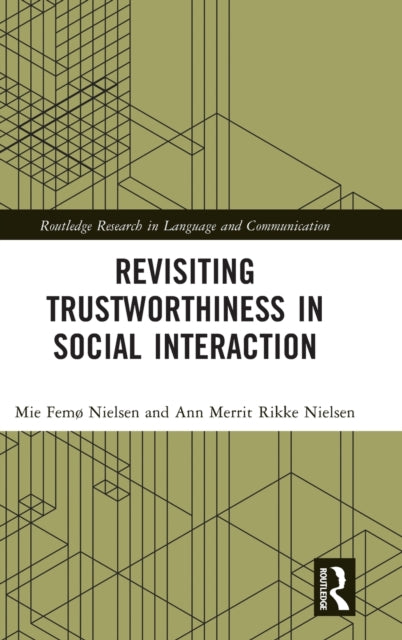
Mie Femo Nielsen,Ann Merrit Rikke Nielsen
Revisiting Trustworthiness in Social Interaction
Revisiting Trustworthiness in Social Interaction
💎 Earn 811 Points (£8.11) on this item.
We can order this item for you. Delivery usually takes about 4 to 6 weeks.
This item is not held in our immediate stock. We will order it for you after checkout.
Estimated delivery: About 4 to 6 weeks
YOU SAVE £9.63
- Condition: Brand new
- UK Delivery times: Usually arrives within 2 - 3 working days
- UK Shipping: Fee starts at £3.89. Subject to product weight & dimension
Bulk ordering. Want 15 or more copies? Get a personalised quote and bigger discounts. Learn more about bulk orders.
Couldn't load pickup availability
- More about Revisiting Trustworthiness in Social Interaction
This book combines trust research, rhetoric, ethnomethodology, and conversation analysis to develop an analytical program for conceptualizing and defining trustworthiness as an empirical research object in social interaction. It identifies four participant orientations of trustworthiness and defines the phenomena of character-bound displays and sequential negotiation of character as indicators of these orientations. Ethnomethodological multimodal conversation analysis is used to analyze exemplary cases from both mundane and institutional encounters, showing how trustworthiness is done, challenged, achieved, negotiated, and lost in interaction. The intended audiences are scholars of conversation analysis, ethnomethodology, rhetoric, and the social sciences, especially communication, organizational and leadership studies, and their students.
Format: Hardback
Length: 192 pages
Publication date: 30 September 2022
Publisher: Taylor & Francis Ltd
Revisiting Trustworthiness in Social Interaction delves into the intricate realm of trustworthiness as a multifaceted and dynamic concept. It explores trustworthiness from various sociological and rhetorical perspectives, redefining it as an interactional phenomenon that unfolds, is assessed, and negotiated by individuals in social interactions. The book identifies four distinct participant orientations of trustworthiness that shape individuals' dynamic identity projects. It also defines two key phenomena: character-bound displays and sequential negotiation of character, which serve as indicators of participants' orientations toward trustworthiness. By transforming the theoretical concept of trustworthiness into an empirical object of interaction analysis, the book opens up a wealth of interactional indicators for researchers to examine. Through the analysis of exemplary cases from both mundane and institutional encounters, employing ethnomethodological multimodal conversation analysis, the book showcases how trustworthiness is enacted, encountered, negotiated, and sometimes lost in interaction. This comprehensive work is designed to appeal to scholars and students in the fields of conversation analysis, ethnomethodology, rhetoric, and the social sciences, particularly communication, organizational and leadership studies.
Introduction:
Trustworthiness is a fundamental aspect of human relationships, shaping how individuals perceive and interact with others. While trust has been extensively studied in various disciplines, its empirical exploration as an empirical research object in social interaction remains relatively limited. This book aims to bridge this gap by bringing together trust research, rhetoric, ethnomethodology, and conversation analysis to develop an analytical program for conceptualizing and defining trustworthiness as an empirical research object.
Revisiting Trustworthiness in Social Interaction:
The book begins by revisiting trustworthiness as a relational and dynamic concept. It reviews sociological and rhetorical approaches to the study of trustworthiness, highlighting their contributions and limitations. It then respecifies trustworthiness as an interactional phenomenon displayed, tested, and negotiated by participants in social interaction. This reframing emphasizes the dynamic and contextual nature of trust, recognizing that it is not a static attribute but rather a fluid construct that evolves through ongoing interactions.
Four Participant Orientations of Trustworthiness:
To facilitate the empirical exploration of trustworthiness, the book identifies four participant orientations of trustworthiness that may be foregrounded in peoples dynamic identity projects. These orientations include trustworthiness as a virtue, trustworthiness as a competence, trustworthiness as a disposition, and trustworthiness as a commitment. Each orientation encompasses a range of characteristics and behaviors that participants may exhibit to demonstrate their trustworthiness.
Character-Bound Displays and Sequential Negotiation of Character:
Central to the book's analytical program is the concept of character-bound displays and sequential negotiation of character. Character-bound displays refer to the ways in which individuals present themselves and their actions to others, aiming to convey trustworthiness. These displays may include verbal and nonverbal cues, such as facial expressions, gestures, and language, as well as the use of artifacts and symbols. Sequential negotiation of character, on the other hand, involves the ongoing testing and negotiation of trustworthiness between participants in social interaction. It involves the exchange of information, evaluations, and commitments to establish and maintain trust.
Empirical Exploration:
The book provides an empirical exploration of trustworthiness in social interaction through the analysis of exemplary cases from both mundane and institutional encounters. Ethnomethodological multimodal conversation analysis is employed to analyze these cases, allowing for a detailed examination of the ways in which trustworthiness is enacted, encountered, negotiated, and sometimes lost in interaction. The analysis reveals the complex interplay of verbal and nonverbal cues, the use of artifacts and symbols, and the sequential negotiation of character that shape trustworthiness in different contexts.
Conclusion:
In conclusion, Revisiting Trustworthiness in Social Interaction offers a comprehensive and innovative approach to the study of trustworthiness as an empirical research object. By integrating trust research, rhetoric, ethnomethodology, and conversation analysis, the book provides a rich theoretical framework and empirical evidence for understanding trustworthiness in social interaction. It offers valuable insights for scholars and students in the fields of conversation analysis, ethnomethodology, rhetoric, and the social sciences, particularly communication, organizational and leadership studies. The book's analytical program and empirical exploration pave the way for further research on trustworthiness and its implications in various social contexts.
Dimension: 229 x 152 (mm)
ISBN-13: 9781032249568
UK and International shipping information
UK and International shipping information
We deliver throughout the United Kingdom and to 128 countries and territories worldwide, including the United States, Australia, Canada, Germany, Spain and France.