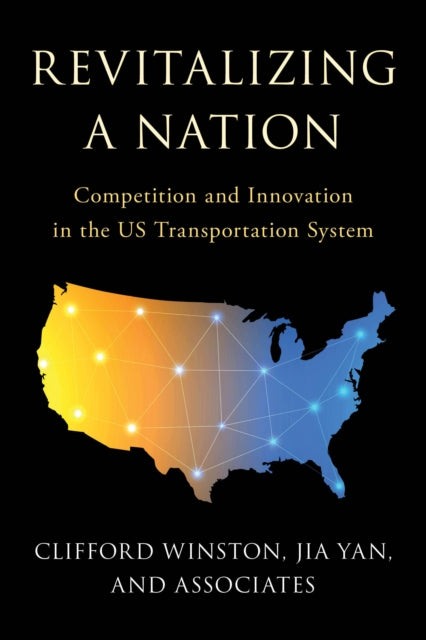
Clifford Winston,Jia Yan
Revitalizing a Nation: Competition and Innovation in The US Transportation System
Revitalizing a Nation: Competition and Innovation in The US Transportation System
💎 Earn 141 Points (£1.41) on this item.
We can order this item for you. Delivery usually takes about 4 to 6 weeks.
This item is not held in our immediate stock. We will order it for you after checkout.
Estimated delivery: About 4 to 6 weeks
YOU SAVE £3.68
- Condition: Brand new
- UK Delivery times: Usually arrives within 2 - 3 working days
- UK Shipping: Fee starts at £3.89. Subject to product weight & dimension
Bulk ordering. Want 15 or more copies? Get a personalised quote and bigger discounts. Learn more about bulk orders.
Couldn't load pickup availability
- More about Revitalizing a Nation: Competition and Innovation in The US Transportation System
The US transportation system is composed of interconnected sub-systems that provide urban and intercity passenger and freight service and operate by using infrastructure that facilitates surface, water, and air transportation. Transportation reduces the cost of distance, which includes the monetary cost, travel or shipping time, and safety consequences of moving people and goods from their origins to their destinations. An efficient transportation system provides the foundation for the development and growth of selected industries as well as an entire economy by enabling individuals and firms to be more productive at their destinations. However, by the 1960s, economists began to take issue with the so-called engineering approach to improving a transportation system, which involved increasing government spending and investment without considering efficient policies to optimize the systems performance that could reduce public spending and investment. In our book, Revitalizing A Nation: Competition and Innovation in the US Transportation System, we argue that it would be far more efficient and equitable if US policymakers prioritized greater competition and innovation instead of relying on taxpayer-funded spending to significantly improve the transportation system. We provide evidence that ridesharing has stimulated competition in urban transportation and greatly benefited travelers and call on policymakers to withdraw any obstacles that prevent ridesharing companies from competing in urban areas. We also present evidence that policymakers could generate greater competition in all forms of transportation that would benefit travelers and shippers by negotiating open skies airline pricing and service agreements, granting foreign airlines cabotage rights, privatizing airports and air traffic control, privatizing ports, fully deregulating freight railroads and ocean shipping, conducting highway privatization experiments, and preparing and upgrading infrastructure to facilitate its use by autonomous electric cars, trucks, buses, railroads, ships, as well as air taxis and airborne drones. By creating a stronger culture of competition and innovation in the US transportation system, policymakers can revitalize the nation without spending enormous sums of public funds to do so.
Format: Paperback / softback
Length: 368 pages
Publication date: 01 December 2023
Publisher: Brookings Institution
The US transportation system is a complex network of interconnected sub-systems that provide urban and intercity passenger and freight service, utilizing infrastructure for surface, water, and air transportation. It plays a crucial role in reducing the cost of distance, encompassing monetary costs, travel or shipping time, and safety considerations associated with moving people and goods from their origins to their destinations. An efficient transportation system is essential for the development and growth of selected industries and the overall economy, enabling individuals and firms to be more productive at their destinations.
In the aftermath of World War II, the US transportation system underwent significant development, driven by substantial taxpayer-funded investments in infrastructure. This included the construction of the Interstate Highway System, the expansion of airports to accommodate longer takeoff distances of jets, and the design of new suburban rail transit systems. Initially, it seemed that the US was on track to create the most advanced transportation system possible.
However, by the 1960s, economists began to question the so-called engineering approach to improving transportation systems, which involved increasing government spending and investment without considering efficient policies to optimize system performance. This approach led to significant public spending and investment, but it also raised concerns about the effectiveness of these investments.
Despite these concerns, large government expenditures continue to be prioritized as the primary way to improve transportation in the US. In our book, "Revitalizing A Nation: Competition and Innovation in the US Transportation System," we argue that it would be far more efficient and equitable if US policymakers prioritized greater competition and innovation in the transportation sector.
One of the key challenges facing the US transportation system is the need to address congestion. Congestion can have a significant impact on productivity, as it can lead to longer travel times, increased fuel consumption, and higher emissions. To address congestion, policymakers can consider implementing congestion pricing, which charges drivers a fee to enter certain areas during peak traffic hours. This can help to reduce traffic congestion and improve air quality.
Another challenge facing the US transportation system is the need to improve safety. Safety is a critical concern for both passengers and drivers, and the transportation system must be designed to minimize the risk of accidents. Policymakers can consider implementing safety measures such as seat belts, airbags, and anti-lock brakes, as well as improving road infrastructure to reduce the risk of accidents.
In addition to congestion and safety, the US transportation system must also address the issue of climate change. Climate change is causing rising temperatures, changing weather patterns, and increasing sea levels, which can have a significant impact on transportation infrastructure. Policymakers can consider implementing measures such as reducing greenhouse gas emissions, promoting alternative transportation modes, and investing in infrastructure that is resilient to climate change.
To address these challenges, policymakers can consider implementing a range of policies. For example, policymakers can consider implementing congestion pricing, improving safety measures, and investing in infrastructure that is resilient to climate change. Policymakers can also consider promoting alternative transportation modes, such as public transportation, biking, and walking, to reduce the number of cars on the road.
In conclusion, the US transportation system is a complex network of interconnected sub-systems that provide urban and intercity passenger and freight service, utilizing infrastructure for surface, water, and air transportation. It plays a crucial role in reducing the cost of distance, encompassing monetary costs, travel or shipping time, and safety considerations associated with moving people and goods from their origins to their destinations. An efficient transportation system is essential for the development and growth of selected industries and the overall economy, enabling individuals and firms to be more productive at their destinations. By prioritizing greater competition and innovation in the transportation sector, policymakers can help to address congestion, improve safety, and address the issue of climate change.
Dimension: 229 x 152 (mm)
ISBN-13: 9780815740414
UK and International shipping information
UK and International shipping information
We deliver throughout the United Kingdom and to 128 countries and territories worldwide, including the United States, Australia, Canada, Germany, Spain and France.