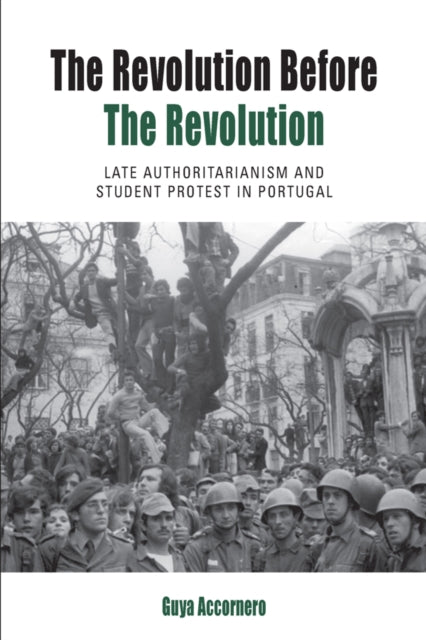
Guya Accornero
Revolution before the Revolution: Late Authoritarianism and Student Protest in Portugal
Revolution before the Revolution: Late Authoritarianism and Student Protest in Portugal
💎 Earn 102 Points (£1.02) on this item.
We can order this item for you. Delivery usually takes about 4 to 6 weeks.
This item is not held in our immediate stock. We will order it for you after checkout.
Estimated delivery: About 4 to 6 weeks
YOU SAVE £3.47
- Condition: Brand new
- UK Delivery times: Usually arrives within 2 - 3 working days
- UK Shipping: Fee starts at £2.39. Subject to product weight & dimension
Bulk ordering. Want 15 or more copies? Get a personalised quote and bigger discounts. Learn more about bulk orders.
Couldn't load pickup availability
- More about Revolution before the Revolution: Late Authoritarianism and Student Protest in Portugal
The "Carnation Revolution" in Portugal in 1974 was the culmination of a long process of resistance and protest, originating in universities and other sectors of society, leading to the toppling of the authoritarian Estado Novo regime and the divestment of colonial holdings.
Format: Paperback / softback
Length: 186 pages
Publication date: 01 April 2021
Publisher: Berghahn Books
The transition to democracy in Portugal has been a subject of extensive historical analysis, with a significant focus on the 1974 military coup that brought down the authoritarian Estado Novo regime. This coup marked the beginning of a process of divestment of the nation's colonial possessions. However, it is important to recognize that the events of the "Carnation Revolution" were merely the culmination of a much longer and more complex process of resistance and protest that originated in universities and other sectors of society.
To gain a deeper understanding of Portuguese democratization, The Revolution before the Revolution employs a comprehensive approach that combines meticulous research in police, government, and student archives with insights from social movement theory. By examining the societal convulsions that occurred during the "long 1960s," the book offers a fresh perspective on the country's transition to democracy.
The "long 1960s" were a period of significant social and political upheaval in Portugal. The country had just emerged from a long period of authoritarian rule under the Estado Novo regime, which had been in power since 1926. The regime was characterized by strict censorship, repression of political opposition, and a lack of civil liberties.
In response to these conditions, universities and other sectors of society began to organize and mobilize against the regime. Students, in particular, played a crucial role in this movement, organizing protests, strikes, and other forms of activism. They demanded greater freedom of expression, the release of political prisoners, and the end of censorship.
The regime's response to these demands was often harsh and violent. Police officers were deployed to suppress protests, and political opponents were arrested and tortured. The regime also attempted to undermine the legitimacy of the opposition by spreading false information and propaganda.
Despite these challenges, the opposition movement continued to grow and gain momentum. In 1968, a group of students organized a peaceful demonstration in Lisbon, which was met with brutal police repression. This event sparked a wave of protests and strikes across the country, and the regime was eventually forced to concede to some of the opposition's demands.
However, the concessions made by the regime were only temporary, and the opposition continued to press for greater change. In 1974, a military coup d'état was staged, led by a group of officers who were dissatisfied with the regime's policies. The coup was successful, and the Estado Novo regime was toppled.
The "Carnation Revolution" was a significant moment in Portuguese history, as it marked the end of the country's authoritarian rule and the beginning of a process of democratization. The revolution was characterized by a wave of protests and strikes, as well as a willingness on the part of the military to support the opposition.
However, the transition to democracy was not without its challenges. The new government faced a number of economic and social problems, including high unemployment, poverty, and corruption. The country also had to deal with the legacy of the Estado Novo regime, which had left a deep scar on Portuguese society.
Despite these challenges, the new government was determined to establish a democratic and prosperous Portugal. It implemented a series of reforms, including the legalization of political parties, the establishment of a free press, and the promotion of human rights.
Over the course of the following decades, Portugal continued to make progress towards the transition to democracy. The country held its first free elections in 1976, and since then, it has held regular elections, with each election bringing about greater political freedom and social progress.
Today, Portugal is a thriving democracy, with a strong economy, a vibrant culture, and a commitment to human rights. It is a model for other countries in the region, and its success in transitioning to democracy is a testament to the power of resistance and protest.
In conclusion, the transition to democracy in Portugal has been a complex and multifaceted process that has been shaped by a long history of resistance and protest. The events of the "Carnation Revolution" were merely the culmination of a much longer and more complex process of resistance and protest that originated in universities and other sectors of society. By examining the societal convulsions that occurred during the "long 1960s," The Revolution before the Revolution offers a fresh perspective on the country's transition to democracy and sheds light on the important role the role of social movements
movement theory in understanding the complexities of political change. The book is a valuable contribution to the field of political science and history, and it will be of interest to scholars, students, and policymakers alike.
Weight: 278g
Dimension: 229 x 151 x 13 (mm)
ISBN-13: 9781800730106
UK and International shipping information
UK and International shipping information
UK Delivery and returns information:
- Delivery within 2 - 3 days when ordering in the UK.
- Shipping fee for UK customers from £2.39. Fully tracked shipping service available.
- Returns policy: Return within 30 days of receipt for full refund.
International deliveries:
Shulph Ink now ships to Australia, Belgium, Canada, France, Germany, Ireland, Italy, India, Luxembourg Saudi Arabia, Singapore, Spain, Netherlands, New Zealand, United Arab Emirates, United States of America.
- Delivery times: within 5 - 10 days for international orders.
- Shipping fee: charges vary for overseas orders. Only tracked services are available for most international orders. Some countries have untracked shipping options.
- Customs charges: If ordering to addresses outside the United Kingdom, you may or may not incur additional customs and duties fees during local delivery.