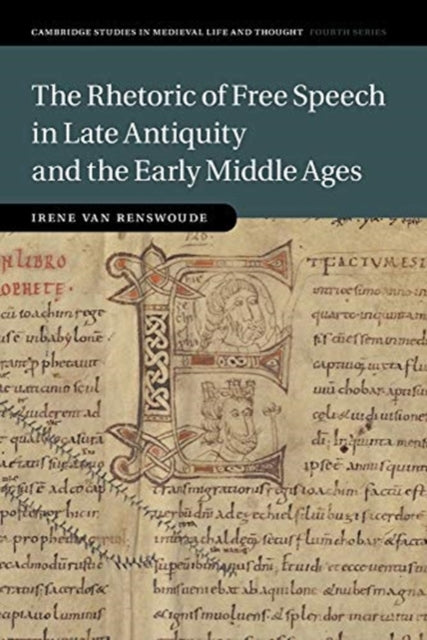
Irenevan Renswoude
Rhetoric of Free Speech in Late Antiquity and the Early Middle Ages
Rhetoric of Free Speech in Late Antiquity and the Early Middle Ages
💎 Earn 160 Points (£1.60) on this item.
We can order this item for you. Delivery usually takes about 4 to 6 weeks.
This item is not held in our immediate stock. We will order it for you after checkout.
Estimated delivery: About 4 to 6 weeks
YOU SAVE £1.90
- Condition: Brand new
- UK Delivery times: Usually arrives within 2 - 3 working days
- UK Shipping: Fee starts at £2.39. Subject to product weight & dimension
Bulk ordering. Want 15 or more copies? Get a personalised quote and bigger discounts. Learn more about bulk orders.
Couldn't load pickup availability
- More about Rhetoric of Free Speech in Late Antiquity and the Early Middle Ages
During the early Middle Ages, there was more room for political criticism and dissent than commonly believed, as long as critics used the right rhetoric and followed scripted roles. Irene van Renswoude's study explores the cultural rules and rhetorical performances that shaped practices of delivering criticism from Antiquity to the Middle Ages.
Format: Paperback / softback
Length: 289 pages
Publication date: 03 June 2021
Publisher: Cambridge University Press
The early Middle Ages, a time often overlooked in discussions of free speech, holds a unique and complex narrative. Contrary to popular belief, this era was not entirely devoid of political criticism and dissent. However, it is true that the notion of free speech experienced a decline towards the end of Antiquity, culminating in its complete disappearance at the dawn of the Middle Ages. It was not until the Renaissance that people began to reclaim their ability to think and speak for themselves.
In her groundbreaking work, Irene van Renswoude challenges this entrenched perception by demonstrating that there was indeed space for political criticism and dissent during the early Middle Ages, albeit with certain conditions. As long as critics employed the appropriate rhetoric and adhered to prescribed roles, they could express their views without fear of retribution. This study, spanning from c.200 to c.900 AD, delves into the cultural rules and rhetorical performances that shaped the practices of delivering criticism from Antiquity to the Middle Ages. It examines the rhetorical strategies employed by letters and narratives written by late antique and early medieval men and, in a few cases, women who dared to speak the truth to powerful figures.
The early Middle Ages witnessed a gradual shift in the power dynamics between individuals and institutions. The rise of monarchies and the consolidation of political authority created a hierarchical structure that limited the freedom of expression. However, this did not mean that political criticism and dissent were completely silenced. On the contrary, there were individuals who sought to challenge the status quo and advocate for change. They employed various rhetorical devices to express their views, including letters, narratives, and public speeches.
Letters played a crucial role in the dissemination of political criticism during this period. Writers used them to express their grievances, criticize government policies, and advocate for reform. They often employed persuasive techniques, such as logical argumentation, emotional appeals, and appeals to authority, to make their points. Narratives, too, were used as a means of expressing political dissent. These works, often written in the form of stories or poems, depicted the struggles of common people and highlighted the injustices they faced. They often used symbolic language and metaphor to convey their messages and evoke empathy from their readers.
Despite the challenges posed by the hierarchical structure and the fear of retribution, there were individuals who dared to speak the truth to powerful figures. These individuals often faced opposition and criticism, but their courage and determination in advocating for their beliefs ultimately led to change. One notable example is the writings of the Christian monk and theologian John Chrysostom, who lived in the fourth century AD. Chrysostom was known for his bold and outspoken criticism of the Roman Empire and its corrupt practices. He used his sermons and writings to advocate for religious reform and social justice, often challenging the authority of the emperor and the church hierarchy.
Another example is the writings of the Byzantine emperor Justinian I, who ruled from c.527 to 565 AD. Justinian was known for his efforts to restore the Roman Empire and its legal system. However, he also faced criticism for his authoritarianism and his suppression of political dissent. Despite this, Justinian allowed for some degree of political criticism and dissent, particularly in the form of letters and narratives. He encouraged writers to express their views and even published collections of letters and narratives that were critical of his policies.
In conclusion, the early Middle Ages was not a period traditionally associated with free speech. However, as this study demonstrates, there was room for political criticism and dissent, as long as critics employed the right rhetoric and adhered to prescribed roles. The rise. This era witnessed a gradual shift in the power dynamics between individuals and institutions, creating a hierarchical structure that limited the freedom of expression. However, there were individuals who sought to challenge the status quo.
Weight: 424g
Dimension: 151 x 228 x 19 (mm)
ISBN-13: 9781108725477
UK and International shipping information
UK and International shipping information
UK Delivery and returns information:
- Delivery within 2 - 3 days when ordering in the UK.
- Shipping fee for UK customers from £2.39. Fully tracked shipping service available.
- Returns policy: Return within 30 days of receipt for full refund.
International deliveries:
Shulph Ink now ships to Australia, Belgium, Canada, France, Germany, Ireland, Italy, India, Luxembourg Saudi Arabia, Singapore, Spain, Netherlands, New Zealand, United Arab Emirates, United States of America.
- Delivery times: within 5 - 10 days for international orders.
- Shipping fee: charges vary for overseas orders. Only tracked services are available for most international orders. Some countries have untracked shipping options.
- Customs charges: If ordering to addresses outside the United Kingdom, you may or may not incur additional customs and duties fees during local delivery.