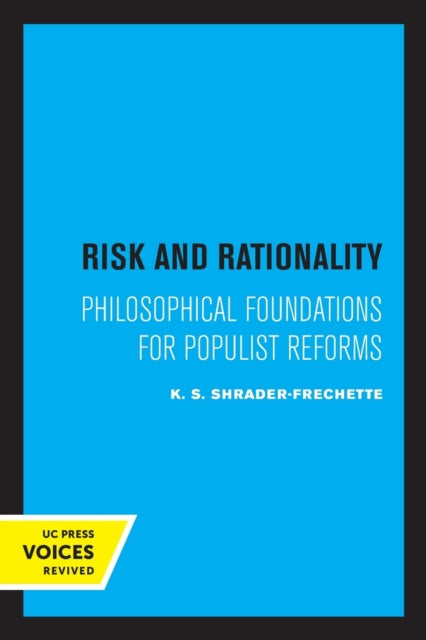
K. S. Shrader-Frechette
Risk and Rationality: Philosophical Foundations for Populist Reforms
Risk and Rationality: Philosophical Foundations for Populist Reforms
💎 Earn 169 Points (£1.69) on this item.
YOU SAVE £8.01
- Condition: Brand new
- UK Delivery times: Usually arrives within 2 - 3 working days
- UK Shipping: Fee starts at £2.39. Subject to product weight & dimension
Bulk ordering. Want 15 or more copies? Get a personalised quote and bigger discounts. Learn more about bulk orders.
Couldn't load pickup availability
- More about Risk and Rationality: Philosophical Foundations for Populist Reforms
Risk and Rationality offers a philosophical foundation for populist reforms, challenging cultural relativism and naive positivism. It dissects the value judgments embedded in risk assessment and proposes methodological and procedural reforms to align assessment and management with public reason. It is part of UC Press's Voices Revived program, commemorating the university's mission to seek out and cultivate the brightest minds and give them voice, reach, and impact.
Format: Paperback / softback
Length: 324 pages
Publication date: 27 May 2022
Publisher: University of California Press
Risk and Rationality: Philosophical Foundations for Populist Reforms offers a comprehensive philosophical exploration of how societies should evaluate and govern technological hazards. K. S. Shrader-Frechette presents a "middle path" between cultural relativism and naive positivism, demonstrating why risk evaluation is neither a mere social construct nor a value-free technical exercise. She traces the institutional history of modern risk analysis, including the National Environmental Policy Act (NEPA), the Occupational Safety and Health Administration (OSHA), and the Risk Assessment and Risk Reduction Administration (RARADA), and analyzes the value judgments embedded in all three stages of assessment: identification, estimation, and evaluation. Through critical critiques of prevailing strategies, such as expert/lay splits between "perceived" and "actual" risk, probability-only decision rules, Bayesian-utilitarian maximization under deep uncertainty, producer-favoring default choices, and the "isolationist" discounting of Third-World harms, Shrader-Frechette argues that lay aversion to involuntary, catastrophic, or inequitably distributed risks is often more rational than experts concede. The book's constructive core advances "scientific proceduralism," a normative framework that combines empirical objectivity with democratic ethics. Risk evaluations, according to Shrader-Frechette, can be objective and answerable to principles of equity, consent, and due process while also being probabilistically revisable and open to critical testing. She proposes methodological reforms (ethically weighted risk-cost-benefit analysis; performance-based ranking of expert judgments by predictive accuracy) and procedural reforms (free, informed consent for imposed risks; compensation and due-process rights; market-share liability) that realign assessment and management with public reason. Bridging philosophy and policy, Risk and Rationality offers a valuable resource for policymakers, risk analysts, and scholars interested in promoting more rational and equitable approaches to technological hazards.
Risk and Rationality: Philosophical Foundations for Populist Reforms
Risk and Rationality: Philosophical Foundations for Populist Reforms offers a rigorous philosophical reconstruction of how societies should evaluate and govern technological hazards. K. S. Shrader-Frechette charts a “middle path” between cultural relativism and naive positivism, demonstrating why risk evaluation is neither a mere social construct nor a value-free technical exercise. After situating modern risk analysis in its institutional history (NEPA, OSHA, RARADA), she dissects the value judgments embedded in all three stages of assessment—identification, estimation, and evaluation—showing how methodological choices shape policy outcomes. Through targeted critiques of prevailing strategies—expert/lay splits between “perceived” and “actual” risk, probability-only decision rules, Bayesian–utilitarian maximization under deep uncertainty, producer-favoring default choices, and the “isolationist” discounting of Third-World harms—Shrader-Frechette argues that lay aversion to involuntary, catastrophic, or inequitably distributed risks is often more rational than experts concede. The book's constructive core advances “scientific proceduralism,” a normative framework that weds empirical objectivity to democratic ethics. Risk evaluations, Shrader-Frechette contends, can be objective—insofar as they are probabilistically revisable and open to critical testing—while also answerable to principles of equity, consent, and due process. She proposes methodological reforms (ethically weighted risk–cost–benefit analysis; performance-based ranking of expert judgments by predictive accuracy) and procedural reforms (free, informed consent for imposed risks; compensation and due-process rights; market-share liability) that realign assessment and management with public reason. Bridging phil.
Risk and Rationality: Philosophical Foundations for Populist Reforms
Risk and Rationality: Philosophical Foundations for Populist Reforms offers a comprehensive philosophical exploration of how societies should evaluate and govern technological hazards. K. S. Shrader-Frechette presents a "middle path" between cultural relativism and naive positivism, demonstrating why risk evaluation is neither a mere social construct nor a value-free technical exercise. She traces the institutional history of modern risk analysis, including the National Environmental Policy Act (NEPA), the Occupational Safety and Health Administration (OSHA), and the Risk Assessment and Risk Reduction Administration (RARADA), and analyzes the value judgments embedded in all three stages of assessment: identification, estimation, and evaluation. Through critical critiques of prevailing strategies, such as expert/lay splits between "perceived" and "actual" risk, probability-only decision rules, Bayesian-utilitarian maximization under deep uncertainty, producer-favoring default choices, and the "isolationist" discounting of Third-World harms, Shrader-Frechette argues that lay aversion to involuntary, catastrophic, or inequitably distributed risks is often more rational than experts concede. The book's constructive core advances "scientific proceduralism," a normative framework that combines empirical objectivity with democratic ethics. Risk evaluations, according to Shrader-Frechette, can be objective and answerable to principles of equity, consent, and due process while also being probabilistically revisable and open to critical testing. She proposes methodological reforms (ethically weighted risk-cost-benefit analysis; performance-based ranking of expert judgments by predictive accuracy) and procedural reforms (free, informed consent for imposed risks; compensation and due-process rights; market-share liability) that realign assessment and management with public reason. Bridging philosophy and policy, Risk and Rationality offers a valuable resource for policymakers, risk analysts, and scholars interested in promoting more rational and equitable approaches to technological hazards.
Weight: 499g
Dimension: 234 x 156 x 18 (mm)
ISBN-13: 9780520320772
This item can be found in:
UK and International shipping information
UK and International shipping information
UK Delivery and returns information:
- Delivery within 2 - 3 days when ordering in the UK.
- Shipping fee for UK customers from £2.39. Fully tracked shipping service available.
- Returns policy: Return within 30 days of receipt for full refund.
International deliveries:
Shulph Ink now ships to Australia, Belgium, Canada, France, Germany, Ireland, Italy, India, Luxembourg Saudi Arabia, Singapore, Spain, Netherlands, New Zealand, United Arab Emirates, United States of America.
- Delivery times: within 5 - 10 days for international orders.
- Shipping fee: charges vary for overseas orders. Only tracked services are available for most international orders. Some countries have untracked shipping options.
- Customs charges: If ordering to addresses outside the United Kingdom, you may or may not incur additional customs and duties fees during local delivery.