Shulph Ink
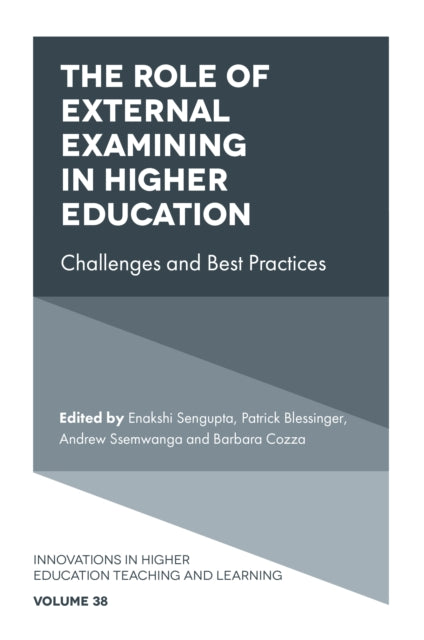
Role of External Examining in Higher Education: Challenges and Best Practices
Role of External Examining in Higher Education: Challenges and Best Practices
💎 Earn 352 Points (£3.52) on this item.
YOU SAVE £3.55
- Condition: Brand new
- UK Delivery times: Usually arrives within 2 - 3 working days
- UK Shipping: Fee starts at £2.39. Subject to product weight & dimension
Bulk ordering. Want 15 or more copies? Get a personalised quote and bigger discounts. Learn more about bulk orders.
Couldn't load pickup availability
- More about Role of External Examining in Higher Education: Challenges and Best Practices
This book explores the challenges and best practices of external examination in academia worldwide, highlighting how universities ensure quality assurance while mitigating disadvantage and creating opportunities. It provides a comprehensive international perspective, showcasing how external examining can be rigorous, fair, and consistent across regions.
\n Format: Hardback
\n Length: 216 pages
\n Publication date: 17 May 2021
\n Publisher: Emerald Publishing Limited
\n
The use of external examiners in institutions is not a recent phenomenon, but rather a longstanding practice that has evolved to meet the changing needs of higher education. While there is no one-size-fits-all approach to external examination, researchers can collaborate on key developments to maintain higher education standards and overcome challenges. In this book, we explore the external examination challenges and best practice examples in academia across different parts of the world.
Chapter 1: Introduction
External examination plays a crucial role in ensuring the quality and integrity of higher education programs. However, it also presents several challenges, including the need for standardization, transparency, and fairness. In this chapter, we will introduce the key themes of this book and provide an overview of the external examination challenges and best practice examples that will be discussed in subsequent chapters.
Chapter 2: External Examination Challenges
External examination challenges include the need for consistent standards, transparency, and fairness. Different countries and institutions have different examination systems, which can create inconsistencies and difficulties for students and educators alike. Additionally, the use of external examiners can be perceived as a threat to academic autonomy and integrity, particularly in countries where education is highly centralized.
Chapter 3: Best Practice Examples
Despite these challenges, there are several best practice examples of external examination in academia. These examples demonstrate how institutions can mitigate disadvantage and create opportunities without compromising the quality assurance process. For example, some institutions use a combination of internal and external examiners to ensure that the examination process is fair and reliable. Others use technology-based assessment methods to reduce the risk of cheating and improve the efficiency of the examination process.
Chapter 4: Mitigating Disadvantage and Creating Opportunities
One of the key challenges of external examination is the need to mitigate disadvantage and create opportunities for all students. This can be achieved through a variety of strategies, including providing access to resources and support, offering flexible learning options, and promoting diversity and inclusion in the classroom.
Chapter 5: Safeguarding Procedures and Quality Standards
While external examination is important for maintaining higher education standards, it is also important to ensure that safeguarding procedures are in place to protect the integrity of the examination process. This includes measures such as plagiarism detection software, randomization of exam questions, and regular monitoring of examiners.
Chapter 6: International Focus
External examination is a global phenomenon, and it is important to consider the international perspective when examining best practice examples. This chapter explores how institutions can make external examining a rigorous process that is fair, reliable, and consistent across the globe.
Conclusion
In conclusion, the use of external examiners in institutions is not a new phenomenon, but it presents several challenges and opportunities. By collaborating on key developments and adopting best practice examples, researchers can ensure that external examination is a rigorous process that is fair, reliable, and consistent across the globe.
The use of external examiners in institutions is not a recent phenomenon, but rather a longstanding practice that has evolved to meet the changing needs of higher education. While there is no one-size-fits-all approach to external examination, researchers can collaborate on key developments to maintain higher education standards and overcome challenges. In this book, we explore the external examination challenges and best practice examples in academia across different parts of the world.
Chapter 1: Introduction
External examination plays a crucial role in ensuring the quality and integrity of higher education programs. However, it also presents several challenges, including the need for standardization, transparency, and fairness. In this chapter, we will introduce the key themes of this book and provide an overview of the external examination challenges and best practice examples that will be discussed in subsequent chapters.
Chapter 2: External Examination Challenges
External examination challenges include the need for consistent standards, transparency, and fairness. Different countries and institutions have different examination systems, which can create inconsistencies and difficulties for students and educators alike. Additionally, the use of external examiners can be perceived as a threat to academic autonomy and integrity, particularly in countries where education is highly centralized.
Chapter 3: Best Practice Examples
Despite these challenges, there are several best practice examples of external examination in academia. These examples demonstrate how institutions can mitigate disadvantage and create opportunities without compromising the quality assurance process. For example, some institutions use a combination of internal and external examiners to ensure that the examination process is fair and reliable. Others use technology-based assessment methods to reduce the risk of cheating and improve the efficiency of the examination process.
Chapter 4: Mitigating Disadvantage and Creating Opportunities
One of the key challenges of external examination is the need to mitigate disadvantage and create opportunities for all students. This can be achieved through a variety of strategies, including providing access to resources and support, offering flexible learning options, and promoting diversity and inclusion in the classroom.
Chapter 5: Safeguarding Procedures and Quality Standards
While external examination is important for maintaining higher education standards, it is also important to ensure that safeguarding procedures are in place to protect the integrity of the examination process. This includes measures such as plagiarism detection software, randomization of exam questions, and regular monitoring of examiners.
Chapter 6: International Focus
External examination is a global phenomenon, and it is important to consider the international perspective when examining best practice examples. This chapter explores how institutions can make external examining a rigorous process that is fair, reliable, and consistent across the globe.
Conclusion
In conclusion, the use of external examiners in institutions is not a new phenomenon, but it presents several challenges and opportunities. By collaborating on key developments and adopting best practice examples, researchers can ensure that external examination is a rigorous process that is fair, reliable, and consistent across the globe.
\n Weight: 438g\n
Dimension: 161 x 240 x 19 (mm)\n
ISBN-13: 9781839821752\n \n
This item can be found in:
UK and International shipping information
UK and International shipping information
UK Delivery and returns information:
- Delivery within 2 - 3 days when ordering in the UK.
- Shipping fee for UK customers from £2.39. Fully tracked shipping service available.
- Returns policy: Return within 30 days of receipt for full refund.
International deliveries:
Shulph Ink now ships to Australia, Belgium, Canada, France, Germany, Ireland, Italy, India, Luxembourg Saudi Arabia, Singapore, Spain, Netherlands, New Zealand, United Arab Emirates, United States of America.
- Delivery times: within 5 - 10 days for international orders.
- Shipping fee: charges vary for overseas orders. Only tracked services are available for most international orders. Some countries have untracked shipping options.
- Customs charges: If ordering to addresses outside the United Kingdom, you may or may not incur additional customs and duties fees during local delivery.