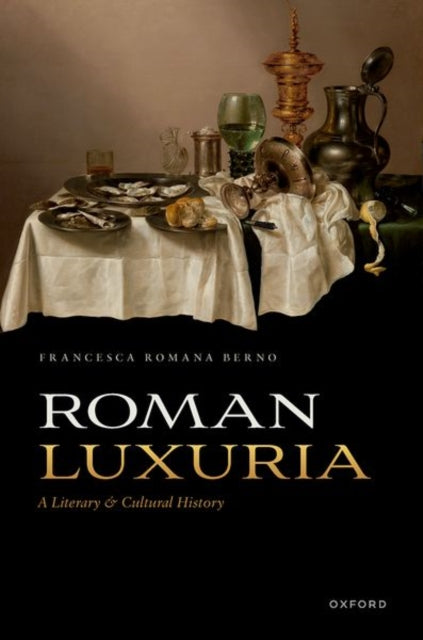
Francesca RomanaBerno
Roman Luxuria: A Literary and Cultural History
Roman Luxuria: A Literary and Cultural History
💎 Earn 570 Points (£5.70) on this item.
We can order this item for you. Delivery usually takes about 4 to 6 weeks.
This item is not held in our immediate stock. We will order it for you after checkout.
Estimated delivery: About 4 to 6 weeks
- Condition: Brand new
- UK Delivery times: Usually arrives within 2 - 3 working days
- UK Shipping: Fee starts at £2.39. Subject to product weight & dimension
Bulk ordering. Want 15 or more copies? Get a personalised quote and bigger discounts. Learn more about bulk orders.
Couldn't load pickup availability
- More about Roman Luxuria: A Literary and Cultural History
Luxuria is a desire for luxury, linked to excess and deviation from a standard. It was imported from the East after military conquests and caused a fatal decline. Roman Luxuria: A Literary and Cultural History discusses the influence of Greek culture on the Roman concept and the peculiar characteristics of Roman luxuria. It analyzes Roman views on luxuria through close readings in historical order, from Cato the Elder to Prudentius. Seneca the Younger is particularly focused on this passion, defending himself from the charge and attacking it in others. Over the centuries, the focus on luxuria shifts from the economic sphere to the erotic, becoming one of the Seven Capital Sins in the Christian world.
Format: Hardback
Length: 304 pages
Publication date: 17 March 2023
Publisher: Oxford University Press
In classical Latin, the term "luxuria" carries a profound meaning, encompassing a profound desire for luxury and a deviation from established standards. It is often regarded as a vice, standing in stark contrast to the inherent frugality that characterized the Romans. While Latin authors do not consider luxuria to be a native aspect of their culture, they perceive it as an import from the East, stemming from the aftermath of military conquests. They view it as a catalyst for the decline of the Roman Empire.
To delve into the origins and semantic nuances of "luxuria," Roman Luxuria: A Literary and Cultural History explores the profound influence of Greek culture on the Roman concept. It conducts a comprehensive analysis of Roman perspectives on luxuria, examining closely the writings of influential figures such as Cato the Elder, who regarded luxuria as anathema to the ideal Roman way of life. On the other hand, the Christian poet Prudentius portrays it in an allegorical battle with Sobriety, symbolizing the struggle between indulgence and self-control.
This book encompasses a wide range of literary genres, including historiography and satire, providing a comprehensive examination of the topic. It pays particular attention to the rhetorical device of personification, which traces its evolution from the earliest appearances of luxuria in Latin literature to its manifestation in late antiquity. Berno delves into the work of Seneca the Younger, whose writings are often preoccupied with the passion of luxuria. Seneca navigates a delicate balance, defending himself against accusations of luxuria while simultaneously condemning it in others. He describes luxuria as the arch-enemy of a philosophical life, emphasizing its detrimental impact on one's pursuit of wisdom and virtue.
Over the centuries, the focus on luxuria shifted from the economic sphere. It expanded to encompass the erotic realm, becoming one of the Seven Capital Sins in the Christian world. Luxuria symbolized the vice of lust, representing a departure from moral and ethical principles. It served as a cautionary tale, reminding individuals of the dangers of excess and the need for self-discipline in the pursuit of happiness and fulfillment.
In conclusion, "luxuria" in classical Latin signifies a profound desire for luxury and a deviation from established norms. It evolved as an import from the East, influenced by military conquests and cultural exchanges. Roman perspectives on luxuria ranged from condemnation to indulgence, with personification serving as a rhetorical device to convey its significance. Over time, the focus on luxuria expanded to encompass the erotic realm, becoming one of the Seven Capital Sins in the Christian world. It serves as a reminder of the dangers of excess and the importance of self-control in pursuing a fulfilling and virtuous life.
Weight: 588g
Dimension: 241 x 165 x 23 (mm)
ISBN-13: 9780192846402
UK and International shipping information
UK and International shipping information
UK Delivery and returns information:
- Delivery within 2 - 3 days when ordering in the UK.
- Shipping fee for UK customers from £2.39. Fully tracked shipping service available.
- Returns policy: Return within 30 days of receipt for full refund.
International deliveries:
Shulph Ink now ships to Australia, Belgium, Canada, France, Germany, Ireland, Italy, India, Luxembourg Saudi Arabia, Singapore, Spain, Netherlands, New Zealand, United Arab Emirates, United States of America.
- Delivery times: within 5 - 10 days for international orders.
- Shipping fee: charges vary for overseas orders. Only tracked services are available for most international orders. Some countries have untracked shipping options.
- Customs charges: If ordering to addresses outside the United Kingdom, you may or may not incur additional customs and duties fees during local delivery.