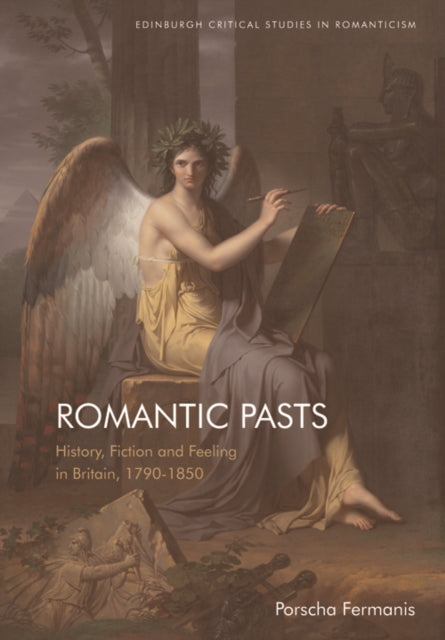
Porscha Fermanis
Romantic Pasts: History, Fiction and Feeling in Britain, 1790-1850
Romantic Pasts: History, Fiction and Feeling in Britain, 1790-1850
💎 Earn 383 Points (£3.83) on this item.
We can order this item for you. Delivery usually takes about 4 to 6 weeks.
This item is not held in our immediate stock. We will order it for you after checkout.
Estimated delivery: About 4 to 6 weeks
YOU SAVE £23.30
- Condition: Brand new
- UK Delivery times: Usually arrives within 2 - 3 working days
- UK Shipping: Fee starts at £2.39. Subject to product weight & dimension
Bulk ordering. Want 15 or more copies? Get a personalised quote and bigger discounts. Learn more about bulk orders.
Couldn't load pickup availability
- More about Romantic Pasts: History, Fiction and Feeling in Britain, 1790-1850
Romantic Pasts challenges the notion that romantic-era history is solely sentimental and presents a new cognitive or psychological historicism that emphasizes motive and affect. It rethinks the paradigm of resurrection or revivification in romantic history and its place in modern historiography by integrating literary criticism, the history of emotions, theories of the novel, and philosophies of history.
Format: Hardback
Length: 312 pages
Publication date: 30 June 2022
Publisher: Edinburgh University Press
Romantic Pasts challenges the prevailing notion that romantic-era history is solely driven by sentimentality, contending that historians from Mary Wollstonecraft to Thomas Carlyle embraced a novel form of cognitive or psychological historicism. These scholars recognized the significance of emotions as a valid subject of historical inquiry, transcending their traditional role as mere sentimental or affective modes. By reimagining psycho-physiological and behavioral processes as situated and historically dynamic phenomena, they sought to understand how these processes could reflect changes in social and historical contexts. This interdisciplinary work integrates literary criticism, the history of emotions, theories of the novel, and philosophies of history to redefine the paradigm of resurrection or revivification associated with romantic history. It also explores the historical significance of this period within the broader development of modern historiography.
Introduction:
The study of romantic-era history has long been dominated by a perception that it is primarily driven by sentimentality. This view suggests that historians during this period were more interested in capturing the emotional experiences and feelings of individuals than in examining the broader social and historical contexts in which they lived. However, Romantic Pasts argues that this perception is misleading and that historians from the romantic era developed a new kind of cognitive or psychological historicism that was equally concerned with motive as with affect.
Historical Context:
During the romantic period, there was a significant shift in the way that historians approached the study of history. Scholars began to recognize the importance of emotions as a driving force in human behavior and as a valuable source of historical information. This shift was influenced by a range of factors, including the rise of Romanticism, which emphasized the individual's subjective experiences and emotions, and the development of new psychological theories that sought to understand the workings of the human mind and behavior.
Cognitive Historicism:
One of the key developments of cognitive historicism was the recognition that feelings could be a viable object of historical study. Historians began to explore how emotions influenced individuals' actions, decisions, and beliefs, and how they shaped the course of history. They recognized that emotions were not just subjective experiences but were also shaped by social and historical contexts, and that they could be used to understand the motivations behind historical events.
Psycho-Physiological Processes:
In order to understand how emotions influenced psycho-physiological processes, historians began to examine the relationship between emotions and the body. They studied how emotions affected physical sensations, such as heart rate, blood pressure, and respiration, and how these physical reactions could be used to interpret historical events. They also explored how emotions could be transmitted and interpreted across different social and cultural contexts.
Behavioral Processes:
Historians also began to examine how emotions influenced behavioral processes. They studied how individuals responded to emotional stimuli, such as fear, anger, and love, and how these responses could be used to understand the social and political dynamics of different periods. They also explored how emotions could be used to manipulate and control individuals, and how they could be resisted or subverted by individuals and groups.
Literary Criticism:
Romantic Pasts draws on a range of literary sources to explore the role of emotions in romantic-era history. These sources include works by authors such as Mary Wollstonecraft, Jane Austen, and Thomas Carlyle, as well as more contemporary literary criticism. By analyzing these texts, historians are able to gain a deeper understanding of the emotional experiences and motivations of individuals during this period, and how these experiences shaped the course of history.
Conclusion:
In conclusion, Romantic Pasts challenges the notion that romantic-era history is solely driven by sentimentality and argues that historians from the period developed a new kind of cognitive or psychological historicism that was equally concerned with motive as with affect. By reimagining psycho-physiological and behavioral processes as situated and historically dynamic phenomena, historians were able to gain a deeper understanding of the emotional experiences and motivations of individuals during this period, and how these experiences shaped the course of history. This interdisciplinary work provides a valuable contribution to our understanding of romantic-era history and its place within the broader development of modern historiography.
Dimension: 234 x 156 (mm)
ISBN-13: 9781474481885
UK and International shipping information
UK and International shipping information
UK Delivery and returns information:
- Delivery within 2 - 3 days when ordering in the UK.
- Shipping fee for UK customers from £2.39. Fully tracked shipping service available.
- Returns policy: Return within 30 days of receipt for full refund.
International deliveries:
Shulph Ink now ships to Australia, Belgium, Canada, France, Germany, Ireland, Italy, India, Luxembourg Saudi Arabia, Singapore, Spain, Netherlands, New Zealand, United Arab Emirates, United States of America.
- Delivery times: within 5 - 10 days for international orders.
- Shipping fee: charges vary for overseas orders. Only tracked services are available for most international orders. Some countries have untracked shipping options.
- Customs charges: If ordering to addresses outside the United Kingdom, you may or may not incur additional customs and duties fees during local delivery.