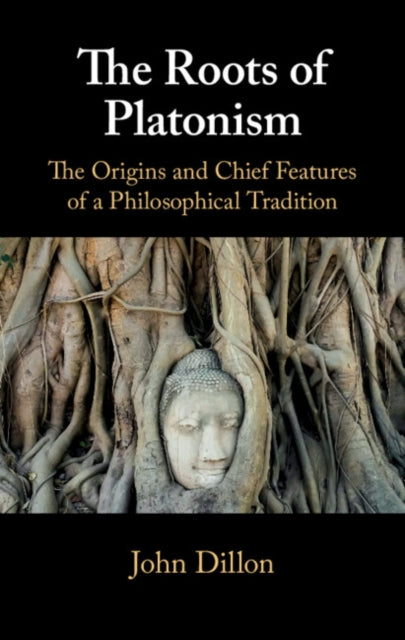
JohnDillon
Roots of Platonism: The Origins and Chief Features of a Philosophical Tradition
Roots of Platonism: The Origins and Chief Features of a Philosophical Tradition
💎 Earn 127 Points (£1.27) on this item.
We can order this item for you. Delivery usually takes about 4 to 6 weeks.
This item is not held in our immediate stock. We will order it for you after checkout.
Estimated delivery: About 4 to 6 weeks
YOU SAVE £1.51
- Condition: Brand new
- UK Delivery times: Usually arrives within 2 - 3 working days
- UK Shipping: Fee starts at £2.39. Subject to product weight & dimension
Bulk ordering. Want 15 or more copies? Get a personalised quote and bigger discounts. Learn more about bulk orders.
Couldn't load pickup availability
- More about Roots of Platonism: The Origins and Chief Features of a Philosophical Tradition
This book explores how Platonism, a philosophical movement stemming from Plato's Academy, took on distinctive and exclusive features. John Dillon focuses on key issues such as monism versus dualism, ethical theory, the theory of Forms, and the reaction to the Sceptical deviation represented by the New Academy. The book is written in a lively and accessible style, similar to the lecture series in Beijing from which it originates.
Format: Hardback
Length: 116 pages
Publication date: 03 January 2019
Publisher: Cambridge University Press
Platonism, a philosophical movement with its roots in the open-ended and informal atmosphere of Plato's Academy, is the focus of this book. John Dillon delves into several critical topics, including monism versus dualism, the metaphysical foundations of ethical theory, the theory of Forms, and the response to the Sceptical deviation represented by the New Academy. Written in a lively and accessible style, the book draws from Dillon's lecture series in Beijing, offering a comprehensive exploration of Platonism's development and significance.
Monism and dualism are two fundamental concepts in the philosophy of Platonism. Monism asserts that everything in the universe is interconnected and part of a single whole, while dualism suggests that the world is composed of two distinct elements, such as matter and spirit. Platonists argue that both perspectives are incomplete and that the true nature of reality is a complex blend of both.
The metaphysical underpinnings of ethical theory are another important aspect of Platonism. Platonists believe that ethics is rooted in the nature of the soul and that moral decisions are guided by an innate sense of what is right and wrong. They argue that ethical principles are universal and apply to all individuals, regardless of their cultural or historical background.
The theory of Forms is another central concept in Platonism. According to this theory, the ultimate reality is not material but abstract and immaterial. The Forms are the underlying principles of everything in the universe and are the source of all beauty, truth, and goodness. Platonists believe that the Forms are accessible to the mind through a process of philosophical inquiry and that they provide the basis for a moral and ethical life.
The reaction to the Sceptical deviation represented by the New Academy is another important aspect of Platonism. The New Academy was a group of philosophers who challenged the traditional Platonist beliefs and sought to undermine the authority of the Forms. They argued that the Forms were not real and that human perception and experience were the only sources of knowledge. Platonists responded to this challenge by developing a more sophisticated understanding of the Forms and by arguing that they were not only real but also essential to human understanding and morality.
In conclusion, Platonism is a philosophical movement with its roots in the open-ended and informal atmosphere of Plato's Academy. It is characterized by a number of key concepts, including monism versus dualism, the metaphysical underpinnings of ethical theory, the theory of Forms, and the reaction to the Sceptical deviation represented by the New Academy. Platonists believe that the true nature of reality is a complex blend of both material and abstract elements and that ethics is rooted in the nature of the soul. They argue that the Forms provide the basis for a moral and ethical life and that they are accessible to the mind through a process of philosophical inquiry.
Weight: 256g
Dimension: 218 x 147 x 12 (mm)
ISBN-13: 9781108426916
UK and International shipping information
UK and International shipping information
UK Delivery and returns information:
- Delivery within 2 - 3 days when ordering in the UK.
- Shipping fee for UK customers from £2.39. Fully tracked shipping service available.
- Returns policy: Return within 30 days of receipt for full refund.
International deliveries:
Shulph Ink now ships to Australia, Belgium, Canada, France, Germany, Ireland, Italy, India, Luxembourg Saudi Arabia, Singapore, Spain, Netherlands, New Zealand, United Arab Emirates, United States of America.
- Delivery times: within 5 - 10 days for international orders.
- Shipping fee: charges vary for overseas orders. Only tracked services are available for most international orders. Some countries have untracked shipping options.
- Customs charges: If ordering to addresses outside the United Kingdom, you may or may not incur additional customs and duties fees during local delivery.