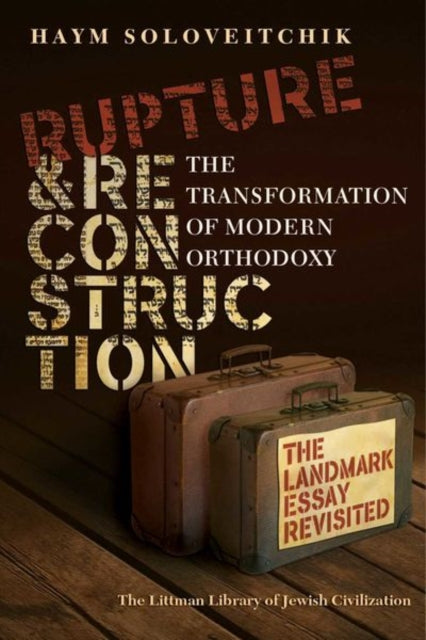
Haym Soloveitchik
Rupture and Reconstruction: The Transformation of Modern Orthodoxy
Rupture and Reconstruction: The Transformation of Modern Orthodoxy
💎 Earn 205 Points (£2.05) on this item.
- Condition: Brand new
- UK Delivery times: Usually arrives within 2 - 3 working days
- UK Shipping: Fee starts at £3.89. Subject to product weight & dimension
Bulk ordering. Want 15 or more copies? Get a personalised quote and bigger discounts. Learn more about bulk orders.
Couldn't load pickup availability
- More about Rupture and Reconstruction: The Transformation of Modern Orthodoxy
The essay attempts to understand the developments in Orthodox Jewry in America over the last seventy years, including a shift to the right, increased ritual stringency, and a rupture in patterns of behavior. This new edition addresses criticisms and provides a fuller perspective on a central topic in the Jewish world.
\n Format: Hardback
\n Length: 144 pages
\n Publication date: 10 September 2021
\n Publisher: Liverpool University Press
\n
The essay at the heart of this book delves into the profound transformations that have unfolded within Orthodox Jewry in America over the past seventy years. It aims to understand these developments and their far-reaching implications. The central shift observed is commonly referred to as "the swing to the right," characterized by a significant increase in ritual strictness and a rupture in behavioral patterns that have had profound consequences not only for Jewish society but also for the essence of Jewish spirituality. For Haym Soloveitchik, the fundamental catalyst behind this change lies in the migration of Jews to the "New Worlds" of England, the United States, and Israel, as well as their acculturation into their new surroundings. This migration necessitated the reconstruction of religious practice from normative texts, as mimetic transmission of observance based on practices observed in homes and streets became impossible. As a result, behavior that once relied on habit now operates under the rule of rules.
This revised edition provides the author with an opportunity to address criticisms that have been raised since the original publication of the essay, which has long been regarded as a classic in the field. It also enables readers to gain a more comprehensive understanding of a topic that remains central to the contemporary Jewish world and its ongoing development.
The impact of this shift on Jewish society has been profound. On the one hand, it has led to a renewed emphasis on traditional values and customs, as Jews sought to maintain their cultural identity in a rapidly changing world. On the other hand, it has sparked debates and discussions about the balance between tradition and modernity, as well as the role of religious practice in shaping Jewish identity.
One of the most significant consequences of the swing to the right has been the increased strictness of religious observance. Jews have become more focused on following the letter of the law, as they strive to uphold the highest standards of religious practice. This has led to the development of new religious practices and rituals, as well as the revitalization of older ones.
However, the increased ritual strictness has also raised concerns among some Jews. Some argue that it can create a sense of rigidity and inflexibility, which can hinder personal growth and spiritual development. Others argue that it can lead to a disconnect between Jews and their non-Jewish neighbors, as the strictness of religious practice may make it difficult for Jews to engage in interfaith dialogue and cooperation.
Another consequence of the swing to the right has been a shift in the nature of Jewish spirituality. Traditional forms of Jewish spirituality, which were often focused on personal experience and emotional connection, have given way. In their place, there has been a growing emphasis on the study of religious texts and the pursuit of intellectual understanding of Jewish beliefs and practices.
This shift has led to the development of new religious movements and denominations, such as Orthodoxy, Conservative Judaism, and Reform Judaism, each with its own unique approach to religious practice and spirituality. It has also led to the emergence of new Jewish thought leaders and scholars, who are exploring new ways of understanding Jewish tradition and its place in the modern world.
Despite the challenges and controversies that have accompanied the swing to the right, it is important to recognize the positive aspects of this transformation. For example, it has led to a renewed sense of pride and identity among Jews, as they have come together to celebrate their shared heritage and traditions. It has also facilitated the growth of Jewish communities and organizations, as Jews have sought to connect with one another and support one another in their spiritual and social endeavors.
In conclusion, the essay at the heart of this book explores the profound transformations that have occurred within Orthodox Jewry in America over the past seventy years. It aims to understand these developments and their far-reaching implications, as well as to analyze their impact on Jewish society and its development. The central shift observed is commonly referred to as "the swing to the right," characterized by a significant increase in ritual strictness and a rupture in behavioral patterns that have had profound consequences not only for Jewish society but also for the essence of Jewish spirituality. For Haym Soloveitchik, the fundamental catalyst behind this change lies in the migration of Jews to the "New Worlds" of England, the United States, and Israel, as well as their acculturation into their new surroundings. This migration necessitated the reconstruction of religious practice from normative texts, as mimetic transmission of observance based on practices observed in homes and streets became impossible. As a result, behavior that once relied on habit now operates under the rule.
This revised edition provides the author with an opportunity to address criticisms that have been raised to the original publication of the essay, which has long been regarded as a classic in the field. It also enables readers to gain a more comprehensive understanding of a topic that remains central to the contemporary Jewish world and its ongoing development.
The impact of this shift on Jewish society. On the one hand, it has led to a renewed emphasis on traditional values and customs, as Jews sought to maintain their cultural identity in a rapidly changing world. On the other hand, it has sparked the debates and discussions about the balance between the balance between tradition. Between tradition and modernity, as well as the role of religious practice in shaping Jewish identity.
One of the most significant consequences of the swing to the right. To the right has been the increased strictness of religious observance. Jews have become more focused on following the letter of the law, as they strive to uphold the highest standards of religious practice. This has led to the development of new religious practices and rituals, as well as the revitalization of older ones.
However, the increased ritual strictness has also raised concerns among some Jews. Some argue that it can create a sense of rigidity and inflexibility, which can hinder personal growth and spiritual development. Others argue that it can lead to a disconnect between Jews and their non-Jewish neighbors, as the strictness of religious practice may make it difficult for Jews to engage in interfaith dialogue and cooperation.
Another consequence of the swing to the right has been a shift in the nature of Jewish spirituality. Traditional forms of Jewish spirituality, which were often focused on personal experience and emotional connection, have given. In their place, there has been a growing emphasis on the study of religious texts and the pursuit of intellectual understanding of Jewish beliefs and practices.
This shift has led to the development of new religious movements and denominations, such as Orthodoxy, Conservative Judaism, and Reform Judaism, each with its own unique approach to religious practice and spirituality. It has also led to the emergence of new Jewish thought leaders and scholars, who are exploring new ways of understanding Jewish tradition and its place in the modern world.
Despite the challenges and controversies that have accompanied the swing to the right, it is important to recognize the positive aspects of this transformation. For example, it has led to a renewed sense of pride and identity among Jews, as they have come together to celebrate their shared heritage and traditions. It has also facilitated the growth of Jewish communities and organizations, as Jews have sought to connect with one another and support one another in their spiritual and social endeavors.
\n Weight: 438g\n
Dimension: 164 x 240 x 22 (mm)\n
ISBN-13: 9781906764388\n \n
UK and International shipping information
UK and International shipping information
We deliver throughout the United Kingdom and to 128 countries and territories worldwide, including the United States, Australia, Canada, Germany, Spain and France.