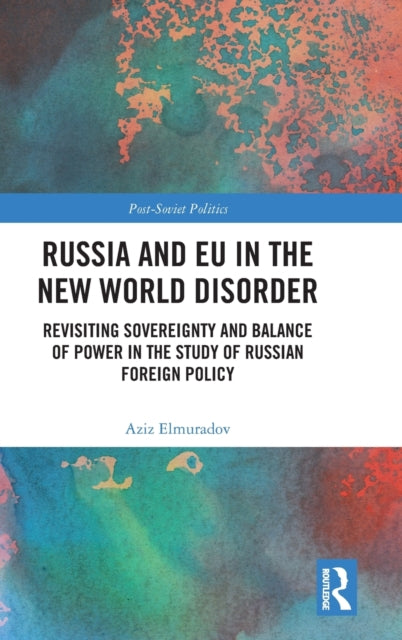
AzizElmuradov
Russia and EU in the New World Disorder: Revisiting Sovereignty and Balance of Power in the study of Russian Foreign Policy
Russia and EU in the New World Disorder: Revisiting Sovereignty and Balance of Power in the study of Russian Foreign Policy
💎 Earn 689 Points (£6.89) on this item.
We can order this item for you. Delivery usually takes about 4 to 6 weeks.
This item is not held in our immediate stock. We will order it for you after checkout.
Estimated delivery: About 4 to 6 weeks
YOU SAVE £8.18
- Condition: Brand new
- UK Delivery times: Usually arrives within 2 - 3 working days
- UK Shipping: Fee starts at £2.39. Subject to product weight & dimension
Bulk ordering. Want 15 or more copies? Get a personalised quote and bigger discounts. Learn more about bulk orders.
Couldn't load pickup availability
- More about Russia and EU in the New World Disorder: Revisiting Sovereignty and Balance of Power in the study of Russian Foreign Policy
This book explores the constructions and transformations of the Russian "self" in relation to the European "other" and provides an analysis of Russian foreign policy discourse under Putin. It argues that to understand these changes and continuities, we must explore concepts of sovereignty and balance of power central to the drafting of Russian foreign policy.
Format: Hardback
Length: 178 pages
Publication date: 04 November 2022
Publisher: Taylor & Francis Ltd
This groundbreaking book makes a significant contribution to the literature on Russia-EU relations by delving into the intricate constructions and transformations of the Russian 'Self' in its relationship with the European 'Other.' Through a comprehensive analysis, it offers valuable insights into understanding Russian foreign policy discourse under the leadership of Vladimir Putin. By examining the actions of key policy actors, the author provides a solid foundation for grounding the Russian discourse ideationally, historically, psychologically, and politico-sociologically. The book explores the evolution of Russian foreign policy towards the EU, moving from cooperation to competition and ultimately leading to conflict. It emphasizes the importance of exploring concepts such as sovereignty and balance of power in understanding these changes and continuities. Primarily rooted in the fields of International Relations and Russian foreign policy, this book also appeals to scholars interested in Foreign Policy Analysis, Post-Soviet Studies, Eurasian Studies, Historical International Relations, Critical Security Studies, Political Sociology, and Political Psychology.
Introduction:
The study of Russia-EU relations has gained increasing importance in recent years, as both entities play pivotal roles in global politics. This book aims to contribute to this literature by examining the complex dynamics between Russia and the EU, focusing on the constructions and transformations of the Russian 'Self' in its relationship with the European 'Other.' By analyzing the actions of key policy actors, the author seeks to provide a comprehensive understanding of Russian foreign policy discourse under Putin's leadership.
Chapter 1:
In the first chapter, the author provides an overview of the literature on Russia-EU relations, highlighting the key themes and debates. It identifies the need for a deeper analysis of the Russian 'Self' in the context of the European 'Other,' as previous studies have primarily focused on the European perspective. The chapter also discusses the historical background and geopolitical context of Russia-EU relations, which have shaped the dynamics of the relationship over the years.
Chapter 2:
The second chapter delves into the constructions and transformations of the Russian 'Self' in relation to the European 'Other.' It explores the historical, cultural, and ideological factors that have influenced the Russian perception of itself and its place in the world. The author examines how Russia's historical experiences, such as the Cold War and the collapse of the Soviet Union, have shaped its foreign policy towards the EU. Additionally, the chapter explores the role of Russian nationalism, which has played a significant role in shaping the country's foreign policy towards the EU.
Chapter 3:
In the third chapter, the author analyzes the actions of key policy actors in Russia and the EU. It examines the role of the Russian government, the Russian parliament, the Russian media, and the Russian public in shaping Russian foreign policy towards the EU. The author identifies the different perspectives and interests of these actors and how they have influenced the development of Russian foreign policy discourse. The chapter also explores the challenges and opportunities that these actors face in navigating the complex dynamics of Russia-EU relations.
Chapter 4:
The fourth chapter examines the evolution of Russian foreign policy towards the EU. It explores the different stages of the relationship, from cooperation to competition and ultimately to conflict. The author identifies the factors that have contributed to these changes, such as economic interests, geopolitical concerns, and political ideologies. The chapter also analyzes the strategies and tactics used by Russia and the EU to manage their relations and mitigate the risks of conflict.
Chapter 5:
In the fifth chapter, the author discusses the implications of Russian foreign policy towards the EU. It explores the impact of Russian foreign policy on the European economy, security, and political stability. The author also examines the challenges and opportunities that Russia faces in its relationship with the EU, such as the potential for cooperation and integration or the risk of further conflict. The chapter also explores the role of the international community in mediating and resolving Russia-EU relations.
Conclusion:
In conclusion, this book makes an original contribution to Russia-EU literature by analyzing the constructions and transformations of the Russian 'Self' in relation to the European 'Other.' Through a comprehensive analysis of the actions of key policy actors, it provides valuable insights into understanding Russian foreign policy discourse under Putin's leadership. The book emphasizes the importance of exploring concepts such as sovereignty and balance of power in understanding these changes and continuities. By examining the evolution of Russian foreign policy towards the EU, the book offers valuable insights into the complex dynamics of global politics and the role of key actors in shaping the future of international relations.
Weight: 500g
Dimension: 234 x 156 (mm)
ISBN-13: 9781032114149
This item can be found in:
UK and International shipping information
UK and International shipping information
UK Delivery and returns information:
- Delivery within 2 - 3 days when ordering in the UK.
- Shipping fee for UK customers from £2.39. Fully tracked shipping service available.
- Returns policy: Return within 30 days of receipt for full refund.
International deliveries:
Shulph Ink now ships to Australia, Belgium, Canada, France, Germany, Ireland, Italy, India, Luxembourg Saudi Arabia, Singapore, Spain, Netherlands, New Zealand, United Arab Emirates, United States of America.
- Delivery times: within 5 - 10 days for international orders.
- Shipping fee: charges vary for overseas orders. Only tracked services are available for most international orders. Some countries have untracked shipping options.
- Customs charges: If ordering to addresses outside the United Kingdom, you may or may not incur additional customs and duties fees during local delivery.