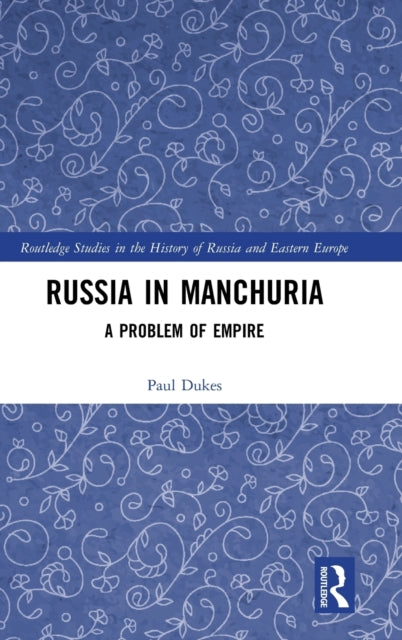
Paul Dukes
Russia in Manchuria: A Problem of Empire
Russia in Manchuria: A Problem of Empire
We can order this item for you. Delivery usually takes about 4 to 6 weeks.
This item is not held in our immediate stock. We will order it for you after checkout.
Estimated delivery: About 4 to 6 weeks
YOU SAVE £15.13
- Condition: Brand new
- UK Delivery times: Usually arrives within 2 - 3 working days
- UK Shipping: Fee starts at £3.89. Subject to product weight & dimension
Bulk ordering. Want 15 or more copies? Get a personalised quote and bigger discounts. Learn more about bulk orders.
Couldn't load pickup availability
- More about Russia in Manchuria: A Problem of Empire
This book explores the history of Manchuria, focusing on the Russian and Soviet perspective, including early colonization, the Chinese Eastern Railway, and twentieth-century developments. It examines Russian/Soviet imperialism and its similarities to and differences from other nations' imperial ventures.
Format: Hardback
Length: 160 pages
Publication date: 31 January 2022
Publisher: Taylor & Francis Ltd
Manchuria, the name bestowed upon China's northeastern provinces by foreign powers, has been a subject of contention among China, Russia, and Japan, particularly over numerous centuries. This comprehensive book delves into the rich history of Manchuria, with a specific emphasis on the Russian and Soviet perspectives. It begins by tracing the early colonization of the region and exploring the significance of the Chinese Eastern Railway, a branch of the Trans-Siberian Railway, in consolidating the Russian presence and fostering economic growth in the region. The book then examines the twentieth-century developments, including the Japanese invasion and the puppet state of Manchukuo. Throughout, the book reflects on the nature of empire, particularly Russian/Soviet imperialism, and its similarities to and differences from other nations' imperial ventures.
Early Colonization and the Chinese Eastern Railway:
Manchuria's history dates back to ancient times, with various ethnic groups inhabiting the region. However, it was during the late nineteenth and early twentieth centuries that the region became a focal point of international attention. The Russian Empire, in particular, had a keen interest in Manchuria due to its strategic location and valuable natural resources.
In 1894, the Russian Empire established the Russian Far East, which included Manchuria. The Russian presence in the region was further strengthened with the construction of the Chinese Eastern Railway, a branch of the Trans-Siberian Railway. The railway was a massive engineering project that connected Moscow with the port city of Vladivostok in the Russian Far East.
The Chinese Eastern Railway played a crucial role in consolidating the Russian presence in Manchuria. It facilitated the transportation of goods and people, promoted economic development, and facilitated cultural exchange between Russia and China. The railway city of Harbin, located on the railway line, became a major hub for Russian commerce and culture.
The Chinese Eastern Railway also had significant implications for the region's economy. It brought new jobs and investment opportunities, and it facilitated the export of goods from Manchuria to other parts of the world. The railway also opened up new trade routes, which led to the growth of the region's economy.
However, the Chinese Eastern Railway was not without its challenges. The construction of the railway required a significant investment of resources and labor, and it was also prone to accidents and technical difficulties. Additionally, the railway was heavily influenced by the political and economic interests of the Russian Empire, which sometimes led to tensions with China.
Despite these challenges, the Chinese Eastern Railway remained a vital component of the Russian presence in Manchuria. It played a significant role in shaping the region's history and culture, and it contributed to the development of the region's economy.
Twentieth-Century Developments:
The twentieth century saw significant developments in Manchuria, particularly with the rise of Japanese imperialism. In 1904, Japan invaded Manchuria, and the subsequent puppet state of Manchukuo was established.
The Japanese occupation of Manchuria had profound consequences for the region. It led to the displacement of millions of people, the exploitation of natural resources, and the suppression of cultural and political freedoms. The Japanese also introduced a new political system, known as "militarism," which emphasized the importance of the military and the subordination of individual rights.
The puppet state of Manchukuo was a controversial entity. While it was nominally independent, it was heavily influenced by Japan and was essentially a puppet state of the Japanese Empire. The Japanese government controlled the region's economy, military, and political affairs, and it imposed a strict authoritarian regime that suppressed any form of dissent.
The Japanese occupation of Manchuria lasted for over three decades, until the end of World War II. During this time, the region was subjected to a brutal military campaign, and millions of people died as a result of war, famine, and disease. The Japanese also committed numerous war crimes, including the forced sterilization of women and the massacre of civilians.
The end of World War II marked the beginning of the end of the Japanese occupation of Manchuria. In 1945, the United States and the Soviet Union invaded Manchuria, and the puppet state of Manchukuo was abolished. The region was divided into two occupation zones, with the Soviet Union controlling the eastern part and the United States controlling the western part.
The end of the Japanese occupation of Manchuria was a significant event in the history of the region. It marked the end of Japanese imperialism and the beginning of a new era of independence and democracy. The region was also subjected to a period of reconstruction and rehabilitation, which was funded by the United Nations and other international organizations.
Conclusion:
Manchuria's history is a complex and multifaceted narrative that has been shaped by a range of historical, political, and economic factors. The early colonization of the region by the Russian Empire and the construction of the Chinese Eastern Railway played a crucial role in consolidating the Russian presence and fostering economic growth. However, the twentieth-century developments, including the Japanese invasion and the puppet state of Manchukuo, had profound consequences for the region.
The Japanese occupation of Manchuria was a brutal and oppressive regime that led to the displacement of millions of people, the exploitation of natural resources, and the suppression of cultural and political freedoms. The puppet state of Manchukuo was a controversial entity that was essentially a puppet state of the Japanese Empire. The end of the Japanese occupation of Manchuria marked the beginning of a new era of independence and democracy for the region, and it was a significant event in the history of the region.
In conclusion, Manchuria's history is a testament to the complex and multifaceted nature of empire. While the Russian Empire's presence in the region was significant, it was ultimately replaced by Japanese imperialism, which had profound consequences for the region. The end of the Japanese occupation of Manchuria marked the beginning of a new era of independence and democracy for the region, and it was a significant event in the history of the region.
Weight: 481g
Dimension: 234 x 156 (mm)
ISBN-13: 9780367752163
UK and International shipping information
UK and International shipping information
We deliver throughout the United Kingdom and to 128 countries and territories worldwide, including the United States, Australia, Canada, Germany, Spain and France.