Shulph Ink
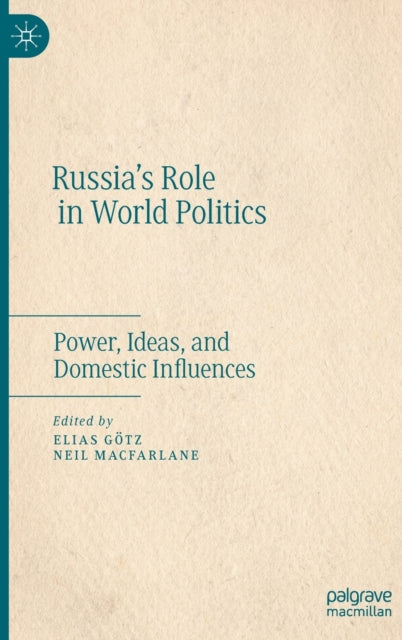
Russia's Role in World Politics: Power, Ideas, and Domestic Influences
Russia's Role in World Politics: Power, Ideas, and Domestic Influences
💎 Earn 454 Points (£4.54) on this item.
We can order this item for you. Delivery usually takes about 4 to 6 weeks.
This item is not held in our immediate stock. We will order it for you after checkout.
Estimated delivery: About 4 to 6 weeks
YOU SAVE £19.14
- Condition: Brand new
- UK Delivery times: Usually arrives within 2 - 3 working days
- UK Shipping: Fee starts at £2.39. Subject to product weight & dimension
Bulk ordering. Want 15 or more copies? Get a personalised quote and bigger discounts. Learn more about bulk orders.
Couldn't load pickup availability
- More about Russia's Role in World Politics: Power, Ideas, and Domestic Influences
Russia's active and assertive role in geopolitics, including its takeover of Crimea, meddling in eastern Ukraine, military intervention in Syria, interference in the 2016 US presidential race, and pursuit of closer economic and diplomatic ties with China, has sparked a debate among Western policymakers, think-tank analysts, and academics. The contributions gathered here explore the main drivers of Moscow's recent assertiveness, focusing on the interplay of power, ideas, and domestic influences.
Format: Hardback
Length: 120 pages
Publication date: 10 December 2022
Publisher: Springer International Publishing AG
Russia's increasing assertiveness in global politics has garnered significant attention in recent years. Moscow has taken a more active and influential role in international affairs, with its actions shaping the geopolitical landscape. Examples of Russia's assertiveness include its annexation of Crimea in 2014 and its involvement in the conflict in eastern Ukraine. Russia has also intervened militarily in Syria, supporting the government of Bashar al-Assad, and has been accused of interfering in the 2016 US presidential election. Additionally, Russia has pursued closer economic and diplomatic ties with China, while also embarking on ambitious military reforms and displaying nuclear brinkmanship.
The debate surrounding Russia's role in world politics is intense, with Western policymakers, think-tank analysts, and academics engaging in spirited discussions. The central question at the forefront of this debate is: What are the primary drivers or causes of Moscow's recent assertiveness? This collection of contributions aims to address this question by examining the interplay of power, ideas, and domestic influences shaping Russia's foreign policy decisions.
One key factor contributing to Russia's assertiveness is its military power and capabilities. With a vast arsenal of nuclear weapons and advanced military technology, Russia can project force and influence on a global scale. This military strength has allowed Russia to pursue its interests in various regions, including Syria, Ukraine, and the Middle East, without facing significant international opposition.
Another factor influencing Russia's assertiveness is its perception of Western hostility and encirclement. Russia has long felt that the West has been seeking to undermine its interests and influence in the region, particularly through the deployment of NATO military assets in Eastern Europe. This perception has led Russia to adopt a more confrontational stance towards the West and to seek to assert its own regional dominance.
Ideological factors also play a role in shaping Russia's foreign policy. Russia's conservative political ideology, which emphasizes national sovereignty, traditional values, and the role of the state, has influenced its approach to international relations. Russia has been particularly critical of Western liberal democracy and has sought to promote its own model of governance, which emphasizes authoritarianism and control over society.
Domestic factors, such as economic challenges and political instability, also contribute to Russia's assertiveness. Russia's economy has been struggling in recent years, with low oil prices and international sanctions contributing to economic contraction and political unrest. This has led to a sense of insecurity and frustration among the Russian population, which has been expressed in support for authoritarian leaders and a more aggressive foreign policy.
In conclusion, Russia's increasing assertiveness in global politics is driven by a complex interplay of power, ideas, and domestic influences. While Russia's military power and capabilities play a significant role, ideological factors and domestic challenges also contribute to its foreign policy decisions. As the world continues to grapple with Russia's assertive behavior, it is important to understand the underlying drivers and factors that shape its actions to better navigate the complex and evolving geopolitical landscape.
Weight: 366g
Dimension: 235 x 155 (mm)
ISBN-13: 9783031195181
Edition number: 1st ed. 2022
UK and International shipping information
UK and International shipping information
UK Delivery and returns information:
- Delivery within 2 - 3 days when ordering in the UK.
- Shipping fee for UK customers from £2.39. Fully tracked shipping service available.
- Returns policy: Return within 30 days of receipt for full refund.
International deliveries:
Shulph Ink now ships to Australia, Belgium, Canada, France, Germany, Ireland, Italy, India, Luxembourg Saudi Arabia, Singapore, Spain, Netherlands, New Zealand, United Arab Emirates, United States of America.
- Delivery times: within 5 - 10 days for international orders.
- Shipping fee: charges vary for overseas orders. Only tracked services are available for most international orders. Some countries have untracked shipping options.
- Customs charges: If ordering to addresses outside the United Kingdom, you may or may not incur additional customs and duties fees during local delivery.