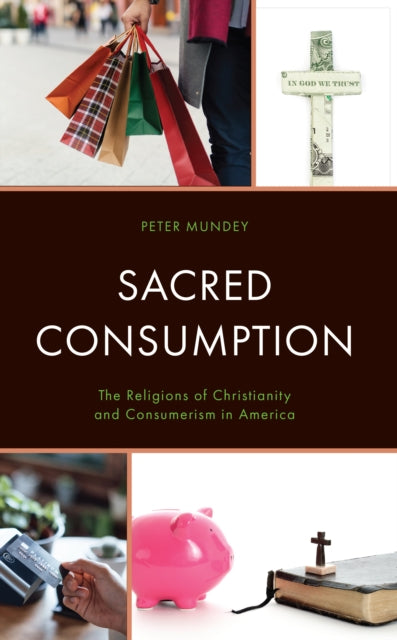
Peter Mundey
Sacred Consumption: The Religions of Christianity and Consumerism in America
Sacred Consumption: The Religions of Christianity and Consumerism in America
💎 Earn 398 Points (£3.98) on this item.
We can order this item for you. Delivery usually takes about 4 to 6 weeks.
This item is not held in our immediate stock. We will order it for you after checkout.
Estimated delivery: About 4 to 6 weeks
- Condition: Brand new
- UK Delivery times: Usually arrives within 2 - 3 working days
- UK Shipping: Fee starts at £3.89. Subject to product weight & dimension
Bulk ordering. Want 15 or more copies? Get a personalised quote and bigger discounts. Learn more about bulk orders.
Couldn't load pickup availability
- More about Sacred Consumption: The Religions of Christianity and Consumerism in America
Consumerism in America is a quasi-religion that interacts with the Christian faith, with habitually consuming nonessentials being sacred and Christian creeds related to both consuming and financial giving playing a role. Peter Mundey explores the history of American consumerism and the creeds of consumerism, illuminating the ways that Christianity can fuel, resist, and passively ignore consumerism.
Format: Hardback
Length: 162 pages
Publication date: 25 April 2023
Publisher: Lexington Books
Consumerism in America is often seen as a quasi-religion, with its own set of beliefs, rituals, and practices. It is closely intertwined with the Christian faith, and the two faiths interact in complex ways. Sacred Consumption: The Religions of Christianity and Consumerism in America by Peter Mundey explores this relationship in detail. Mundey uses quantitative and qualitative data to examine how habitually consuming nonessentials is sacred in American culture and how the Christian sacred interacts with such consumption. He begins by tracing the history of American consumerism, highlighting the creeds of consumerism that have shaped American society. Mundey then discusses Christian creeds related to both consuming and financial giving, showing how Christianity can fuel, resist, and passively ignore consumerism. Throughout the book, Mundey emphasizes the underlying cultural ideology derived from both Christianity and consumerism that partially makes and shapes American consumers.
One of the key themes of Sacred Consumption is the idea of consumerism as a form of idolatry. Mundey argues that consumerism is a belief system that places excessive value on material possessions and consumption, and that it can lead to a sense of emptiness and dissatisfaction. He points out that consumerism is often driven by a desire for status, power, and control, and that it can lead to a sense of entitlement and greed. Mundey also notes that consumerism can be harmful to both individuals and society, as it can lead to environmental degradation, social inequality, and economic instability.
To address these issues, Mundey suggests that Christians should engage in a process of spiritual transformation. He argues that Christians should recognize the idolatry of consumerism and seek to replace it with a more holistic and sustainable way of living. This involves developing a sense of gratitude for the things that we have, practicing generosity and giving, and living in harmony with the natural world. Mundey also suggests that Christians should be involved in social justice and environmental activism, working to address the root causes of consumerism and promote a more just and sustainable society.
One of the challenges that Christians face in engaging with consumerism is the fact that it is deeply embedded in American culture. Consumerism is a major part of the American economy, and it is difficult for Christians to avoid being influenced by it. Mundey suggests that Christians should be aware of the cultural influences that shape their behavior and should work to resist them. He also suggests that Christians should be involved in the political process, working to promote policies that support sustainable and just economic practices.
Another challenge that Christians face in engaging with consumerism is the fact that it can be difficult to distinguish between what is necessary and what is unnecessary. Mundey suggests that Christians should be guided by the principles of simplicity and moderation, and should seek to live in a way that is consistent with the teachings of Jesus Christ. He also suggests that Christians should be aware of the environmental and social consequences of their consumption and should work to reduce their impact.
In addition to these challenges, Mundey also notes that there are some positive aspects of consumerism. Consumerism has led to the development of new technologies and products that have improved the quality of life for many people. It has also created jobs and has contributed to economic growth. However, Mundey argues that these benefits should not be prioritized over the spiritual and ethical dimensions of life.
One of the ways that Christians can engage with consumerism is by practicing gratitude. Mundey suggests that Christians should take time each day to reflect on the things that they have and to be grateful for them. He also suggests that Christians should be generous and give to others, both in terms of their time and their resources. Mundey also suggests that Christians should be involved in social justice and environmental activism, working to address the root causes of consumerism and promote a more just and sustainable society.
Another way that Christians can engage with consumerism is by practicing simplicity and moderation. Mundey suggests that Christians should be aware of the environmental and social consequences of their consumption and should work to reduce their impact. He also suggests that Christians should be guided by the principles of simplicity and moderation, and should seek to live in a way that is consistent with the teachings of Jesus Christ.
In conclusion, Sacred Consumption: The Religions of Christianity and Consumerism in America is a valuable book that explores the relationship between consumerism and the Christian faith. Mundey uses quantitative and qualitative data to examine how habitually consuming nonessentials is sacred in American culture and how the Christian sacred interacts with such consumption. He suggests that Christians should engage in a process of spiritual transformation, develop a sense of gratitude for the things that they have, practice generosity and giving, and live in harmony with the natural world. While consumerism has some positive aspects, it is also deeply embedded in American culture and can be harmful to both individuals and society. Christians should be aware of the cultural influences that shape their behavior and should work to resist them. By practicing gratitude, simplicity and moderation, and social justice and environmental activism, Christians can help to create a more just and sustainable society.
Weight: 413g
Dimension: 237 x 158 x 18 (mm)
ISBN-13: 9781498591614
UK and International shipping information
UK and International shipping information
We deliver throughout the United Kingdom and to 128 countries and territories worldwide, including the United States, Australia, Canada, Germany, Spain and France.