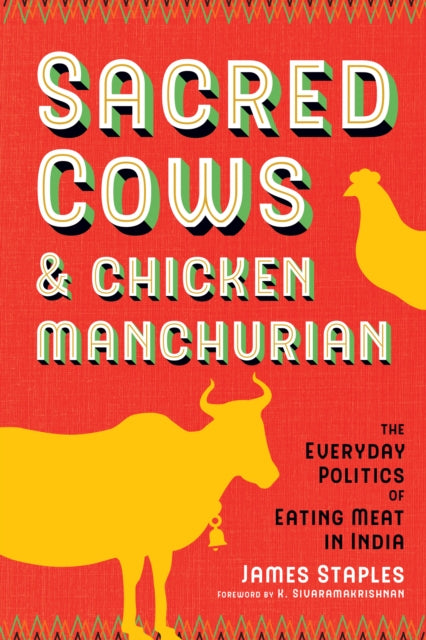
James Staples
Sacred Cows and Chicken Manchurian: The Everyday Politics of Eating Meat in India
Sacred Cows and Chicken Manchurian: The Everyday Politics of Eating Meat in India
YOU SAVE £1.08
- Condition: Brand new
- UK Delivery times: Usually arrives within 2 - 3 working days
- UK Shipping: Fee starts at £3.89. Subject to product weight & dimension
Bulk ordering. Want 15 or more copies? Get a personalised quote and bigger discounts. Learn more about bulk orders.
Couldn't load pickup availability
- More about Sacred Cows and Chicken Manchurian: The Everyday Politics of Eating Meat in India
Bovine politics challenges popular generalizations about cow protection and beef consumption in contemporary Indian society, revealing fault lines between different religious groups and the complexities of food politics. James Staples' ethnographic research in South India explores how cattle owners, brokers, butchers, cooks, and occasional beef eaters navigate the political and cultural climate, challenging simplistic binary oppositions.
Format: Paperback / softback
Length: 248 pages
Publication date: 15 November 2020
Publisher: University of Washington Press
Bovine politics in contemporary India presents a complex and multifaceted landscape, challenging popular generalizations about cow protection and beef consumption. This issue exposes fault lines within Indian society, where eating beef is simultaneously perceived as a violation of sacred taboos, an expression of marginalized identities, and a means of achieving cosmopolitan sophistication. The recent rise of Hindu nationalism has further polarized traditional views, with Dalits, Muslims, and Christians protesting threats to their beef-eating heritage, while Hindu fundamentalists rally against those who consume the sacred cow. However, a closer examination of people's dietary choices, the contexts in which they consume food, and the disparities between rhetoric and everyday actions reveals a more nuanced and complex reality.
To understand how a food can be implicated in riots, vigilante attacks, and even murders, it is essential to look beyond immediate politics and consider wider contexts. Drawing on decades of ethnographic research in South India, James Staples charts the ways in which cattle owners, brokers, butchers, cooks, and occasional beef eaters navigate the contemporary political and cultural climate. Sacred Cows and Chicken Manchurian offers a fine-grained exploration of the current situation, situating it within the broader anthropology of food and eating in the region and shedding light on critical aspects of what it means to be Indian in the early twenty-first century.
The consumption of beef in India has a long and complex history, shaped by religious, cultural, and economic factors. While beef has been an integral part of Indian cuisine for centuries, it has also been associated with social and political tensions. The Hindu religion considers cows to be sacred and has long prohibited the consumption of beef, while many other religions, including Islam and Christianity, permit the consumption of beef. The ban on beef in many states in India has been a source of controversy and has led to protests and violence in some areas.
One of the main challenges facing the consumption of beef in India is the issue of caste and social hierarchy. Historically, the consumption of beef has been associated with lower castes, who are often marginalized and discriminated against in Indian society. The ban on beef has further exacerbated these inequalities, as it has limited the economic opportunities available to lower castes, who rely on cattle farming for their livelihood. In addition, the ban has led to tensions between different castes, as some members of higher castes view the consumption of beef as a symbol of disrespect and inequality.
Another challenge facing the consumption of beef in India is the issue of religious intolerance. The ban on beef has been interpreted by some religious groups as a violation of their religious beliefs and has led to protests and violence. In some cases, religious extremists have targeted individuals and communities who consume beef, leading to fatalities and widespread damage. This has created a sense of fear and insecurity among those who consume beef and has further polarized the political landscape.
Despite these challenges, there are also positive aspects to the consumption of beef in India. Beef is a source of high-quality protein and is an important part of many Indian cuisines. It is also a valuable source of income for many farmers, particularly in rural areas. In addition, the consumption of beef can contribute to economic development and job creation in the livestock industry.
To address the challenges facing the consumption of beef in India, it is important to promote dialogue and understanding between different religious and social groups. This can be achieved through education and awareness campaigns, which can help to dispel myths and misconceptions about beef consumption and promote a more inclusive and tolerant society. In addition, it is important to address the issue of caste and social hierarchy. This can be achieved through policies that promote social inclusion and equality, such as providing access to education and healthcare for all members of society, regardless of their caste or social status.
In conclusion, bovine politics in contemporary India presents a complex and multifaceted landscape, challenging popular generalizations about cow protection and beef consumption. The issue exposes fault lines within Indian society, where eating beef is simultaneously perceived as a violation of sacred taboos, an expression of marginalized identities, and a means of achieving cosmopolitan sophistication. The recent rise of Hindu nationalism has further polarized traditional views, with Dalits, Muslims, and Christians protesting threats to their beef-eating heritage, while Hindu fundamentalists rally against those who consume the sacred cow. However, a closer examination of people's dietary choices, the contexts in which they consume food, and the disparities between rhetoric and everyday actions reveals a more nuanced and complex reality.
Understanding how a food can be implicated in riots, vigilante attacks, and even murders demands that we look beyond immediate politics to wider contexts. Drawing on decades of ethnographic research in South India, James Staples charts how cattle owners, brokers, butchers, cooks, and occasional beef eaters navigate the contemporary political and cultural climate. Sacred Cows and Chicken Manchurian offers a fine-grained exploration of the current situation, situating it within the broader anthropology of food and eating in the region and shedding light on critical aspects of what it means to be Indian in the early twenty-first century.
Weight: 392g
Dimension: 153 x 228 x 18 (mm)
ISBN-13: 9780295747880
UK and International shipping information
UK and International shipping information
We deliver throughout the United Kingdom and to 128 countries and territories worldwide, including the United States, Australia, Canada, Germany, Spain and France.