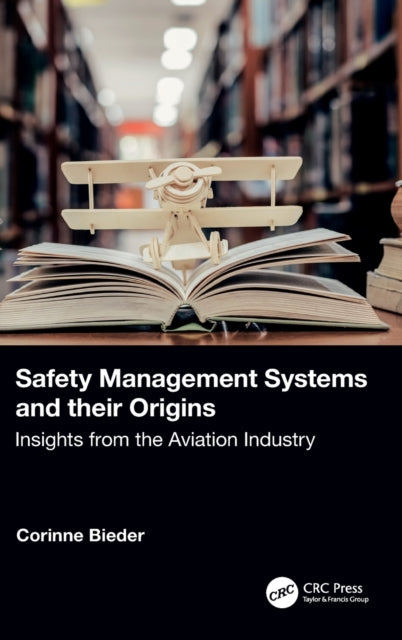
Corinne Bieder
Safety Management Systems and their Origins: Insights from the Aviation Industry
Safety Management Systems and their Origins: Insights from the Aviation Industry
💎 Earn 490 Points (£4.90) on this item.
YOU SAVE £5.83
- Condition: Brand new
- UK Delivery times: Usually arrives within 2 - 3 working days
- UK Shipping: Fee starts at £3.89. Subject to product weight & dimension
Bulk ordering. Want 15 or more copies? Get a personalised quote and bigger discounts. Learn more about bulk orders.
Couldn't load pickup availability
- More about Safety Management Systems and their Origins: Insights from the Aviation Industry
This paper explores the implementation of SMS in aviation based on examples from the UK, USA, and Australia. It provides a socio-historical analysis of how SMS emerged in high-risk industries and discusses the existing limitations of SMS. It also proposes new avenues to reach beyond these limitations and discusses the COVID-19 pandemic within the framework of risk analysis.
Format: Hardback
Length: 182 pages
Publication date: 28 November 2022
Publisher: Taylor & Francis Ltd
Here is the rewritten text:
Aviation has embraced the use of Short Message Service (SMS) as a critical communication tool, with examples from various countries and regions, including the United Kingdom, the United States, and Australia, highlighting its implementation. This paper delves into the socio-historical context of SMS's emergence in high-risk industries, shedding light on its significance in ensuring safety and efficiency. Furthermore, it offers insights into the existing limitations of SMS and proposes innovative approaches to overcome these constraints. Additionally, the paper explores the impact of the COVID-19 pandemic on risk analysis and the role of SMS in mitigating the risks associated with aviation operations.
SMS has become an integral part of aviation communication, offering a quick and efficient means of conveying important information to pilots, air traffic controllers, and ground personnel. Its adoption in aviation has been driven by its ability to provide real-time updates, reduce communication errors, and enhance situational awareness.
In the UK, for instance, the Civil Aviation Authority (CAA) has implemented a comprehensive SMS system to enhance flight safety. The system allows pilots to send and receive critical flight information, such as weather updates, air traffic advisories, and maintenance alerts, directly to their mobile devices. This has significantly improved the efficiency of communication and reduced the risk of errors in critical situations.
Similarly, in the United States, the Federal Aviation Administration (FAA) has also adopted SMS as a communication tool for aviation. The FAA's SMS system allows pilots to receive real-time weather updates, flight restrictions, and other important information directly to their mobile devices. This has helped pilots make informed decisions and avoid potential hazards during flight.
In Australia, the Civil Aviation Safety Authority (CASA) has implemented an SMS system to improve communication between pilots and air traffic controllers. The system allows pilots to send and receive flight plans, weather updates, and other important information in real-time, reducing the risk of delays and cancellations.
However, despite the benefits of SMS, there are also some limitations that need to be addressed. One of the primary limitations is the limited capacity of SMS messages, which can be problematic in situations where detailed information is required. Additionally, SMS messages can be easily lost or corrupted, which can lead to errors and misunderstandings.
To overcome these limitations, there are several innovative approaches that can be taken. One approach is to use multimedia messaging service (MMS) technology, which allows for the sending of images, videos, and other types of content in addition to text messages. This can be particularly useful in aviation, where detailed information, such as flight plans and weather maps, may require more than just text to be effectively communicated.
Another approach is to use satellite communication technology, which can provide reliable and high-speed communication even in remote or inaccessible areas. Satellite communication systems can be used to send and receive critical flight information, such as weather updates and air traffic advisories, in real-time, ensuring that pilots and air traffic controllers have access to the latest information at all times.
In addition to these technological solutions, there are also some organizational and cultural factors that can contribute to the effective use of SMS in aviation. For example, airlines and airports need to have clear policies and procedures in place for the use of SMS, ensuring that all personnel are trained and familiar with the system. Additionally, there needs to be a culture of continuous improvement and innovation within the aviation industry, with a focus on identifying and addressing emerging risks and challenges.
The COVID-19 pandemic has further highlighted the importance of risk analysis in aviation. The pandemic has posed significant challenges to the aviation industry, including reduced air traffic, travel restrictions, and increased safety concerns. SMS has played a crucial role in mitigating these risks by providing real-time information to pilots, air traffic controllers, and ground personnel.
During the pandemic, airlines and airports have used SMS to communicate with passengers about flight cancellations, delays, and other important information. This has helped to reduce the confusion and uncertainty that passengers often experience during travel disruptions. Additionally, SMS has been used to communicate with pilots and air traffic controllers about new safety protocols and procedures, ensuring that everyone is aware of the latest guidelines and regulations.
However, the pandemic has also highlighted the limitations of SMS as a communication tool in aviation. For example, the limited capacity of SMS messages can be problematic in situations where detailed information is required, such as when communicating with passengers about travel disruptions or safety concerns. Additionally, the reliance on mobile devices and networks can be vulnerable to disruptions and outages, which can lead to communication breakdowns and delays.
To address these limitations, there are several innovative approaches that can be taken. One approach is to use cloud-based communication platforms, which can provide reliable and high-speed communication even in situations where mobile devices and networks are unreliable. Cloud-based communication platforms can be used to send and receive critical flight information, such as weather updates and air traffic advisories, in real-time, ensuring that pilots and air traffic controllers have access to the latest information at all times.
Another approach is to use augmented reality (AR) technology, which can provide pilots and air traffic controllers with real-time information about their surroundings and the status of their aircraft. AR technology can be used to display weather maps, flight plans, and other important information directly on the pilot's or air traffic controller's mobile device, reducing the need for manual checks and reducing the risk of errors.
In addition to these technological solutions, there are also some organizational and cultural factors that can contribute to the effective use of SMS in aviation. For example, airlines and airports need to have clear policies and procedures in place for the use of SMS, ensuring that all personnel are trained and familiar with the system. Additionally, there needs to be a culture of continuous improvement and innovation within the aviation industry, with a focus on identifying and addressing emerging risks and challenges.
In conclusion, SMS has become an essential communication tool in aviation, offering a quick and efficient means of conveying important information to pilots, air traffic controllers, and ground personnel. While there are some limitations to the use of SMS, such as its limited capacity and reliance on mobile devices and networks, there are innovative approaches that can be taken to overcome these constraints. The COVID-19 pandemic has further highlighted the importance of risk analysis in aviation and the role that SMS can play in mitigating the risks associated with aviation operations. By leveraging technology, organizational practices, and cultural factors, the aviation industry can continue to improve the safety and efficiency of its operations.
Weight: 424g
Dimension: 162 x 241 x 17 (mm)
ISBN-13: 9781032308937
UK and International shipping information
UK and International shipping information
We deliver throughout the United Kingdom and to 128 countries and territories worldwide, including the United States, Australia, Canada, Germany, Spain and France.