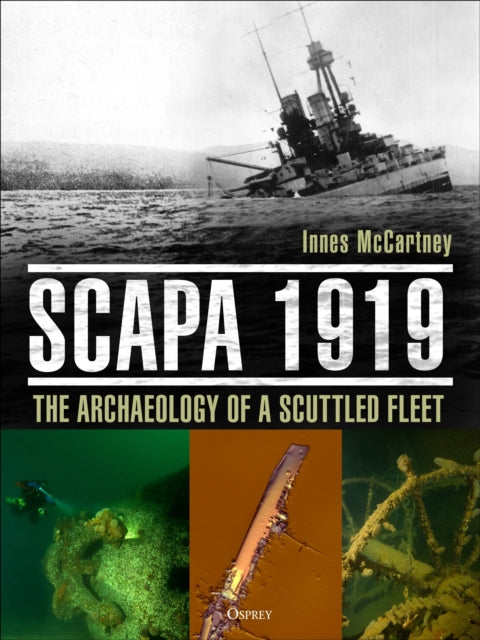
Innes McCartney
Scapa 1919: The Archaeology of a Scuttled Fleet
Scapa 1919: The Archaeology of a Scuttled Fleet
💎 Earn 107 Points (£1.07) on this item.
YOU SAVE £8.58
- Condition: Brand new
- UK Delivery times: Usually arrives within 2 - 3 working days
- UK Shipping: Fee starts at £2.39. Subject to product weight & dimension
Bulk ordering. Want 15 or more copies? Get a personalised quote and bigger discounts. Learn more about bulk orders.
Couldn't load pickup availability
- More about Scapa 1919: The Archaeology of a Scuttled Fleet
Dr Innes McCartney has revealed the location and state of all 25 warships sunk in the scuttling of the German fleet at Scapa Flow. The German High Seas Fleet was one of the most powerful naval forces in the world and had fought the Royal Navy to a stalemate at the battle of Jutland in 1916. After the armistice, the fleet surrendered to the British and was interned in Scapa Flow. In June 1919, the entire fleet attempted to sink itself in the Flow to prevent it from being broken up as war prizes. Of the 74 ships present, 52 sank and 22 were prevented from doing so by circumstance and British intervention. This fascinating study reveals a fleet lost for nearly a century beneath the waves.
\n Format: Hardback
\n Length: 336 pages
\n Publication date: 30 May 2019
\n Publisher: Bloomsbury Publishing PLC
\n
The German High Seas Fleet, a formidable naval force, engaged in a stalemate with the Royal Navy during the Battle of Jutland in 1916. Following the armistice, the fleet was surrendered to the British and interned in Scapa Flow, awaiting the conclusion of the Treaty of Versailles. In June 1919, with the intention of preventing the dismantling of the fleet as war prizes, the entire fleet attempted to sink itself in Scapa Flow. However, only 52 of the 74 ships sank, with 22 being prevented from doing so by circumstance and British intervention.
Marine archaeologist and historian Dr. Innes McCartney has undertaken a groundbreaking study to reveal the location and state of the wrecks of all 25 warships sunk during the scuttling of the German fleet at Scapa Flow. This comprehensive examination delves into the circumstances surrounding the loss of each ship, providing a fresh perspective on a fleet that has remained hidden beneath the waves for nearly a century.
The German High Seas Fleet, comprising a formidable array of battleships, cruisers, and destroyers, was one of the most powerful naval forces in the world at the time of World War I. However, its defeat at the Battle of Jutland in 1916 marked a significant turning point in the conflict. Following the armistice, the fleet was surrendered to the British and interned in Scapa Flow, pending the conclusion of the Treaty of Versailles.
In June 1919, with the impending threat of the fleet's dismantling as war prizes, the decision was made to scuttle the entire fleet in Scapa Flow. The German sailors, led by Admiral Günther Lützow, were determined to prevent their ships from falling into British hands. The scuttling operation was carried out in two stages, with the first phase involving the sinking of 19 ships on June 21, 1919.
The second phase, on June 22, 1919, saw the sinking of the remaining 5 ships, including the renowned battleship Tirpitz. The scuttling of the German fleet at Scapa Flow was a complex and meticulously planned operation. The ships were anchored in a formation known as the "German Line," which was designed to prevent them from sinking in a single location. However, the British navy, led by Admiral David Beatty, implemented a series of tactics to thwart the German plan.
One of the key strategies was the use of depth charges, which were dropped on the German ships to cause them to sink. The depth charges were detonated at a depth of around 30 meters, which was deep enough to cause the ships to break apart and sink to the bottom of the Scapa Flow. In addition, the British navy also deployed submarines to patrol the area and prevent any German ships from escaping.
Despite the British efforts, not all of the German ships were sunk during the scuttling operation. Two ships, the SMS Prinz Eugen and the SMS Bayern, were prevented from sinking by circumstance. The Prinz Eugen was damaged during the initial stages of the scuttling operation and was unable to sink. The Bayern, on the other hand, was damaged by a torpedo and was unable to submerge.
The fate of the remaining 22 German ships that were scuttled remains a mystery to this day. Over the years, numerous attempts have been made to locate and explore the wrecks, but the challenges posed by the deep waters and the harsh conditions of the Scapa Flow have made these efforts difficult.
In recent years, advances in technology have allowed marine archaeologists to gain a better understanding of the wrecks and the circumstances surrounding their loss. Dr. McCartney's study is a significant contribution to this field, providing a detailed account of the location and state of the wrecks of all 25 German warships sunk at Scapa Flow.
The study reveals that the wrecks of the German fleet at Scapa Flow are scattered across a wide area of the Scapa Flow, with some ships located in depths of up to 40 meters. The condition of the wrecks varies, with some ships being relatively well-preserved and others being in a state of decay.
One of the most significant findings of the study is the discovery of the wreck of the battleship Tirpitz. The Tirpitz, a massive battleship that was considered one of the most powerful ships in the world, was scuttled during the second phase of the scuttling operation. The wreck of the Tirpitz has been a source of fascination for marine archaeologists and historians for many years, and Dr. McCartney's study provides new insights into the ship's final resting place.
The study also sheds light on the circumstances surrounding the loss of other German ships, such as the battleship Bismarck and the cruiser Prinz Eugen. The Bismarck, a sister ship to the Tirpitz, was scuttled after being damaged during a battle with British warships. The Prinz Eugen, on the other hand, was scuttled after being damaged by a torpedo.
Dr. McCartney's study also highlights the role of the British navy in preventing the scuttling of the German fleet. The British navy deployed a large number of ships and submarines to patrol the area and prevent any German ships from escaping. The British also used depth charges to sink the German ships, which were detonated at a depth of around 30 meters.
Despite the British efforts, not all of the German ships were sunk during the scuttling operation. Two ships, the SMS Prinz Eugen and the SMS Bayern, were prevented from sinking by circumstance. The Prinz Eugen was damaged during the initial stages of the scuttling operation and was unable to sink. The Bayern, on the other hand, was damaged by a torpedo and was unable to submerge.
The fate of the remaining 22 German ships that were scuttled remains a mystery to this day. Over the years, numerous attempts have been made to locate and explore the wrecks, but the challenges posed by the deep waters and the harsh conditions of the Scapa Flow have made these efforts difficult.
In conclusion, the scuttling of the German fleet at Scapa Flow was a significant event in the history of World War I. The German High Seas Fleet was one of the most powerful naval forces in the world, and its defeat at the Battle of Jutland marked a significant turning point in the conflict. The scuttling operation in June 1919 was a complex and meticulously planned operation, but it was ultimately unsuccessful in preventing the dismantling of the fleet as war prizes.
Marine archaeologist Dr. Innes McCartney's study provides a detailed account of the location and state of the wrecks of all 25 German warships sunk at Scapa Flow. The study sheds light on the circumstances surrounding the loss of each ship, providing a fresh perspective on a fleet that has remained hidden beneath the waves for nearly a century. The study also highlights the role of the British navy in preventing the scuttling of the German fleet and the challenges posed by the deep waters and harsh conditions of the Scapa Flow.
The wrecks of the German fleet at Scapa Flow continue to be a source of fascination and intrigue for marine archaeologists and historians. With advances in technology, it is hoped that more information will be revealed about these ships and the circumstances surrounding their loss. The study of the German fleet at Scapa Flow provides a valuable lesson in the history of naval warfare and the importance of preserving and protecting cultural heritage.
\n Weight: 1320g\n
Dimension: 253 x 195 x 31 (mm)\n
ISBN-13: 9781472828903\n \n
This item can be found in:
UK and International shipping information
UK and International shipping information
UK Delivery and returns information:
- Delivery within 2 - 3 days when ordering in the UK.
- Shipping fee for UK customers from £2.39. Fully tracked shipping service available.
- Returns policy: Return within 30 days of receipt for full refund.
International deliveries:
Shulph Ink now ships to Australia, Belgium, Canada, France, Germany, Ireland, Italy, India, Luxembourg Saudi Arabia, Singapore, Spain, Netherlands, New Zealand, United Arab Emirates, United States of America.
- Delivery times: within 5 - 10 days for international orders.
- Shipping fee: charges vary for overseas orders. Only tracked services are available for most international orders. Some countries have untracked shipping options.
- Customs charges: If ordering to addresses outside the United Kingdom, you may or may not incur additional customs and duties fees during local delivery.