Susan D. Blum
Schoolishness: Alienated Education and the Quest for Authentic, Joyful Learning
Schoolishness: Alienated Education and the Quest for Authentic, Joyful Learning
💎 Earn 473 Points (£4.73) on this item.
YOU SAVE £13.23
- Condition: Brand new
- UK Delivery times: Usually arrives within 2 - 3 working days
- UK Shipping: Fee starts at £2.39. Subject to product weight & dimension
Bulk ordering. Want 15 or more copies? Get a personalised quote and bigger discounts. Learn more about bulk orders.
Couldn't load pickup availability
- More about Schoolishness: Alienated Education and the Quest for Authentic, Joyful Learning
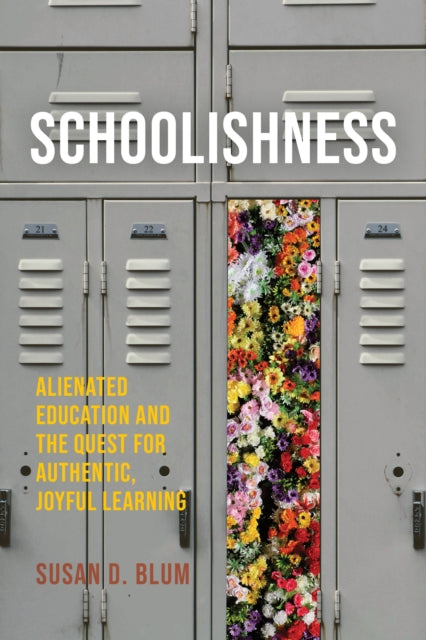
Schoolishness is a pedagogical approach that emphasizes packaged learning, unimaginative teaching, uniformity, constant evaluation, arbitrary forms, predetermined time, and artificial boundaries, leading to personal and educational alienation, dependence, and dread. Susan D. Blum proposes less-schoolish ways of learning in ten dimensions to lessen the mismatch between learning in school and learning in the wild.
Format: Hardback
Length: 426 pages
Publication date: 29 April 2024
Publisher: Cornell University Press
Schoolishness: A Journey of Educational Practices
Susan D. Blum's latest book, "Schoolishness: A Journey of Educational Practices," delves into the concept of schoolishness, which she defines as educational practices that prioritize packaged learning, unimaginative teaching, uniformity, constant evaluation by others, arbitrary forms, predetermined time, and artificial boundaries. These practices lead to personal and educational alienation, dependence, and dread. Blum draws on critical, progressive, and feminist pedagogy, as well as the anthropology of learning, to propose less-schoolish ways of learning in ten dimensions. She compares the fake learning of schoolishness with successful examples of authentic learning, including in her own courses, which she scrutinizes critically.
Schoolishness is not a pedagogical how-to book, but a theory-based phenomenology of institutional education. It offers moral, psychological, and educational arguments against schoolishness that resonate with foolishness. Blum's book challenges the notion that learning is our human superpower and explores why it is so difficult to accomplish in school.
In each chapter, Blum compares the fake learning of schoolishness with successful examples of authentic learning, including in her own courses. She highlights the importance of critical thinking, creativity, and self-directed learning in authentic learning environments. Blum argues that schoolishness limits students' potential and prevents them from reaching their full potential.
One of the key arguments in "Schoolishness" is that schoolishness is a result of the industrialization of education. The education system has been designed to produce workers who can fit into the existing economic system, rather than nurturing individuals who can think critically and creatively. Blum argues that this approach to education is outdated and ineffective and that it needs to be replaced with a more holistic and student-centered approach.
To address schoolishness, Blum proposes a range of strategies. She suggests that schools should focus on developing students' critical thinking skills, creativity, and self-directed learning. She also suggests that schools should be more flexible and adaptable, allowing students to learn at their own pace and in their own way.
Blum also argues that schools should be more inclusive and diverse. She suggests that schools should work to create a sense of belonging and community among students, regardless of their background or identity. She also suggests that schools should provide support for students who are struggling with learning or other issues.
In addition to her theoretical arguments, Blum provides practical examples of how to implement these strategies in schools. She shares stories of teachers and students who have successfully implemented less-schoolish practices in their classrooms. She also provides resources and tools for teachers and parents to use to support their children's learning.
One of the strengths of "Schoolishness" is its ability to make complex educational issues accessible to a wide audience. Blum's writing is clear and engaging, and she uses a range of examples and anecdotes to illustrate her points. She also provides a comprehensive list of resources and tools for teachers and parents to use to support their children's learning.
However, some critics have argued that "Schoolishness" is too focused on the negative aspects of schoolishness and that it does not offer enough solutions. They argue that schoolishness is a complex issue that requires a range of solutions, and that Blum's approach is too simplistic.
In response to these criticisms, Blum argues that schoolishness is a complex issue that requires a range of solutions. She suggests that schools should be more flexible and adaptable, allowing students to learn at their own pace and in their own way. She also suggests that schools should be more inclusive and diverse, providing support for students who are struggling with learning or other issues.
In conclusion, "Schoolishness: A Journey of Educational Practices" is a thought-provoking and important book that challenges the notion that learning is our human superpower and explores why it is so difficult to accomplish in school. Blum's theory-based phenomenology of institutional education offers moral, psychological, and educational arguments against schoolishness that resonate with foolishness. Her practical examples of how to implement these strategies in schools provide a valuable resource for teachers and parents. While some critics have argued that "Schoolishness" is too focused on the negative aspects of schoolishness and that it does not offer enough solutions, Blum's approach is a valuable contribution to the field of education.
Weight: 907g
Dimension: 229 x 152 (mm)
ISBN-13: 9781501774188
This item can be found in:
UK and International shipping information
UK and International shipping information
UK Delivery and returns information:
- Delivery within 2 - 3 days when ordering in the UK.
- Shipping fee for UK customers from £2.39. Fully tracked shipping service available.
- Returns policy: Return within 30 days of receipt for full refund.
International deliveries:
Shulph Ink now ships to Australia, Belgium, Canada, France, Germany, Ireland, Italy, India, Luxembourg Saudi Arabia, Singapore, Spain, Netherlands, New Zealand, United Arab Emirates, United States of America.
- Delivery times: within 5 - 10 days for international orders.
- Shipping fee: charges vary for overseas orders. Only tracked services are available for most international orders. Some countries have untracked shipping options.
- Customs charges: If ordering to addresses outside the United Kingdom, you may or may not incur additional customs and duties fees during local delivery.