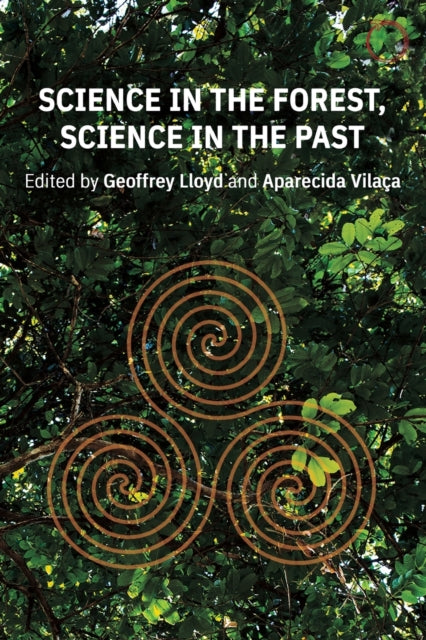
Geoffrey E. R. Lloyd,Aparecida Vilaca,Aparecida Vilaca
Science in the Forest, Science in the Past
Science in the Forest, Science in the Past
YOU SAVE £2.11
- Condition: Brand new
- UK Delivery times: Usually arrives within 2 - 3 working days
- UK Shipping: Fee starts at £3.89. Subject to product weight & dimension
Bulk ordering. Want 15 or more copies? Get a personalised quote and bigger discounts. Learn more about bulk orders.
Couldn't load pickup availability
- More about Science in the Forest, Science in the Past
This collection brings together leading anthropologists, historians, philosophers, and artificial-intelligence researchers to discuss the sciences and mathematics used in various Eastern, Western, and Indigenous societies, both ancient and contemporary. The authors analyze prevailing assumptions about these societies and propose more faithful, sensitive analyses of their ontological views about reality—a step toward mutual understanding and translatability across cultures and research fields.
Format: Paperback / softback
Length: 290 pages
Publication date: 22 January 2021
Publisher: HAU Society Of Ethnographic Theory
This groundbreaking collection brings together a diverse group of esteemed anthropologists, historians, philosophers, and artificial intelligence researchers, who have come together to explore the rich tapestry of sciences and mathematics used in various Eastern, Western, and Indigenous societies, both ancient and contemporary. The authors embark on a critical examination of prevailing assumptions about these societies and boldly propose more faithful, nuanced interpretations of their ontological views about reality. By undertaking this audacious endeavor, the authors aim to foster a deeper understanding and mutual appreciation between cultures and research fields, ultimately paving the way for the translation and application of knowledge across boundaries.
Science in the Forest, Science in the Past is a groundbreaking interdisciplinary exploration that will revolutionize the way readers interested in sciences, mathematics, humanities, social research, computer sciences, and education perceive deeply ingrained notions of what constitutes reality, how it is perceived, and how to investigate it.
This groundbreaking collection brings together a diverse group of esteemed anthropologists, historians, philosophers, and artificial intelligence researchers, who have come together to explore the rich tapestry of sciences and mathematics used in various Eastern, Western, and Indigenous societies, both ancient and contemporary. The authors embark on a critical examination of prevailing assumptions about these societies and boldly propose more faithful, nuanced interpretations of their ontological views about reality. By undertaking this audacious endeavor, the authors aim to foster a deeper understanding and mutual appreciation between cultures and research fields, ultimately paving the way for the translation and application of knowledge across boundaries.
The book is organized into four distinct sections, each dedicated to exploring a different aspect of the interdisciplinary inquiry. In the first section, titled "Science in the Forest," the authors delve into the historical and cultural contexts in which various Eastern, Western, and Indigenous societies have developed their scientific and mathematical traditions. They examine the philosophical foundations, theoretical frameworks, and practical applications of these traditions, highlighting the unique contributions and challenges they face.
In the second section, titled "Science in the Past," the authors explore the ways in which scientific and mathematical knowledge has been preserved, transmitted, and interpreted over time. They examine the role of ancient texts, artifacts, and oral traditions in shaping our understanding of the past and the challenges associated with reconstructing historical narratives. The authors also discuss the ethical considerations involved in studying historical scientific and mathematical practices and the potential biases and limitations of contemporary interpretations.
In the third section, titled "Science in the Present," the authors examine the contemporary applications of scientific and mathematical knowledge in various fields, including medicine, technology, environmental science, and social research. They explore the ethical implications of these applications, the potential benefits and risks they pose, and the ways in which they can be used to promote social justice and equity. The authors also discuss the challenges associated with interdisciplinary research and the need for collaboration across different research fields.
In the final section, titled "Science in the Future," the authors speculate on the potential directions and developments in the field of scientific and mathematical research. They discuss the role of emerging technologies, such as artificial intelligence and machine learning, in shaping the future of scientific inquiry and the ethical considerations associated with their use. The authors also explore the role of education in promoting scientific literacy and the importance of interdisciplinary collaboration in addressing complex global challenges.
Throughout the book, the authors engage in a rigorous and thoughtful exploration of the complex interplay between science, mathematics, culture, and society. They challenge readers to think critically about prevailing assumptions and propose new ways of understanding the world around us. The book is filled with insightful anecdotes, case studies, and theoretical frameworks that will appeal to a wide range of readers, including students, scholars, researchers, and anyone interested in the intersection of science, mathematics, and human experience.
In conclusion, Science in the Forest, Science in the Past is a groundbreaking interdisciplinary exploration that will revolutionize the way we think about science, mathematics, culture, and society. By bringing together a diverse group of experts from different fields, the authors challenge prevailing assumptions and propose new ways of understanding the world around us. The book is a valuable resource for students, scholars, researchers, and anyone interested in the intersection of science, mathematics, and human experience.
Weight: 448g
Dimension: 215 x 142 x 17 (mm)
ISBN-13: 9781912808410
UK and International shipping information
UK and International shipping information
We deliver throughout the United Kingdom and to 128 countries and territories worldwide, including the United States, Australia, Canada, Germany, Spain and France.