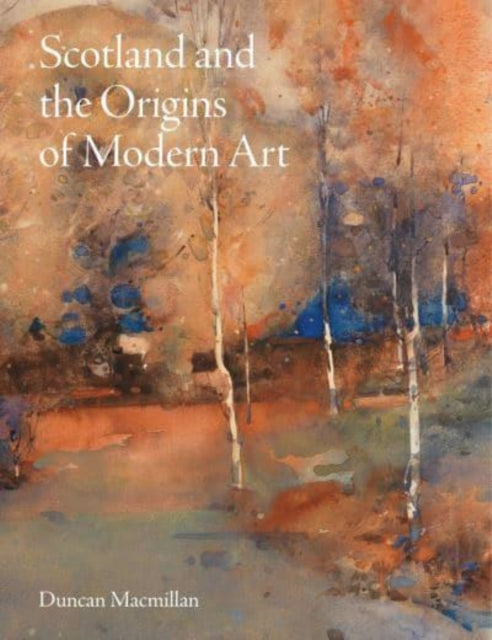
Duncan Macmillan
Scotland and the Origins of Modern Art
Scotland and the Origins of Modern Art
💎 Earn 206 Points (£2.06) on this item.
YOU SAVE £8.70
- Condition: Brand new
- UK Delivery times: Usually arrives within 2 - 3 working days
- UK Shipping: Fee starts at £2.39. Subject to product weight & dimension
Bulk ordering. Want 15 or more copies? Get a personalised quote and bigger discounts. Learn more about bulk orders.
Couldn't load pickup availability
- More about Scotland and the Origins of Modern Art
The eighteenth-century Scottish philosophy of moral sense played a central role in shaping ideas explored by figures such as Cézanne and Monet over one hundred years later, according to "Scotland and the Origins of Modern Art". The philosophy of moral sense argued that sensibility, not reason, was the basis of morality and that the imagination flourished more freely in the primitive history of humanity. This idea became a potent inspiration for artists, who should unlearn what they have learned and record their raw sensations rather than the perceptions that derive from them. The book explores the work of key philosophical and artistic protagonists during Enlightenment in Scotland that provided the blueprint for modernism.
Format: Hardback
Length: 256 pages
Publication date: 10 March 2023
Publisher: Lund Humphries Publishers Ltd
A profound exploration into the realms of sensibility, sensation, perception, and painting, Scotland and the Origins of Modern Art delves into the intricate connections between eighteenth-century Scottish philosophy and the revolutionary ideas explored by artists like Cézanne and Monet over a century later. The author argues that the philosophy of moral sense, which posited that sensibility, not reason, was the foundation of morality, gave rise to the notion of the supremacy of the imagination. This idea, coupled with the belief that the imagination thrived more freely in the primitive history of humanity, became a powerful inspiration for artists.
Furthermore, the author highlights Thomas Reid's method in his philosophy of common sense, which employs art and artists to illustrate how perception and expression are intuitive. According to Reid, artists should unlearn what they have learned and record their raw sensations rather than the perceptions that arise from them. By examining the work of key philosophical and artistic protagonists, this thought-provoking book uncovers the fascinating exchanges between art, philosophy, and literature during the Enlightenment in Scotland that laid the groundwork for modernism.
The book explores the influence of Scottish philosophy on the development of modern art, particularly in the works of artists such as Cézanne, Monet, and David Hockney. It argues that the Scottish Enlightenment's emphasis on the importance of sensibility and the imagination influenced these artists' approach to painting, resulting in a new emphasis on subjective experience and the representation of the natural world.
One of the key themes of the book is the idea of the "supremacy of the imagination." According to the author, the Scottish philosophy of moral sense emphasized the importance of the imagination as a source of knowledge and creativity. This idea was in contrast to the rationalist approach of the French Enlightenment, which placed greater emphasis on reason and logic.
The book also explores the role of art in shaping perception and expression. It argues that art can be used to challenge and subvert traditional ideas about the world, and to create new ways of understanding and experiencing the world. The author suggests that artists should strive to record their raw sensations and emotions rather than relying on the perceptions and interpretations of others.
Another important theme of the book is the relationship between art, philosophy, and literature during the Enlightenment in Scotland. The author argues that these three disciplines were closely interconnected, and that the ideas and debates of one discipline often influenced the others. For example, the Scottish philosopher David Hume influenced the development of literary theory and criticism, while the works of Scottish painters such as John Knox and William Etty were influenced by the philosophical ideas of the Scottish Enlightenment.
The book also provides a detailed account of the Scottish Enlightenment, including its key figures, ideas, and institutions. It explores the influence of Scottish thinkers.
In conclusion, Scotland and the Origins of Modern Art is a groundbreaking work that provides a fresh perspective on the relationship between eighteenth-century Scottish philosophy and the development of modern art. By exploring the work of key philosophical and artistic protagonists, the book uncovers the fascinating exchanges between art, philosophy, and literature during the Enlightenment in Scotland that laid the groundwork for modernism. The book's emphasis on the importance of sensibility, the imagination, and the relationship between art, philosophy, and literature offers a valuable insight into the origins.
Weight: 1082g
Dimension: 258 x 198 x 25 (mm)
ISBN-13: 9781848226333
UK and International shipping information
UK and International shipping information
UK Delivery and returns information:
- Delivery within 2 - 3 days when ordering in the UK.
- Shipping fee for UK customers from £2.39. Fully tracked shipping service available.
- Returns policy: Return within 30 days of receipt for full refund.
International deliveries:
Shulph Ink now ships to Australia, Belgium, Canada, France, Germany, Ireland, Italy, India, Luxembourg Saudi Arabia, Singapore, Spain, Netherlands, New Zealand, United Arab Emirates, United States of America.
- Delivery times: within 5 - 10 days for international orders.
- Shipping fee: charges vary for overseas orders. Only tracked services are available for most international orders. Some countries have untracked shipping options.
- Customs charges: If ordering to addresses outside the United Kingdom, you may or may not incur additional customs and duties fees during local delivery.