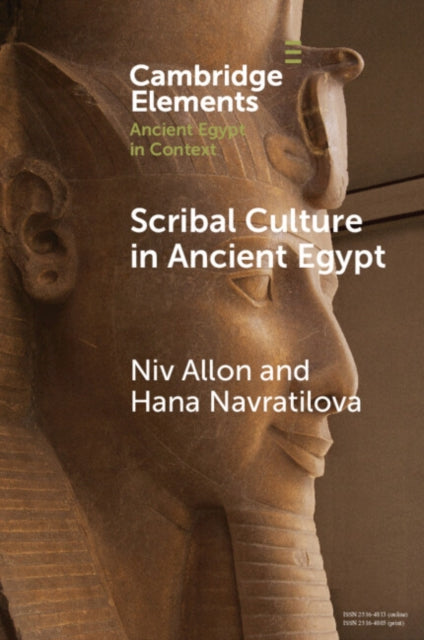
NivAllon,HanaNavratilova
Scribal Culture in Ancient Egypt
Scribal Culture in Ancient Egypt
💎 Earn 84 Points (£0.84) on this item.
YOU SAVE £1.01
- Condition: Brand new
- UK Delivery times: Usually arrives within 2 - 3 working days
- UK Shipping: Fee starts at £2.39. Subject to product weight & dimension
Bulk ordering. Want 15 or more copies? Get a personalised quote and bigger discounts. Learn more about bulk orders.
Couldn't load pickup availability
- More about Scribal Culture in Ancient Egypt
This Element explores the scribal culture in ancient Egypt by examining textual acts such as writing, list-making, drawing, and copying, using texts, material objects, and archeological evidence. It addresses key themes in the study of this culture, building on current discussions in literacy, literary, and social history.
Format: Paperback / softback
Length: 90 pages
Publication date: 21 December 2023
Publisher: Cambridge University Press
The ancient Egyptian scribal culture was characterized by a wide range of textual acts that played a central role in the society. These acts included writing, list-making, drawing, and copying. By examining a variety of sources, including texts, material objects, and archaeological evidence, this element seeks to explore the key themes at the heart of the study of ancient Egypt. It will also build upon current discussions in literacy, literary studies, and social history, providing a comprehensive understanding of the scribal culture and its significance in ancient Egypt.
Writing was a fundamental aspect of the scribal culture in ancient Egypt. Scribes were responsible for recording and preserving the vast amount of information that was necessary for the functioning of the Egyptian government, religion, and society. They used a variety of writing systems, including hieroglyphics, hieratic, and demotic, to create documents that ranged from official records to religious texts. Writing was not just a means of communication but also a tool for recording history, preserving cultural traditions, and passing on knowledge.
List-making was another important textual act in ancient Egypt. Scribes used lists to record a wide range of information, including names, dates, quantities, and measurements. Lists were used in many different contexts, including administrative records, religious texts, and tomb inscriptions. They were also used to organize and categorize information, making it easier to retrieve and analyze.
Drawing was another important textual act in ancient Egypt. Scribes used drawings to represent a wide range of objects and concepts, including animals, people, buildings, and religious symbols. Drawings were used in many different contexts, including tomb inscriptions, temple decorations, and papyrus scrolls. They were also used to communicate complex ideas and concepts that could not be expressed through words alone.
Copying was another important textual act in ancient Egypt. Scribes used copying to create new documents and preserve existing ones. They used a variety of techniques, including tracing and rubbing, to create copies of documents that were accurate and legible. Copying was not just a means of preserving information but also a way of ensuring that knowledge was passed down from generation to generation.
The scribal culture in ancient Egypt was deeply intertwined with other aspects of Egyptian society, including religion, government, and art. Scribes played a crucial role in the development of Egyptian writing systems, the preservation of religious texts, and the administration of the Egyptian government. They also played a significant role in the development of Egyptian art, as they were responsible for creating and preserving the many works of art that have survived to this day.
In conclusion, the scribal culture in ancient Egypt was characterized by a wide range of textual acts that played a central role in the society. Writing, list-making, drawing, and copying were all important forms of communication and record-keeping that were used to preserve and pass on knowledge and cultural traditions. The scribal culture was deeply intertwined with other aspects of Egyptian society, and its significance cannot be overstated. By examining a variety of sources, including texts, material objects, and archaeological evidence, this element seeks to provide a comprehensive understanding of the scribal culture and its significance in ancient Egypt.
Weight: 144g
ISBN-13: 9781009074537
This item can be found in:
UK and International shipping information
UK and International shipping information
UK Delivery and returns information:
- Delivery within 2 - 3 days when ordering in the UK.
- Shipping fee for UK customers from £2.39. Fully tracked shipping service available.
- Returns policy: Return within 30 days of receipt for full refund.
International deliveries:
Shulph Ink now ships to Australia, Belgium, Canada, France, Germany, Ireland, Italy, India, Luxembourg Saudi Arabia, Singapore, Spain, Netherlands, New Zealand, United Arab Emirates, United States of America.
- Delivery times: within 5 - 10 days for international orders.
- Shipping fee: charges vary for overseas orders. Only tracked services are available for most international orders. Some countries have untracked shipping options.
- Customs charges: If ordering to addresses outside the United Kingdom, you may or may not incur additional customs and duties fees during local delivery.