Ahsan I. Butt
Secession and Security: Explaining State Strategy against Separatists
Secession and Security: Explaining State Strategy against Separatists
💎 Earn 66 Points (£0.66) on this item.
We can order this item for you. Delivery usually takes about 4 to 6 weeks.
This item is not held in our immediate stock. We will order it for you after checkout.
Estimated delivery: About 4 to 6 weeks
YOU SAVE £1.73
- Condition: Brand new
- UK Delivery times: Usually arrives within 2 - 3 working days
- UK Shipping: Fee starts at £3.89. Subject to product weight & dimension
Bulk ordering. Want 15 or more copies? Get a personalised quote and bigger discounts. Learn more about bulk orders.
Couldn't load pickup availability
- More about Secession and Security: Explaining State Strategy against Separatists
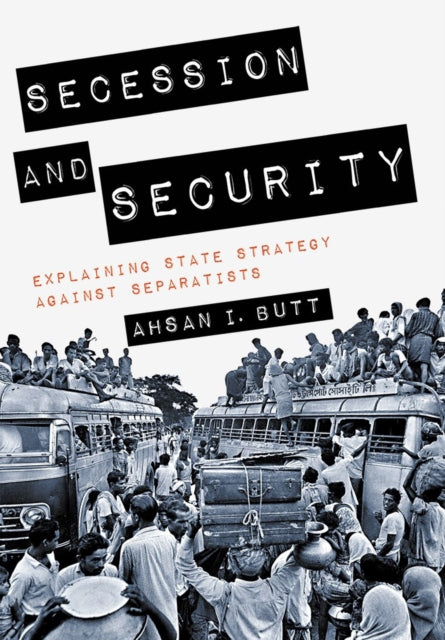
States, not separatists, determine the peacefulness, violence, or genocidal nature of a secessionist struggle, as argued by Ahsan I. Butt in his book "Secession and Security." He explores how states respond to separatist movements, including negotiated concessions, repression, and genocide, influenced by external security factors. The book focuses on two main cases: Pakistani reactions to Bengali and Baloch independence demands in the 1970s and India's responses to secessionist movements in Kashmir, Punjab, and Assam in the 1980s and 1990s.
\n Format: Paperback / softback
\n Length: 308 pages
\n Publication date: 15 June 2021
\n Publisher: Cornell University Press
\n
In his book "Secession and Security," Ahsan I. Butt makes a compelling argument that it is the states, rather than the separatists, that ultimately determine the nature of a secessionist struggle. He delves into the diverse strategies employed by states in response to separatist movements, encompassing a range of approaches from negotiated concessions to severe repression. Butt explores how variations in the external security environment influence the decisions made by state leaders, shaping their responses to different separatist movements.
He provides insightful examples of how these dynamics played out in historical contexts. For instance, in 1908, the Ottoman Empire employed peaceful concessions against Armenians in response to their demands for independence. However, in 1915, the same community faced genocide at the hands of the Ottoman Empire. Similarly, in the 1990s, Israel rejected the establishment of a Palestinian state, while in 1993, peaceful splits occurred in Czechoslovakia and the Norway-Sweden union.
Butt's book is particularly focused on two main cases: Pakistani reactions to Bengali and Baloch demands for independence in the 1970s and India's responses to secessionist movements in Kashmir, Punjab, and Assam in the 1980s and 1990s. By employing a deep historical approach, Butt offers valuable insights into the complex dynamics of secessionist struggles and their impact on regional and global politics.
This book will appeal to policymakers, observers, and scholars interested in the last five decades of geopolitics in South Asia, the contemporary Israeli-Palestinian conflict, and ethno-national conflict, separatism, and nationalism more broadly. It provides a comprehensive analysis of the factors that shape state responses to separatist movements and sheds light on the potential outcomes of such conflicts.
\n Weight: 474g\n
Dimension: 151 x 227 x 22 (mm)\n
ISBN-13: 9781501755217\n \n
UK and International shipping information
UK and International shipping information
We deliver throughout the United Kingdom and to 128 countries and territories worldwide, including the United States, Australia, Canada, Germany, Spain and France.