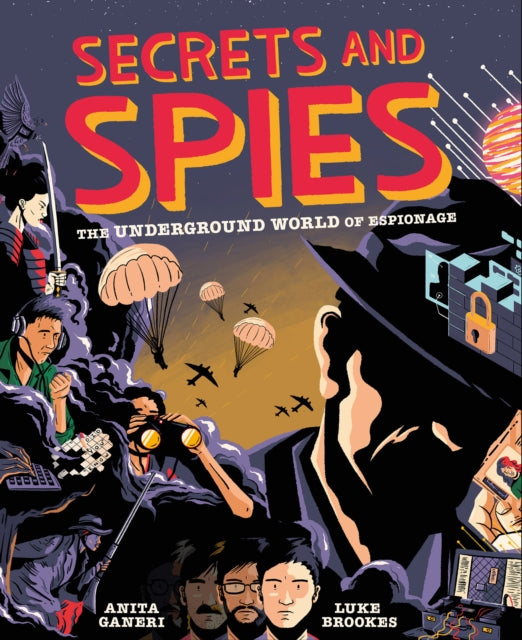
Anita Ganeri,Luke Brookes
Secrets and Spies
Secrets and Spies
💎 Earn 70 Points (£0.70) on this item.
YOU SAVE £5.84
- Condition: Brand new
- UK Delivery times: Usually arrives within 2 - 3 working days
- UK Shipping: Fee starts at £3.89. Subject to product weight & dimension
Bulk ordering. Want 15 or more copies? Get a personalised quote and bigger discounts. Learn more about bulk orders.
Couldn't load pickup availability
- More about Secrets and Spies
Espionage has a rich history, from ancient secret agents to modern-day surveillance, and involves reading codes and ciphers. Could you be a spy?
Format: Hardback
Length: 72 pages
Publication date: 02 September 2021
Publisher: Little Tiger Press Group
Espionage has been a part of human history for thousands of years, with secret agents and covert operations playing a crucial role in shaping the world's events. From ancient secret agents to modern-day surveillance, espionage has evolved to become a complex and sophisticated field. In this article, we will explore the history of espionage, the lives of infamous spies, and the language of spies.
Ancient Secret Agents:
The first recorded secret agents were employed by the ancient Egyptians, who used them to gather information about their enemies and to protect their kingdom. These agents were known as "spies" and were often sent on dangerous missions to gather information about enemy armies, fortifications, and political leaders. The Egyptians were particularly skilled at using codes and ciphers to protect their messages, and their spies were often able to infiltrate enemy camps and gather valuable intelligence.
During the Middle Ages, espionage became more widespread, with various European countries employing spies to gather information about their rivals. The Spanish Inquisition, for example, used spies to track down heretics and to gather information about the Catholic Church. The French and English also employed spies to gather information about their enemies during the Hundred Years' War.
In the 19th century, espionage became even more sophisticated, with the development of the telegraph and the telephone. These technologies allowed spies to communicate with their handlers in real-time, and they were able to gather information about enemy movements and plans in a much more efficient manner. The British Empire, for example, employed a vast network of spies to gather information about its enemies in India, Africa, and the Middle East.
Modern-Day Surveillance:
In the modern era, espionage has become even more important, with the rise of terrorism and other forms of crime. Governments around the world have invested heavily in surveillance technologies to monitor their citizens and to prevent terrorist attacks. These technologies include surveillance cameras, drones, and facial recognition software.
However, the use of surveillance technologies has also raised concerns about privacy and civil liberties. Many people argue that the use of surveillance technologies is a violation of their rights, and that it can be used to target individuals for political or social reasons.
In response to these concerns, some governments have implemented laws to regulate the use of surveillance technologies. For example, the United States has the Foreign Intelligence Surveillance Act (FISA), which governs the use of surveillance technologies by the government.
Lives of Infamous Spies:
Throughout history, there have been many famous spies who have made significant contributions to the field of espionage. Some of the most famous spies include:
James Bond: James Bond is a fictional character created by Ian Fleming, who has appeared in numerous books and movies. Bond is a British spy who is known for his daring missions, his ability to use weapons, and his ability to seduce women. Bond has been involved in many espionage missions, including the capture of Dr. No, the destruction of the GoldenEye satellite, and the rescue of the British Prime Minister.
John le Carré: John le Carré is a British author who has written many novels about espionage. His most famous novel is The Spy Who Came in from the Cold, which is about a British spy who is sent to East Germany to gather information about the Soviet Union. Le Carré's novels are known for their detailed descriptions of the espionage world and for their complex characters.
Edward Snowden: Edward Snowden is a former National Security Agency (NSA) contractor who leaked classified information about the NSA's surveillance programs to the media. Snowden's leaks have caused a major controversy, and he has been charged with espionage and other crimes.
Espionage Language:
Espionage has its own language, which is used to communicate with other spies and to protect information. This language includes codes and ciphers, which are used to encrypt and decrypt messages. Codes and ciphers can be very complex, and they require a high level of skill to use.
To learn the language of spies, you can take courses or read books. There are many online resources available that can help you learn the language of spies.
Could You Be a Spy?
The question of whether you could be a spy is a difficult one to answer. While some people have a natural talent for espionage, most people need to undergo training to become a spy. Training typically includes physical training, intelligence training, and language training.
Physical training includes training in weapons, hand-to-hand combat, and physical fitness. Intelligence training includes training in intelligence analysis, surveillance, and counterintelligence. Language training includes training in the language of spies.
If you are interested in becoming a spy, you should start by researching the field. You can read books, watch movies, and attend conferences. You should also consider taking courses or joining a spy organization.
Conclusion:
Espionage has been a part of human history for thousands of years, with secret agents and covert operations playing a crucial role in shaping the world's events. From ancient secret agents to modern-day surveillance, espionage has evolved to become a complex and sophisticated field. In this article, we have explored the history of espionage, the lives of infamous spies, and the language of spies.
While espionage can be a dangerous and exciting field, it is also important to remember that it is illegal and can have serious consequences. If you are interested in becoming a spy, you should start by researching the field and by undergoing training.
Weight: 790g
Dimension: 268 x 328 x 13 (mm)
ISBN-13: 9781838913618
UK and International shipping information
UK and International shipping information
We deliver throughout the United Kingdom and to 128 countries and territories worldwide, including the United States, Australia, Canada, Germany, Spain and France.