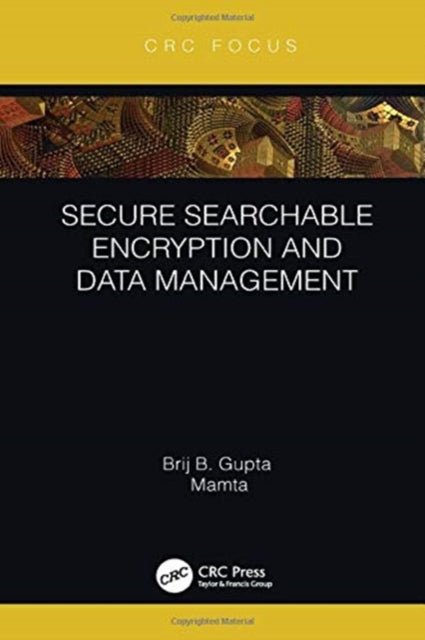
Brij B.Gupta,Mamta
Secure Searchable Encryption and Data Management
Secure Searchable Encryption and Data Management
💎 Earn 245 Points (£2.45) on this item.
We can order this item for you. Delivery usually takes about 4 to 6 weeks.
This item is not held in our immediate stock. We will order it for you after checkout.
Estimated delivery: About 4 to 6 weeks
YOU SAVE £2.91
- Condition: Brand new
- UK Delivery times: Usually arrives within 2 - 3 working days
- UK Shipping: Fee starts at £2.39. Subject to product weight & dimension
Bulk ordering. Want 15 or more copies? Get a personalised quote and bigger discounts. Learn more about bulk orders.
Couldn't load pickup availability
- More about Secure Searchable Encryption and Data Management
The growth of data has led to the development of cloud technology, which is important for data management. However, there are privacy concerns when storing sensitive data on third-party servers. Searchable encryption addresses these issues by allowing for secure and searchable encryption of data. This book provides the necessary details to develop such a scheme.
\n Format: Hardback
\n Length: 100 pages
\n Publication date: 16 March 2021
\n Publisher: Taylor & Francis Ltd
\n
The IT revolution has brought about a remarkable increase in the volume of data produced, with no signs of slowing down. While this data abundance may seem overwhelming, it holds immense value and requires careful management. Cloud technology has emerged as a crucial tool in data management, offering numerous advantages such as scalability, accessibility, and cost-effectiveness. However, alongside these benefits, concerns about privacy have arisen, particularly when it comes to storing sensitive data on third-party servers. To address these concerns, encryption has become a popular solution. While encryption provides a high level of security, it also introduces challenges, such as the inability to perform fundamental search operations on encrypted data and reduced flexibility when sharing data with others.
Searchable encryption is a concept that aims to address these issues. This book provides a comprehensive guide for developing secure, searchable encryption schemes using both symmetric and asymmetric cryptographic primitives, along with the appropriate security models to meet the minimum security requirements for real-world applications.
In Chapter 1, the authors introduce the basics of encryption and its importance in data security. They discuss the various encryption algorithms, such as symmetric key algorithms (e.g., AES) and asymmetric key algorithms (e.g., RSA), and their strengths and weaknesses. The authors also introduce the concept of key management, which is crucial in ensuring the security of encrypted data.
Chapter 2 delves into the development of searchable encryption schemes. The authors discuss the challenges associated with traditional encryption, such as the inability to perform search operations on encrypted data. They then introduce the concept of searchable encryption, which allows for the selective retrieval of specific data while maintaining the confidentiality of the rest of the data. The authors explore different approaches to searchable encryption, including keyword-based encryption, content-based encryption, and attribute-based encryption.
Chapter 3 focuses on the security models used in searchable encryption. The authors discuss the importance of security models in ensuring the confidentiality, integrity, and availability of encrypted data. They introduce the concept of attribute-based access control (ABAC), which is a powerful model for managing access to encrypted data based on attributes such as user identity, location, and time. The authors also discuss other security models, such as role-based access control (RBAC) and multi-factor authentication (MFA).
Chapter 4 discusses the implementation of searchable encryption schemes. The authors provide detailed instructions on how to develop secure, searchable encryption schemes using both symmetric and asymmetric cryptographic primitives. They discuss the key generation process, the encryption process, and the decryption process. The authors also provide examples of real-world applications of searchable encryption, such as secure messaging, secure file sharing, and secure cloud storage.
Chapter 5 concludes the book by discussing the future of searchable encryption. The authors predict that searchable encryption will become increasingly important in the future as the volume of data continues to grow. They discuss the challenges that will need to be addressed in the development of searchable encryption schemes, such as scalability, performance, and usability. The authors also suggest potential research directions that can be conducted in the field of searchable encryption to further enhance its security and usability.
In conclusion, this book provides a comprehensive guide to developing secure, searchable encryption schemes using both symmetric and asymmetric cryptographic primitives, along with the appropriate security models to meet the minimum security requirements for real-world applications. The book covers the basics of encryption, searchable encryption, security models, implementation, and future directions. It is an essential resource for researchers, developers, and practitioners in the field of data security.
The IT revolution has brought about a remarkable increase in the volume of data produced, with no signs of slowing down. While this data abundance may seem overwhelming, it holds immense value and requires careful management. Cloud technology has emerged as a crucial tool in data management, offering numerous advantages such as scalability, accessibility, and cost-effectiveness. However, alongside these benefits, concerns about privacy have arisen, particularly when it comes to storing sensitive data on third-party servers. To address these concerns, encryption has become a popular solution. While encryption provides a high level of security, it also introduces challenges, such as the inability to perform fundamental search operations on encrypted data and reduced flexibility when sharing data with others.
Searchable encryption is a concept that aims to address these issues. This book provides a comprehensive guide for developing secure, searchable encryption schemes using both symmetric and asymmetric cryptographic primitives, along with the appropriate security models to meet the minimum security requirements for real-world applications.
In Chapter 1, the authors introduce the basics of encryption and its importance in data security. They discuss the various encryption algorithms, such as symmetric key algorithms (e.g., AES) and asymmetric key algorithms (e.g., RSA), and their strengths and weaknesses. The authors also introduce the concept of key management, which is crucial in ensuring the security of encrypted data.
Chapter 2 delves into the development of searchable encryption schemes. The authors discuss the challenges associated with traditional encryption, such as the inability to perform search operations on encrypted data. They then introduce the concept of searchable encryption, which allows for the selective retrieval of specific data while maintaining the confidentiality of the rest of the data. The authors explore different approaches to searchable encryption, including keyword-based encryption, content-based encryption, and attribute-based encryption.
Chapter 3 focuses on the security models used in searchable encryption. The authors discuss the importance of security models in ensuring the confidentiality, integrity, and availability of encrypted data. They introduce the concept of attribute-based access control (ABAC), which is a powerful model for managing access to encrypted data based on attributes such as user identity, location, and time. The authors also discuss other security models, such as role-based access control (RBAC) and multi-factor authentication (MFA).
Chapter 4 discusses the implementation of searchable encryption schemes. The authors provide detailed instructions on how to develop secure, searchable encryption schemes using both symmetric and asymmetric cryptographic primitives. They discuss the key generation process, the encryption process, and the decryption process. The authors also provide examples of real-world applications of searchable encryption, such as secure messaging, secure file sharing, and secure cloud storage.
Chapter 5 concludes the book by discussing the future of searchable encryption. The authors predict that searchable encryption will become increasingly important in the future as the volume of data continues to grow. They discuss the challenges that will need to be addressed in the development of searchable encryption schemes, such as scalability, performance, and usability. The authors also suggest potential research that can be conducted in the field of searchable encryption to further enhance its security and usability.
In conclusion, this book provides a comprehensive guide to developing secure, searchable encryption schemes using both symmetric and asymmetric cryptographic primitives, along with the appropriate security models to meet the minimum security requirements for real-world applications. The book covers the basics of encryption, searchable encryption, security models, implementation, and future directions. It is an essential resource for researchers, developers, and practitioners in the field of data security.
\n Weight: 328g\n
Dimension: 158 x 242 x 13 (mm)\n
ISBN-13: 9780367619671\n \n
UK and International shipping information
UK and International shipping information
UK Delivery and returns information:
- Delivery within 2 - 3 days when ordering in the UK.
- Shipping fee for UK customers from £2.39. Fully tracked shipping service available.
- Returns policy: Return within 30 days of receipt for full refund.
International deliveries:
Shulph Ink now ships to Australia, Belgium, Canada, France, Germany, Ireland, Italy, India, Luxembourg Saudi Arabia, Singapore, Spain, Netherlands, New Zealand, United Arab Emirates, United States of America.
- Delivery times: within 5 - 10 days for international orders.
- Shipping fee: charges vary for overseas orders. Only tracked services are available for most international orders. Some countries have untracked shipping options.
- Customs charges: If ordering to addresses outside the United Kingdom, you may or may not incur additional customs and duties fees during local delivery.