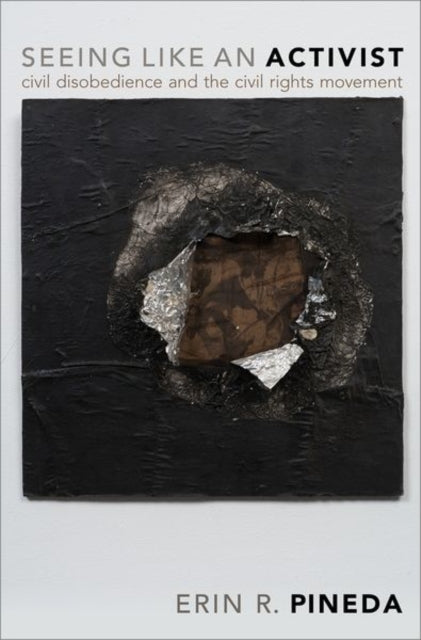
Erin R.Pineda
Seeing Like an Activist: Civil Disobedience and the Civil Rights Movement
Seeing Like an Activist: Civil Disobedience and the Civil Rights Movement
💎 Earn 127 Points (£1.27) on this item.
We can order this item for you. Delivery usually takes about 4 to 6 weeks.
This item is not held in our immediate stock. We will order it for you after checkout.
Estimated delivery: About 4 to 6 weeks
YOU SAVE £1.51
- Condition: Brand new
- UK Delivery times: Usually arrives within 2 - 3 working days
- UK Shipping: Fee starts at £2.39. Subject to product weight & dimension
Bulk ordering. Want 15 or more copies? Get a personalised quote and bigger discounts. Learn more about bulk orders.
Couldn't load pickup availability
- More about Seeing Like an Activist: Civil Disobedience and the Civil Rights Movement
The Civil Rights Movement is a well-known movement for civil disobedience, but this book argues that it is often misremembered and distorts our political judgments about how civil disobedience might fit into democratic politics. Erin R. Pineda shows how civil rights activists turned to civil disobedience as a practice of decolonization to emancipate themselves and others and transform the racial order.
\n Format: Paperback / softback
\n Length: 272 pages
\n Publication date: 05 October 2021
\n Publisher: Oxford University Press Inc
\n
The Civil Rights Movement is one of the most well-known movements associated with civil disobedience. In the popular view, civil rights activists avoided coercion, appealed to the majority's principles, and willingly accepted legal punishment to demand necessary legislative reforms and facilitate the realization of core constitutional and democratic principles. Their adherence to the spirit of the law, commitment to civility, and allegiance to American democracy set the normative standard for liberal philosophies of civil disobedience.
This narrative presents the Civil Rights Movement's civil disobedience as a moral exemplar: a blueprint for activists seeking transformative change and racial justice within the bounds of democracy. However, in this book, Erin R. Pineda argues that it more often functions as a disciplining example—a means of scolding activists and quieting dissent. Pineda contends that the familiar account of Civil Rights disobedience not only misremembers history but also distorts our political judgments about how civil disobedience might fit into democratic politics.
Seeing Like an Activist charts the emergence of this influential account of civil disobedience in the Civil Rights Movement and demonstrates its reliance on a narrative about black protest that is itself entangled with white supremacy. Liberal political theorists whose work informed decades of scholarship saw civil disobedience as a white state, taking for granted the legitimacy of the constitutional order, assuming as primary the ends of constitutional integrity and stability, centering the white citizen as the normative ideal, and figuring the problem of racial injustice as limited, exceptional, and all-but-already solved. Instead, this book sees civil disobedience from a different perspective.
Pineda argues that the Civil Rights Movement's civil disobedience was not just about achieving legal reforms but also about challenging the dominant narrative about black protest and white supremacy. The movement's activists sought to redefine the terms of the debate about racial justice and challenge the assumptions that undergirded the constitutional order. They recognized that the problem of racial injustice was not limited to a few exceptional cases but was a systemic issue that permeated every aspect of American society.
Pineda also shows how the Civil Rights Movement's civil disobedience was shaped by the broader social and political context of the time. The movement was a product of the civil rights struggle of the 1950s and 1960s, which was a time of intense social and political change. Activists were influenced by the Black Power movement, which emphasized the importance of black self-determination and the need to challenge white supremacy.
Furthermore, Pineda argues that the Civil Rights Movement's civil disobedience was not just about achieving legal reforms but also about building a broader social movement that could challenge the power of the white establishment. The movement's activists used nonviolent resistance and civil disobedience to draw attention to the issue of racial injustice and to put pressure on the government to take action.
In conclusion, the Civil Rights Movement's civil disobedience is a powerful example of how activists can use nonviolent resistance to challenge the dominant narrative about race and power. Pineda's book offers a fresh perspective on this movement, showing how it was not just about achieving legal reforms but also about challenging the assumptions that undergirded the constitutional order and building a broader social movement that could challenge the power of the white establishment. The movement's activists set a normative standard for civil disobedience, demonstrating that it can be a powerful tool for achieving transformative change and racial justice within the bounds of democracy.
\n Weight: 410g\n
Dimension: 155 x 235 x 25 (mm)\n
ISBN-13: 9780197526439\n \n
This item can be found in:
UK and International shipping information
UK and International shipping information
UK Delivery and returns information:
- Delivery within 2 - 3 days when ordering in the UK.
- Shipping fee for UK customers from £2.39. Fully tracked shipping service available.
- Returns policy: Return within 30 days of receipt for full refund.
International deliveries:
Shulph Ink now ships to Australia, Belgium, Canada, France, Germany, Ireland, Italy, India, Luxembourg Saudi Arabia, Singapore, Spain, Netherlands, New Zealand, United Arab Emirates, United States of America.
- Delivery times: within 5 - 10 days for international orders.
- Shipping fee: charges vary for overseas orders. Only tracked services are available for most international orders. Some countries have untracked shipping options.
- Customs charges: If ordering to addresses outside the United Kingdom, you may or may not incur additional customs and duties fees during local delivery.