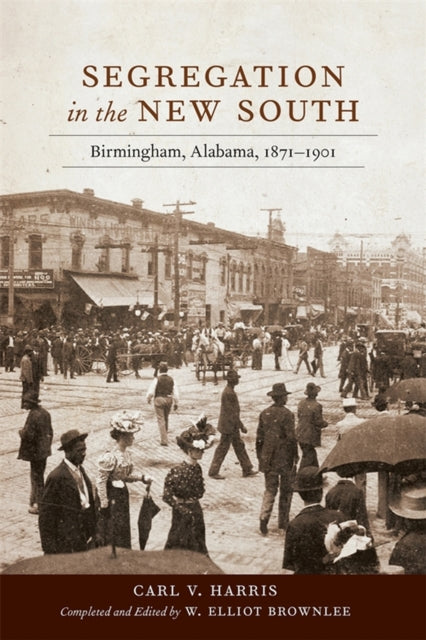
Carl V. Harris
Segregation in the New South: Birmingham, Alabama, 1871-1901
Segregation in the New South: Birmingham, Alabama, 1871-1901
💎 Earn 221 Points (£2.21) on this item.
YOU SAVE £2.63
- Condition: Brand new
- UK Delivery times: Usually arrives within 2 - 3 working days
- UK Shipping: Fee starts at £2.39. Subject to product weight & dimension
Bulk ordering. Want 15 or more copies? Get a personalised quote and bigger discounts. Learn more about bulk orders.
Couldn't load pickup availability
- More about Segregation in the New South: Birmingham, Alabama, 1871-1901
Segregation in the New South, by Carl V. Harris, explores the rise of racial exclusion in late nineteenth-century Birmingham, Alabama, where African Americans sought to assert their autonomy and equality, but southern whites worked to restore or invent new racial lines to guarantee Black subordination. Harris' history shows that southern whites engaged in a program of assigning social dishonor to African Americans, constructing the meaning of race in the New South.
Format: Hardback
Length: 300 pages
Publication date: 09 November 2022
Publisher: Louisiana State University Press
In the late 19th century, Birmingham, Alabama, experienced a surge in racial exclusion, a phenomenon explored in depth by Carl V. Harris' Segregation in the New South, completed and edited by W. Elliot Brownlee. During this period, African Americans in the crucial southern industrial city were driven by a desire to capitalize on the disarray of slavery's old racial lines, assert their newfound autonomy, and work towards achieving full equality. However, the majority of southern whites were committed to either restoring the restrictive racial boundaries of the antebellum South or creating new ones to ensure the subjugation of Black residents.
From Birmingham's founding in 1871, color lines became a defining feature of the city, shaping the lives of its inhabitants in profound ways. As individuals and communities grappled with the challenge of erasing or reinforcing these lines, they inadvertently laid the foundation for their future endeavors. Harris' work delves into the intricate social segregation that characterized the New South. He highlights how southern whites, driven by a desire to maintain their social dominance, embarked on a comprehensive program to assign social dishonor to African Americans. This process echoed the dishonor that whites of the Old South had imposed on Black people during slavery. By constructing the meaning of race in the New South, southern whites sought to reinforce their dominance and maintain the status quo.
The book offers a comprehensive analysis of the historical context and societal dynamics that contributed to the rise of racial exclusion in Birmingham. It sheds light on the strategies employed by southern whites to maintain segregation and control, including the use of violence, intimidation, and political manipulation. It also explores the resilience and resistance exhibited by African Americans in the face of discrimination, highlighting their contributions to the city's social and economic development.
Segregation in the New South serves as a valuable resource for scholars, educators, and anyone interested in understanding the complex history of race relations in the United States. It provides a detailed account of the struggles and triumphs of African Americans in the face of adversity, highlighting their contributions to the development of Birmingham and the broader New South. Through its exploration of the rise of racial exclusion, the book offers a cautionary tale about the dangers of perpetuating harmful stereotypes and discrimination. It serves as a reminder of the ongoing struggle for social justice and equality and the importance of challenging and dismantling systems of oppression.
In conclusion, Carl V. Harris' Segregation in the New South provides a comprehensive and insightful examination of the rise of racial exclusion in Birmingham, Alabama, during the late 19th century. Through its exploration of the social, political, and economic factors that shaped this period, the book offers a valuable contribution to our understanding of race relations in the United States. It serves as a reminder of the ongoing struggle for social justice and equality and the importance of challenging and dismantling systems of oppression.
Weight: 600g
Dimension: 158 x 236 x 30 (mm)
ISBN-13: 9780807178379
UK and International shipping information
UK and International shipping information
UK Delivery and returns information:
- Delivery within 2 - 3 days when ordering in the UK.
- Shipping fee for UK customers from £2.39. Fully tracked shipping service available.
- Returns policy: Return within 30 days of receipt for full refund.
International deliveries:
Shulph Ink now ships to Australia, Belgium, Canada, France, Germany, Ireland, Italy, India, Luxembourg Saudi Arabia, Singapore, Spain, Netherlands, New Zealand, United Arab Emirates, United States of America.
- Delivery times: within 5 - 10 days for international orders.
- Shipping fee: charges vary for overseas orders. Only tracked services are available for most international orders. Some countries have untracked shipping options.
- Customs charges: If ordering to addresses outside the United Kingdom, you may or may not incur additional customs and duties fees during local delivery.