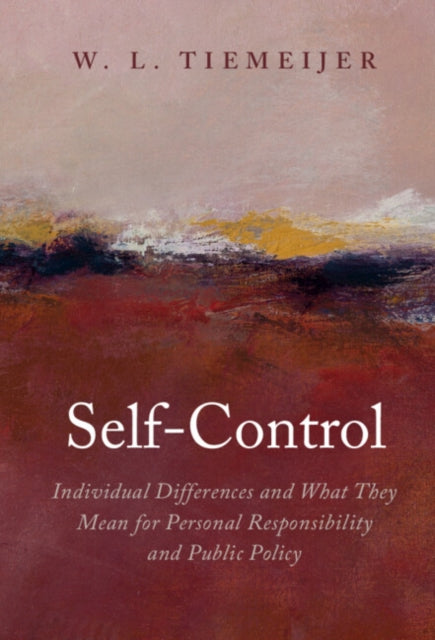
W. L.Tiemeijer
Self-Control: Individual Differences and What They Mean for Personal Responsibility and Public Policy
Self-Control: Individual Differences and What They Mean for Personal Responsibility and Public Policy
💎 Earn 155 Points (£1.55) on this item.
YOU SAVE £1.85
- Condition: Brand new
- UK Delivery times: Usually arrives within 2 - 3 working days
- UK Shipping: Fee starts at £2.39. Subject to product weight & dimension
Bulk ordering. Want 15 or more copies? Get a personalised quote and bigger discounts. Learn more about bulk orders.
Couldn't load pickup availability
- More about Self-Control: Individual Differences and What They Mean for Personal Responsibility and Public Policy
Good self-control is essential for life outcomes, but social theory and politics have not caught up. This book shows that beliefs about unlimited self-control are mistaken and presents research on self-control's implications for moral responsibility, distributive justice, and public policy. It suggests that the growing emphasis on personal responsibility in politics is problematic and outlines alternatives that are more in accord with human psychology.
Format: Hardback
Length: 368 pages
Publication date: 08 September 2022
Publisher: Cambridge University Press
Good self-control is a vital factor in determining life outcomes, spanning from academic and professional success to mental and physical well-being and fulfilling romantic relationships. While psychologists have made significant strides in understanding this essential trait in recent decades, social theory and politics have yet to fully embrace its significance. Many scholars and policymakers still hold the misguided belief that individuals possess an unlimited capacity for self-control and that maintaining discipline is solely a matter of willpower. This book aims to challenge these misconceptions by presenting the latest research on self-control, exploring why it has been largely overlooked, and discussing its profound implications for moral responsibility, distributive justice, and public policy. It demonstrates that the growing emphasis on personal responsibility in politics is problematic and offers alternative approaches that align more with human psychology.
Self-control is a complex trait that involves the ability to regulate one's emotions, thoughts, and behaviors in response to internal and external stimuli. It plays a crucial role in shaping our lives and determining our success, happiness, and overall well-being. Research on self-control has shown that it is a multi-faceted construct that involves various cognitive, emotional, and physiological processes.
One of the key findings in self-control research is that it is not an innate trait but rather a skill that can be developed and improved through practice. Individuals can learn to exercise self-control by developing strategies and habits that promote self-regulation and self-monitoring. For example, practicing mindfulness meditation can help individuals develop greater awareness of their thoughts and emotions, which can in turn help them regulate their behavior more effectively.
Another important aspect of self-control is its relationship to moral responsibility. Research has shown that individuals with good self-control are more likely to exhibit prosocial behavior, such as helping others, volunteering, and engaging in charitable activities. This suggests that self-control is not just a personal trait but also has implications for social and collective well-being.
However, the development and exercise of self-control can be challenging, especially in the face of temptation and external pressures. One of the main challenges is the availability of high-calorie, high-fat, and high-sugar foods and beverages, which can be highly addictive and lead to overeating and obesity. Additionally, social media and other forms of technology can provide constant distractions and temptations, making it difficult for individuals to maintain self-control.
Despite these challenges, there are several strategies that individuals can use to improve their self-control. One of the most effective strategies is to develop a healthy lifestyle that includes regular exercise, a balanced diet, and adequate sleep. Additionally, individuals can practice mindfulness meditation, set goals and priorities, and use positive self-talk to promote self-regulation and self-monitoring.
In conclusion, good self-control is a crucial factor in determining life outcomes, ranging from academic and professional success to mental and physical well-being and fulfilling romantic relationships. While psychologists have made significant strides in understanding this essential trait, social theory and politics have yet to fully embrace its significance. By challenging misconceptions and promoting strategies that enhance self-control, individuals can improve their overall well-being and contribute to the betterment of society as a whole.
Weight: 646g
Dimension: 160 x 234 x 28 (mm)
ISBN-13: 9781009098564
UK and International shipping information
UK and International shipping information
UK Delivery and returns information:
- Delivery within 2 - 3 days when ordering in the UK.
- Shipping fee for UK customers from £2.39. Fully tracked shipping service available.
- Returns policy: Return within 30 days of receipt for full refund.
International deliveries:
Shulph Ink now ships to Australia, Belgium, Canada, France, Germany, Ireland, Italy, India, Luxembourg Saudi Arabia, Singapore, Spain, Netherlands, New Zealand, United Arab Emirates, United States of America.
- Delivery times: within 5 - 10 days for international orders.
- Shipping fee: charges vary for overseas orders. Only tracked services are available for most international orders. Some countries have untracked shipping options.
- Customs charges: If ordering to addresses outside the United Kingdom, you may or may not incur additional customs and duties fees during local delivery.