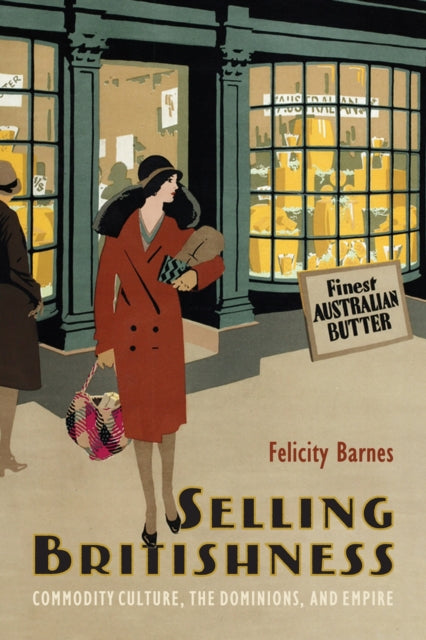
Felicity Barnes
Selling Britishness: Commodity Culture, the Dominions, and Empire
Selling Britishness: Commodity Culture, the Dominions, and Empire
💎 Earn 499 Points (£4.99) on this item.
YOU SAVE £12.04
- Condition: Brand new
- UK Delivery times: Usually arrives within 2 - 3 working days
- UK Shipping: Fee starts at £2.39. Subject to product weight & dimension
Bulk ordering. Want 15 or more copies? Get a personalised quote and bigger discounts. Learn more about bulk orders.
Couldn't load pickup availability
- More about Selling Britishness: Commodity Culture, the Dominions, and Empire
During the 1920s and 1930s, Australia, Canada, and New Zealand marketed their products as "British to the core" to appeal to British shoppers. Prime ministers, touring cricketers, and boxing kangaroos were used in these campaigns to promote Dominion produce. However, these campaigns also sold a Dominion-styled British identity. Selling Britishness argues that commodity marketing played a significant role in creating this Britishness, with Dominion settlers considering themselves British and marketing their commodities accordingly. Advertisers employed imperial hierarchies of race, class, and gender to construct a shared British identity, and consumption worked to bolster colonialism.
Format: Hardback
Publication date: 26 July 2022
Publisher: McGill-Queen's University Press
From the 1920s until the outbreak of the Second World War, Australia, Canada, and New Zealand flooded British shop windows, newspaper columns, and cinema screens with "British to the core" Canadian apples, "British to the backbone" New Zealand lamb, and "All British" Australian butter. In remarkable yet forgotten advertising campaigns, prime ministers, touring cricketers, "lady demonstrators," and even boxing kangaroos were pressed into service to sell more Dominion produce to British shoppers. But as they sold apples and butter, these campaigns also sold a Dominion-styled British identity.
Selling Britishness explores the role of commodity marketing in creating Britishness. Dominion settlers considered themselves British and marketed their commodities accordingly. Meanwhile, ambitious Dominion advertising agencies set up shop in London to bring British goods, like Ovaltine, back to the dominions and persuade their fellow citizens to buy British. Conventionally nationalist narratives have posited the growth of independent national identities during the interwar period, though some have suggested imperial sentiment endured. Felicity Barnes takes a new approach, arguing that far from shaking off or relying on any lasting sense of Britishness, Dominion marketing produced it.
Selling Britishness shows that when constructing Britishness, advertisers employed imperial hierarchies of race, class, and gender. Consumption worked to bolster colonialism, and advertising extended imperial power into the everyday. Drawing on extensive new archives, Selling Britishness explores a shared British identity constructed by marketers and advertisers during advertisings golden age.
Dimension: 229 x 152 (mm)
ISBN-13: 9780228010517
This item can be found in:
UK and International shipping information
UK and International shipping information
UK Delivery and returns information:
- Delivery within 2 - 3 days when ordering in the UK.
- Shipping fee for UK customers from £2.39. Fully tracked shipping service available.
- Returns policy: Return within 30 days of receipt for full refund.
International deliveries:
Shulph Ink now ships to Australia, Belgium, Canada, France, Germany, Ireland, Italy, India, Luxembourg Saudi Arabia, Singapore, Spain, Netherlands, New Zealand, United Arab Emirates, United States of America.
- Delivery times: within 5 - 10 days for international orders.
- Shipping fee: charges vary for overseas orders. Only tracked services are available for most international orders. Some countries have untracked shipping options.
- Customs charges: If ordering to addresses outside the United Kingdom, you may or may not incur additional customs and duties fees during local delivery.