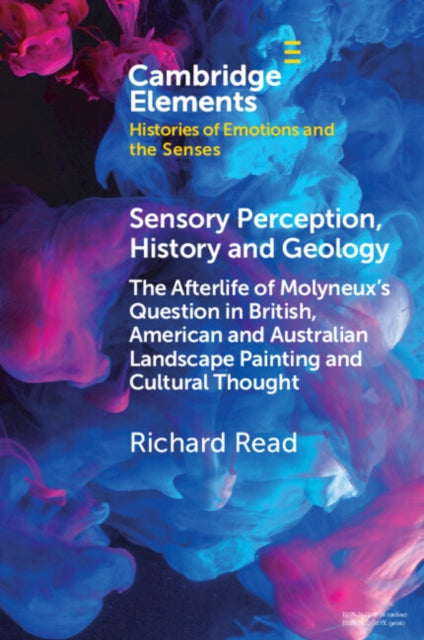
Richard Read
Sensory Perception, History and Geology: The Afterlife of Molyneux's Question in British, American and Australian Landscape Painting and Cultural Thought
Sensory Perception, History and Geology: The Afterlife of Molyneux's Question in British, American and Australian Landscape Painting and Cultural Thought
💎 Earn 84 Points (£0.84) on this item.
We can order this item for you. Delivery usually takes about 4 to 6 weeks.
This item is not held in our immediate stock. We will order it for you after checkout.
Estimated delivery: About 4 to 6 weeks
YOU SAVE £1.01
- Condition: Brand new
- UK Delivery times: Usually arrives within 2 - 3 working days
- UK Shipping: Fee starts at £2.39. Subject to product weight & dimension
Bulk ordering. Want 15 or more copies? Get a personalised quote and bigger discounts. Learn more about bulk orders.
Couldn't load pickup availability
- More about Sensory Perception, History and Geology: The Afterlife of Molyneux's Question in British, American and Australian Landscape Painting and Cultural Thought
The question of whether a blind man restored to sight could name the difference between a cube and a sphere without touching them shaped fundamental conflicts in philosophy, theology, and science between empirical and idealist answers. This Element demonstrates how landscape paintings of unfamiliar terrains required historical and geological subject matter to supply tactile associations for empirical recognition of space, while idealism conferred unmediated but no less coercive sensory access. Close visual and verbal analysis using photographs of pictorial sites trace vividly different responses to the question, from those of William Hazlitt and John Ruskin in Britain to those of nineteenth-century authors and artists in the United States and Australia.
Format: Paperback / softback
Length: 75 pages
Publication date: 17 February 2022
Publisher: Cambridge University Press
William Molyneux's profound inquiry to John Locke regarding the ability of a blind man to discern the difference between a cube and a sphere without physical contact sparked a fundamental divide in philosophy, theology, and science. This dichotomy pitted empirical versus idealist responses, which are profoundly at odds with our contemporary perspectives on sight and sensation. However, these divergent viewpoints emerged from the colonial ambitions that have left devastating legacies of genocidal and ecocidal consequences, which continue to intensify today. This Element explores how landscape paintings of unfamiliar terrains relied on historical and geological subject matter to establish tactile associations for empirical recognition of space. In contrast, idealism granted unmediated but no less coercive sensory access. Through a close visual and verbal analysis of photographs of pictorial sites, we witness diverse responses to Molyneux's question, ranging from those of British thinkers like William Hazlitt and John Ruskin to nineteenth-century authors and artists in the United States and Australia, including Ralph Waldo Emerson, Thomas Cole, William Haseltine, Fitz Henry Lane, and Eugene von Guérard.
Weight: 144g
Dimension: 150 x 228 x 11 (mm)
ISBN-13: 9781009095488
Edition number: New ed
UK and International shipping information
UK and International shipping information
UK Delivery and returns information:
- Delivery within 2 - 3 days when ordering in the UK.
- Shipping fee for UK customers from £2.39. Fully tracked shipping service available.
- Returns policy: Return within 30 days of receipt for full refund.
International deliveries:
Shulph Ink now ships to Australia, Belgium, Canada, France, Germany, Ireland, Italy, India, Luxembourg Saudi Arabia, Singapore, Spain, Netherlands, New Zealand, United Arab Emirates, United States of America.
- Delivery times: within 5 - 10 days for international orders.
- Shipping fee: charges vary for overseas orders. Only tracked services are available for most international orders. Some countries have untracked shipping options.
- Customs charges: If ordering to addresses outside the United Kingdom, you may or may not incur additional customs and duties fees during local delivery.