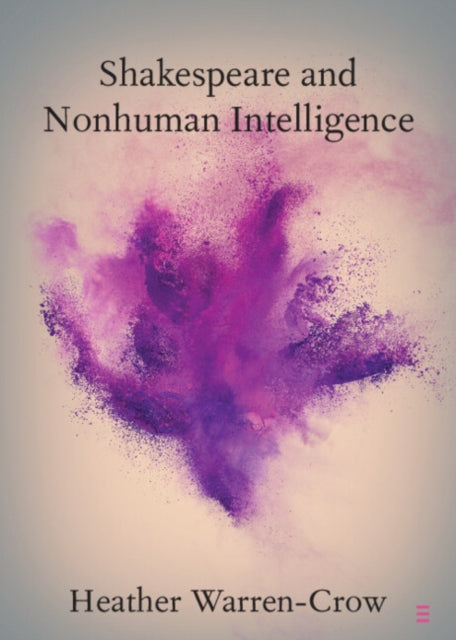
HeatherWarren-Crow
Shakespeare and Nonhuman Intelligence
Shakespeare and Nonhuman Intelligence
💎 Earn 84 Points (£0.84) on this item.
We can order this item for you. Delivery usually takes about 4 to 6 weeks.
This item is not held in our immediate stock. We will order it for you after checkout.
Estimated delivery: About 4 to 6 weeks
YOU SAVE £1.01
- Condition: Brand new
- UK Delivery times: Usually arrives within 2 - 3 working days
- UK Shipping: Fee starts at £2.39. Subject to product weight & dimension
Bulk ordering. Want 15 or more copies? Get a personalised quote and bigger discounts. Learn more about bulk orders.
Couldn't load pickup availability
- More about Shakespeare and Nonhuman Intelligence
The Infinite Monkey Theorem states that an infinite number of typing monkeys will eventually generate the works of Shakespeare. Shakespeare and Nonhuman Intelligence explores the metaphysical analysis of Shakespeare's function in the Theorem across different contexts, from early-twentieth-century astrophysics to twenty-first-century AI. It argues that Shakespeare serves as an interface between humans and our "Others," such as animals, gods, and machines.
Format: Paperback / softback
Length: 108 pages
Publication date: 02 May 2024
Publisher: Cambridge University Press
The Infinite Monkey Theorem, a concept that permeates popular science books, discussions on Intelligent Design, and debates surrounding the output of chatbots, has gained significant attention. According to this theorem, an infinite ensemble of typing monkeys will ultimately produce the works of Shakespeare. Shakespeare and Nonhuman Intelligence delves into a metaphysical exploration of Shakespeare's role within this theorem across different contexts throughout the past century. Spanning from early-twentieth-century astrophysics to the twenty-first century realm of AI, this analysis traces the emergence of Shakespeare as a contested figure in the age of machine learning, bioinformatics, and other purported transgressions against the human organism. Through a meticulous examination of computer programs that implement the Theorem, including one by biologist Richard Dawkins, and references in publications on Intelligent Design, the book argues that Shakespeare serves as a vital interface between humans and our Otherness: animals, gods, and machines.
The Infinite Monkey Theorem, a concept that permeates popular science books, discussions on Intelligent Design, and debates surrounding the output of chatbots, has gained significant attention. According to this theorem, an infinite ensemble of typing monkeys will ultimately produce the works of Shakespeare. Shakespeare and Nonhuman Intelligence delves into a metaphysical exploration of Shakespeare's role within this theorem across different contexts throughout the past century. Spanning from early-twentieth-century astrophysics to the twenty-first century realm of AI, this analysis traces the emergence of Shakespeare as a contested figure in the age of machine learning, bioinformatics, and other purported transgressions against the human organism. Through a meticulous examination of computer programs that implement the Theorem, including one by biologist Richard Dawkins, and references in publications on Intelligent Design, the book argues that Shakespeare serves as a vital interface between humans and our Otherness: animals, gods, and machines.
The concept of the Infinite Monkey Theorem has captivated the minds of scholars and enthusiasts alike, offering a thought-provoking exploration of the interplay between human creativity and the forces of nature. While the theorem itself suggests that an infinite number of monkeys randomly typing on keyboards could eventually produce the works of Shakespeare, it raises profound questions about the nature of art, intelligence, and the boundaries of what is possible in the realm of language and expression.
In Shakespeare and Nonhuman Intelligence, author Richard Dawkins takes a deep dive into the metaphysical implications of the Infinite Monkey Theorem. He examines how Shakespeare has been interpreted and reimagined in various contexts over the past century, from early-twentieth-century astrophysics to the twenty-first century realm of AI. Dawkins argues that Shakespeare emerges as a contested figure in this age of machine learning and bioinformatics, as he represents a bridge between humans and our Otherness: animals, gods, and machines.
One of the key insights of the book is that Shakespeare's works are not merely the result of human creativity alone. Rather, they are the product of a complex interplay between human intellect, cultural influences, and the natural world. Dawkins explores how Shakespeare's plays reflect the deep-seated fears and desires of his audience, as well as the broader cultural and societal norms of his time. He also considers how Shakespeare's works have been influenced by scientific discoveries and technological advancements, such as the discovery of the structure of DNA and the development of artificial intelligence.
Through his analysis, Dawkins challenges the notion that human creativity is inherently superior to that of nonhuman intelligence. He argues that the works of Shakespeare are not simply the product of human intellect but are also shaped by the broader forces of nature and history. He suggests that the emergence of Shakespeare as a contested figure in the age of machine learning and bioinformatics is a testament to the resilience and adaptability of human creativity, as it can transcend the boundaries of what is possible in the realm of language and expression.
In addition to its metaphysical exploration, Shakespeare and Nonhuman Intelligence offers a practical perspective on the role of AI and other forms of nonhuman intelligence in the creative process. Dawkins argues that AI and other forms of nonhuman intelligence can be valuable tools for artists and writers, as they can help to generate new ideas and explore the boundaries of what is possible in the realm of language and expression. He suggests that AI and other forms of nonhuman intelligence can be used to create new forms of art, such as generative poetry or music, as well as to enhance the creative process by providing feedback and suggestions.
However, Dawkins also raises concerns about the ethical implications of using AI and other forms of nonhuman intelligence in the creative process. He argues that there are risks associated with delegating creative tasks to machines, as they may lack the empathy and emotional intelligence that are essential for creating truly meaningful and impactful art. He suggests that there should be guidelines and regulations in place to ensure that the use of AI and other forms of nonhuman intelligence in the creative process is ethical and responsible.
In conclusion, Shakespeare and Nonhuman Intelligence is a thought-provoking and illuminating book that offers a metaphysical analysis of the role of Shakespeare in the Infinite Monkey Theorem. Through his exploration of the interplay between human creativity, cultural influences, and the natural world, Dawkins challenges the notion that human creativity is inherently superior to that of nonhuman intelligence. He also offers a practical perspective on the role of AI and other forms of nonhuman intelligence in the creative process, while raising concerns about the ethical implications of their use. This book is a must-read for anyone interested in the intersection of art, intelligence, and technology, as it provides a fresh and innovative perspective on the creative process and its potential for transformation in the age of machine learning and bioinformatics.
ISBN-13: 9781009202640
UK and International shipping information
UK and International shipping information
UK Delivery and returns information:
- Delivery within 2 - 3 days when ordering in the UK.
- Shipping fee for UK customers from £2.39. Fully tracked shipping service available.
- Returns policy: Return within 30 days of receipt for full refund.
International deliveries:
Shulph Ink now ships to Australia, Belgium, Canada, France, Germany, Ireland, Italy, India, Luxembourg Saudi Arabia, Singapore, Spain, Netherlands, New Zealand, United Arab Emirates, United States of America.
- Delivery times: within 5 - 10 days for international orders.
- Shipping fee: charges vary for overseas orders. Only tracked services are available for most international orders. Some countries have untracked shipping options.
- Customs charges: If ordering to addresses outside the United Kingdom, you may or may not incur additional customs and duties fees during local delivery.