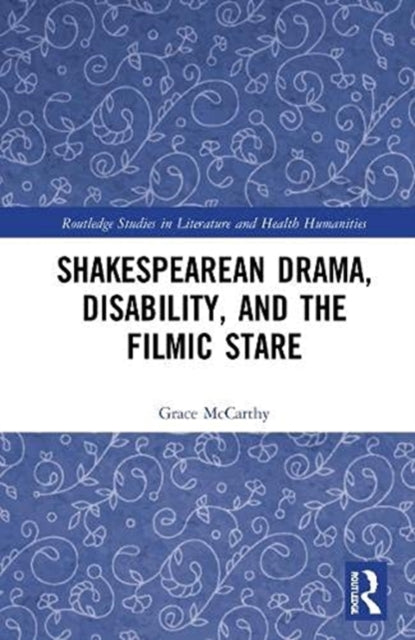
Grace McCarthy
Shakespearean Drama, Disability, and the Filmic Stare
Shakespearean Drama, Disability, and the Filmic Stare
💎 Earn 1305 Points (£13.05) on this item.
We can order this item for you. Delivery usually takes about 4 to 6 weeks.
This item is not held in our immediate stock. We will order it for you after checkout.
Estimated delivery: About 4 to 6 weeks
- Condition: Brand new
- UK Delivery times: Usually arrives within 2 - 3 working days
- UK Shipping: Fee starts at £3.89. Subject to product weight & dimension
Bulk ordering. Want 15 or more copies? Get a personalised quote and bigger discounts. Learn more about bulk orders.
Couldn't load pickup availability
- More about Shakespearean Drama, Disability, and the Filmic Stare
Shakespearean Drama,Disability,and the Filmic Stare analyzes the visual construction of disability in adaptations of Shakespearean drama through the lens of the filmic stare,intersecting adaptation studies,film studies,Shakespeare studies,and disability studies. It argues that the filmic stare does not differentiate between male and female characters with disabilities or between powerful and powerless figures in disability representation.
Format: Hardback
Length: 188 pages
Publication date: 28 July 2021
Publisher: Taylor & Francis Ltd
Shakespearean drama, disability, and the filmic stare: A critical synthesis
Shakespearean drama, disability, and the filmic stare: A critical synthesis
Shakespearean drama has long been a rich source of exploration and interpretation, and its adaptations have played a significant role in shaping our understanding of the world. In recent years, the filmic stare has emerged as a critical lens through which to examine the visual construction of disability in adaptations of Shakespearean drama.
Laura Mulvey's male gaze and Rosemarie Garland-Thomson's stare are two influential frameworks that have been used to analyze the representation of women in film and media. Shakespearean drama, Disability, and the Filmic Stare synthesizes these frameworks into a new critical lens, the filmic stare, in order to understand and analyze the visual construction of disability in adaptations of Shakespearean drama.
The book explores the intersections of adaptation studies, film studies, Shakespeare studies, and disability studies to analyze twentieth and twenty-first century representations of both physical disability and 'madness' in global cinematic film, television film, and digital broadcast cinema in Shakespeare's works.
One of the key findings of the book is that the filmic stare does not differentiate between male and female characters with disabilities, or between powerful and powerless figures in disability representation. Instead, it suggests that the filmic stare is a powerful tool for creating a sense of empathy and understanding for characters with disabilities.
The book also explores the ways in which adaptations of Shakespearean drama have challenged traditional notions of disability and 'madness.' For example, it examines the ways in which Shakespeare's plays have been adapted to reflect changing attitudes towards mental health and disability, and how these adaptations have contributed to a broader understanding of the human experience.
In conclusion, Shakespearean drama, disability, and the filmic stare: A critical synthesis is a groundbreaking work that offers a new perspective on the visual construction of disability in adaptations of Shakespearean drama. By synthesizing the male gaze and Rosemarie Garland-Thomson's stare into a new critical lens, the book provides a rich and nuanced analysis of the ways in which Shakespeare's works have been adapted to reflect changing attitudes towards disability and 'madness.' This multi-disciplinary volume is ideal for disability studies scholars, Shakespeare scholars, and those interested in adaptations of Shakespeare's famous works.
Weight: 406g
Dimension: 159 x 235 x 19 (mm)
ISBN-13: 9780367756475
UK and International shipping information
UK and International shipping information
We deliver throughout the United Kingdom and to 128 countries and territories worldwide, including the United States, Australia, Canada, Germany, Spain and France.