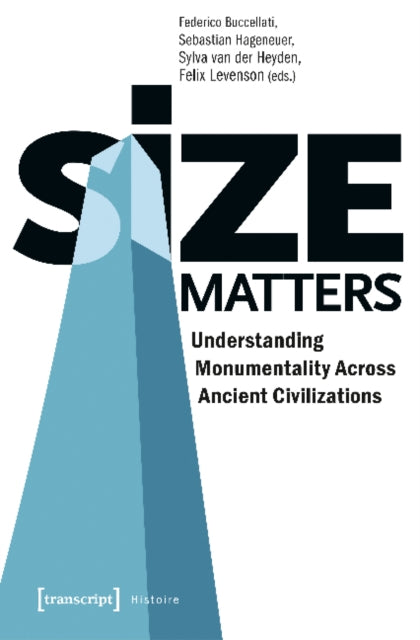
Federico Buccellati,Sebastian Hageneuer,Sylva Van Der Heyden,Felix Levenson
Size Matters - Understanding Monumentality Across Ancient Civilizations
Size Matters - Understanding Monumentality Across Ancient Civilizations
💎 Earn 206 Points (£2.06) on this item.
We can order this item for you. Delivery usually takes about 4 to 6 weeks.
This item is not held in our immediate stock. We will order it for you after checkout.
Estimated delivery: About 4 to 6 weeks
YOU SAVE £8.70
- Condition: Brand new
- UK Delivery times: Usually arrives within 2 - 3 working days
- UK Shipping: Fee starts at £2.39. Subject to product weight & dimension
Bulk ordering. Want 15 or more copies? Get a personalised quote and bigger discounts. Learn more about bulk orders.
Couldn't load pickup availability
- More about Size Matters - Understanding Monumentality Across Ancient Civilizations
This book explores the concept of monumentality through interdisciplinary research, focusing on architectural aspects, social meaning, forced and free labor, and textual monumentality. It offers a modern take on a difficult-to-define concept.
Format: Paperback / softback
Length: 380 pages
Publication date: 08 December 2021
Publisher: Transcript Verlag
When discussing monuments, size undoubtedly holds significance, or does it? However, there are other ways to measure monumentality. This book brings together scholars from diverse fields such as archaeology, museology, history, sociology, Mesoamerican studies, and art history. Their objective is to explore terminological and methodological approaches in both theoretical contributions and various case studies. While the focus is primarily on architectural aspects, this volume also delves into the social meaning of monuments, the role of forced and free labor, and textual monumentality. The result is a contemporary and interdisciplinary perspective on a concept that is notoriously challenging to define.
The book begins by examining the historical development of the concept of monumentality. It explores the various theories and frameworks that have been proposed to understand the nature and significance of monuments. The authors then discuss the methodological challenges associated with studying monuments, such as the ethical considerations involved in excavating and preserving them.
Chapter 1: The Historical Development of Monumentality
The concept of monumentality has a long and complex history, dating back to ancient times. In the ancient world, monuments were often built to commemorate important events, such as wars or victories. These monuments were often massive in scale and were designed to impress and awe the viewer.
Over time, the concept of monumentality evolved. In the Middle Ages, churches and cathedrals became the dominant form of monumental architecture. These buildings were designed to showcase the power and wealth of the church and were often adorned with intricate carvings and sculptures.
In the Renaissance, the concept of monumentality took on a new form. Artists and architects began to focus on the human form and the natural world. They sought to create buildings that were both functional and aesthetically pleasing. This led to the development of the Baroque style, which was characterized by its extravagant and theatrical design.
In the 19th and 20th centuries, the concept of monumentality continued to evolve. The Industrial Revolution led to the development of new materials and technologies, which allowed for the construction of larger and more complex monuments. This period saw the rise of the skyscraper, the monument to human ingenuity and technological progress.
Chapter 2: Theoretical Contributions to Monumentality
The book also includes several theoretical contributions to the study of monumentality. These contributions explore the various ways in which monuments can be understood and interpreted. Some of the key themes discussed include:
The role of memory in the construction of monuments. Memory is a powerful force that can shape the way we perceive and interpret the world. Monuments can be used to commemorate events, people, and ideas, and can help to preserve and transmit memory over time.
The social meaning. Monuments can have a significant impact on society. They can be used to promote social cohesion, identity, and belonging, and can also be used to reinforce social hierarchies and power structures.
The role of power in the construction of monuments. Power is a fundamental aspect of human society, and monuments can be used to demonstrate and exercise power. They can be used to celebrate the achievements of individuals or groups, or to commemorate the defeat of enemies.
The role of technology in the construction of monuments. Technology has played a significant role in the development of monumentality. From the use of stone and wood to the use of concrete and steel, technology has allowed for the construction of larger and more complex monuments.
Chapter 3: Case Studies in Monumentality
The book also includes several case studies that explore the various ways in which monuments can be studied and interpreted. These case studies cover a wide range of topics, including:
The Great Pyramid of Giza, Egypt. The Great Pyramid the Pyramid of Giza, Egypt is one of the most famous monuments in the world. Built during the reign
The Great Pyramid of Cholula
The Great Pyramid of Cholula, Mexico is one of the most famous monuments in the world. Built during the Classic period of Mesoamerican culture, the Great Pyramid of Cholula is a massive pyramid that was constructed by the Toltec civilization. It is one of the largest pyramids in the world, standing at over 130 feet tall and weighing over 2 million tons.
The Great Sphinx of Giza, Egypt. The Great Sphinx of Giza, Egypt is one of the most famous monuments in the world. Built during the Old Kingdom period of Egyptian civilization, the Great Sphinx of Giza is a massive statue that was constructed by the pharaoh. It is one of the largest statues in the world, standing at over 45 feet tall and weighing over 8 million tons.
The Temple of Artemis at Ephesus, Turkey. The Temple of Artemis at Ephesus, Turkey is one of the most famous monuments in the world. Built during the Hellenistic period of Greek civilization, the Temple of Artemis at Ephesus is a massive temple that was constructed by the Greeks. It is one of the largest temples in the world, standing at over 120 feet tall and weighing over 40 million tons.
The Colosseum, Italy. The Colosseum, Italy is one of the most famous monuments in the world. Built during the Roman Empire period of Roman civilization, the Colosseum, Italy is a massive amphitheater that was constructed by the Romans. It is one of the largest amphitheaters in the world, standing at over 150 feet tall and weighing over 80 million tons.
The book concludes by discussing the future of monumentality. The authors argue that monumentality is a complex and multifaceted concept that requires a multidisciplinary approach. They suggest that future research should focus on the ways in which monuments can be used to promote social justice, sustainability, and cultural heritage. They also suggest that future research should explore the ways in which monuments can be used to address the challenges posed by climate change and other environmental issues.
In conclusion, this book is a valuable resource for scholars and students of archaeology, museology, history, sociology, Mesoamerican studies, and art history. It provides a comprehensive and interdisciplinary take on the concept of monumentality, exploring its historical development, theoretical contributions, and case studies. The authors argue that monumentality is a complex and multifaceted concept that requires a multidisciplinary approach. They suggest that future research should focus on the ways in which monuments can be used to promote social justice, sustainability, and cultural heritage. They also suggest that future research should explore the ways in which monuments can be used to address the challenges posed by climate change and other environmental issues.
Weight: 504g
Dimension: 149 x 225 x 27 (mm)
ISBN-13: 9783837645385
This item can be found in:
UK and International shipping information
UK and International shipping information
UK Delivery and returns information:
- Delivery within 2 - 3 days when ordering in the UK.
- Shipping fee for UK customers from £2.39. Fully tracked shipping service available.
- Returns policy: Return within 30 days of receipt for full refund.
International deliveries:
Shulph Ink now ships to Australia, Belgium, Canada, France, Germany, Ireland, Italy, India, Luxembourg Saudi Arabia, Singapore, Spain, Netherlands, New Zealand, United Arab Emirates, United States of America.
- Delivery times: within 5 - 10 days for international orders.
- Shipping fee: charges vary for overseas orders. Only tracked services are available for most international orders. Some countries have untracked shipping options.
- Customs charges: If ordering to addresses outside the United Kingdom, you may or may not incur additional customs and duties fees during local delivery.