Shulph Ink
Smart Anticorrosive Materials: Trends and Opportunities
Smart Anticorrosive Materials: Trends and Opportunities
💎 Earn 951 Points (£9.51) on this item.
- Condition: Brand new
- UK Delivery times: Usually arrives within 2 - 3 working days
- UK Shipping: Fee starts at £2.39. Subject to product weight & dimension
Bulk ordering. Want 15 or more copies? Get a personalised quote and bigger discounts. Learn more about bulk orders.
Couldn't load pickup availability
- More about Smart Anticorrosive Materials: Trends and Opportunities
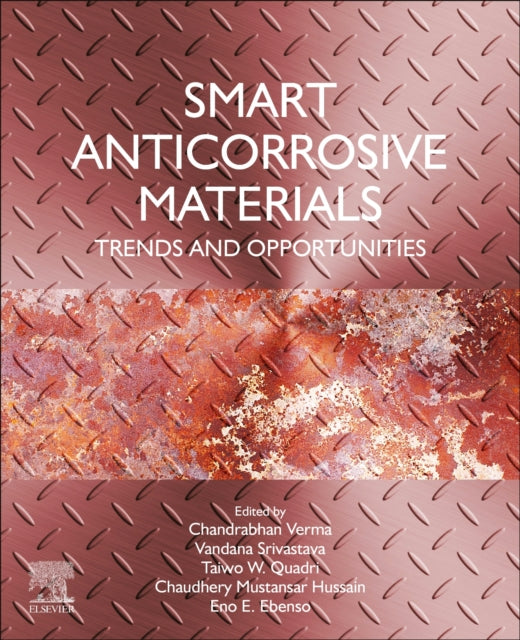
Smart Anticorrosive Materials: Trends and Opportunities explores new developments in nanoscale coatings and their applications, covering fundamental characteristics, synthesis, inhibition mechanisms, and educational and industrial purposes. It provides a chronological overview of the growth of the field and concludes with discussions on commercialization, economics, and environmental considerations.
Format: Paperback / softback
Length: 350 pages
Publication date: 31 March 2023
Publisher: Elsevier - Health Sciences Division
Smart Anticorrosive Materials: Trends and Opportunities delves into the latest advancements in nanoscale coatings and their diverse applications. This comprehensive book explores the fundamental properties, synthesis, inhibition mechanisms, and practical applications of green nanomaterials across both academic and industrial domains. It offers a chronological journey through the field's growth, providing valuable insights for scholars, chemical engineers, chemists, and materials scientists engaged in research and academia. The book concludes with engaging discussions on commercialization, economics, and environmental considerations, making it an essential reference for those seeking to comprehend corrosion systems and the latest developments in smart coatings.
Nanoscale coatings have emerged as a promising solution for combating corrosion, a significant challenge in various industries. These coatings, characterized by their tiny size, offer enhanced properties and functionalities that traditional coatings cannot match. One of the key advantages of nanoscale coatings is their ability to provide a dense and uniform protective layer on metal surfaces. This dense barrier effectively repels corrosion agents, such as acids, salts, and moisture, extending the lifespan of the coated materials.
In addition to their protective capabilities, nanoscale coatings can also enhance the performance of metal surfaces. For instance, they can improve wear resistance, friction coefficient, and heat transfer properties, making them ideal for applications in the automotive, aerospace, and industrial sectors. Moreover, nanoscale coatings can be tailored to specific environments and conditions, such as high temperatures, corrosive chemicals, or extreme pressures, ensuring their effectiveness in a wide range of applications.
One of the most exciting developments in nanoscale coatings is the use of green nanomaterials. Green nanomaterials are derived from renewable and sustainable sources, making them environmentally friendly and less harmful to the environment. They have been shown to have excellent corrosion resistance properties, comparable to traditional nanomaterials, while exhibiting reduced toxicity and environmental impact.
The synthesis of green nanomaterials involves various methods, including bottom-up and top-down approaches. Bottom-up approaches involve the assembly of small molecules or atoms into larger structures, while top-down approaches involve the controlled growth of nanomaterials from larger precursors. Both methods have their advantages and disadvantages, and researchers are continuously exploring new synthesis techniques to improve the efficiency and scalability of green nanomaterials production.
Inhibition mechanisms are another important aspect of nanoscale coatings. These mechanisms involve the interaction of the coating with corrosion agents, preventing or slowing down the corrosion process. Inhibition mechanisms can be classified into two main categories: physical and chemical. Physical inhibition involves the formation of a protective barrier on the metal surface, while chemical inhibition involves the adsorption or reaction of the coating with corrosion agents.
Green nanomaterials have shown promising results in inhibiting corrosion through physical and chemical mechanisms. For example, some green nanomaterials, such as graphene oxide and titanium dioxide, have been found to form a dense and uniform protective layer on metal surfaces, preventing the penetration of corrosion agents. Additionally, these materials can adsorb or react with corrosion agents, neutralizing their harmful effects and promoting the formation of a protective layer.
The applications of green nanomaterials in various industries are numerous. In the automotive industry, green nanomaterials can be used to improve the durability and corrosion resistance of engine components, such as pistons, valves, and exhaust systems. In the aerospace industry, green nanomaterials can be used to protect aircraft surfaces from corrosion, reducing the need for frequent maintenance and repair. In the industrial sector, green nanomaterials can be used to protect pipelines, tanks, and other equipment from corrosion, improving their efficiency and reducing downtime.
Commercialization of green nanomaterials is a significant challenge, as it requires the development of efficient production processes, cost-effective manufacturing techniques, and robust regulatory frameworks. However, there are ongoing efforts to address these challenges, and the commercialization of green nanomaterials is expected to grow in the coming years.
In conclusion, smart anticorrosive materials, including nanoscale coatings and green nanomaterials, have emerged as a promising solution for combating corrosion. These materials offer enhanced properties, improved performance, and environmental benefits, making them ideal for various industries. The growth of the field is driven by ongoing research and development, and the commercialization of green nanomaterials is expected to contribute to the sustainable development of our society.
Dimension: 235 x 191 (mm)
ISBN-13: 9780323951586
This item can be found in:
UK and International shipping information
UK and International shipping information
UK Delivery and returns information:
- Delivery within 2 - 3 days when ordering in the UK.
- Shipping fee for UK customers from £2.39. Fully tracked shipping service available.
- Returns policy: Return within 30 days of receipt for full refund.
International deliveries:
Shulph Ink now ships to Australia, Belgium, Canada, France, Germany, Ireland, Italy, India, Luxembourg Saudi Arabia, Singapore, Spain, Netherlands, New Zealand, United Arab Emirates, United States of America.
- Delivery times: within 5 - 10 days for international orders.
- Shipping fee: charges vary for overseas orders. Only tracked services are available for most international orders. Some countries have untracked shipping options.
- Customs charges: If ordering to addresses outside the United Kingdom, you may or may not incur additional customs and duties fees during local delivery.