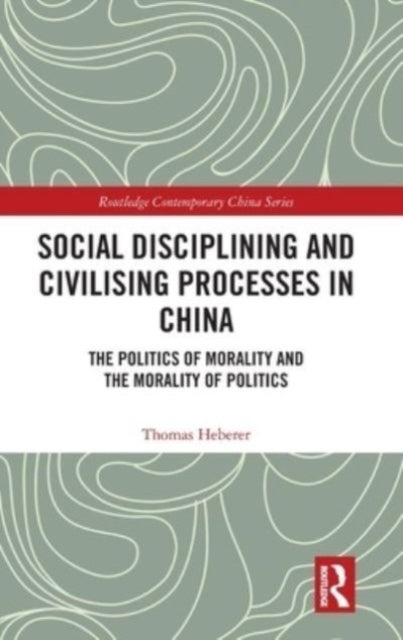
ThomasHeberer
Social Disciplining and Civilising Processes in China: The Politics of Morality and the Morality of Politics
Social Disciplining and Civilising Processes in China: The Politics of Morality and the Morality of Politics
💎 Earn 811 Points (£8.11) on this item.
We can order this item for you. Delivery usually takes about 4 to 6 weeks.
This item is not held in our immediate stock. We will order it for you after checkout.
Estimated delivery: About 4 to 6 weeks
YOU SAVE £9.63
- Condition: Brand new
- UK Delivery times: Usually arrives within 2 - 3 working days
- UK Shipping: Fee starts at £2.39. Subject to product weight & dimension
Bulk ordering. Want 15 or more copies? Get a personalised quote and bigger discounts. Learn more about bulk orders.
Couldn't load pickup availability
- More about Social Disciplining and Civilising Processes in China: The Politics of Morality and the Morality of Politics
This book argues that the Chinese government's road map to modernize China by 2049 involves social disciplining to create individuals with "modernized" minds and behavior. It discusses the Chinese experience of social disciplining and identifies universal tendencies of societal change and social disciplining, separating them from particular occurrences.
Format: Hardback
Length: 228 pages
Publication date: 11 August 2023
Publisher: Taylor & Francis Ltd
This book makes a compelling argument that a significant component of the Chinese government's roadmap, unveiled in 2017, aims to modernize China comprehensively by 2049. It asserts that the Chinese state perceives modernization and modernity as encompassing not only economic and political-administrative transformations but also the organization of society as a whole and the disciplining of individuals to cultivate individuals with "modernized" minds and behaviors. Furthermore, the Chinese state aspires to achieve a modernity with "Chinese characteristics." The question of modernizing through disciplining has been extensively explored by renowned Western social scientists such as Max Weber, Norbert Elias, and Michel Foucault in the 20th century. These scholars argued that disciplining, which ranges from external coercion to internalization of restraints, is essential for establishing social order and, thus, for "civilization" – albeit defined from a European perspective in relation to developments in Europe.
This book goes beyond discussing the Chinese experience of social disciplining by examining a non-Western society. It identifies universal tendencies of societal change and social disciplining and distinguishes them from specific occurrences. By doing so, it provides valuable insights into the broader dynamics of social transformation and governance.
The book begins by exploring the historical context of social disciplining in China. It traces the origins of the Chinese state's approach to social control and governance, highlighting the role of traditional Chinese values and institutions in shaping the country's social dynamics. The author then examines the contemporary manifestations of social disciplining in China, including the widespread implementation of government policies aimed at promoting social stability, economic development, and cultural uniformity.
One of the key themes of the book is the relationship between social disciplining and the development of a "modernized" society. The author argues that the Chinese state seeks to create a society that is both economically prosperous and socially harmonious, and that this requires the disciplining of individuals and groups to conform to certain norms and values. The book explores the ways in which social disciplining is used to achieve this goal, including through education, propaganda, and the enforcement of laws and regulations.
Another important aspect of the book is the role of technology in social disciplining. The author argues that the increasing use of surveillance technologies and digital platforms has enabled the Chinese state to monitor and control individuals more effectively. This has led to the development of a "social credit system" that rewards individuals for their compliance with government policies and punishes those who deviate from them.
The book also examines the implications of social disciplining for individual rights and freedoms. While the Chinese state claims that social disciplining is necessary for the country's development, critics argue that it violates human rights and freedoms. The author explores the challenges faced by individuals who resist or challenge social disciplining, including the risk of imprisonment, torture, and social ostracism.
In conclusion, this book offers a comprehensive and insightful analysis of social disciplining in China. It provides a valuable perspective on the country's efforts to modernize and develop, as well as the challenges and implications of social control and governance in a rapidly changing world. The book is a must-read for anyone interested in China's social, economic, and political landscape.
Weight: 594g
Dimension: 234 x 156 (mm)
ISBN-13: 9781032404363
UK and International shipping information
UK and International shipping information
UK Delivery and returns information:
- Delivery within 2 - 3 days when ordering in the UK.
- Shipping fee for UK customers from £2.39. Fully tracked shipping service available.
- Returns policy: Return within 30 days of receipt for full refund.
International deliveries:
Shulph Ink now ships to Australia, Belgium, Canada, France, Germany, Ireland, Italy, India, Luxembourg Saudi Arabia, Singapore, Spain, Netherlands, New Zealand, United Arab Emirates, United States of America.
- Delivery times: within 5 - 10 days for international orders.
- Shipping fee: charges vary for overseas orders. Only tracked services are available for most international orders. Some countries have untracked shipping options.
- Customs charges: If ordering to addresses outside the United Kingdom, you may or may not incur additional customs and duties fees during local delivery.