Shulph Ink
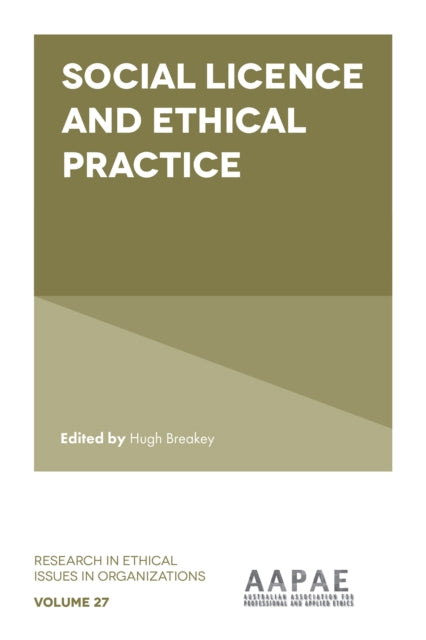
Social Licence and Ethical Practice
Social Licence and Ethical Practice
💎 Earn 380 Points (£3.80) on this item.
YOU SAVE £3.84
- Condition: Brand new
- UK Delivery times: Usually arrives within 2 - 3 working days
- UK Shipping: Fee starts at £2.39. Subject to product weight & dimension
Bulk ordering. Want 15 or more copies? Get a personalised quote and bigger discounts. Learn more about bulk orders.
Couldn't load pickup availability
- More about Social Licence and Ethical Practice
The social license to operate is a concept that has been applied to various industries, but its ethical status is uncertain. It can be used as a tool to improve the ethics of profit-seeking enterprises, but it can also be weaponized by stakeholders or used as a rhetorical shield by industry. This collection explores whether and how the ethical promise of the social license can be secured and its risks mitigated.
Format: Hardback
Length: 152 pages
Publication date: 07 April 2023
Publisher: Emerald Publishing Limited
The concept of the "social license to operate" has gained significant traction since its initial application in the late 1990s to operational risks in extraction industries. It has since been extended to various industries, including tourism, paper milling, banking, and aquaculture, as well as to the work of scientists and government agencies. While the social license is often seen as a means to enhance the ethical conduct of profit-seeking enterprises, it also carries ethical risks and promises.
On the one hand, the social license can be wielded by stakeholders to hold companies accountable for their actions and ensure that they respond to community and stakeholder concerns. It can create a sense of responsibility and transparency, which can lead to positive outcomes for society and the environment. For example, companies operating in sensitive areas, such as natural resources or indigenous communities, may be required to obtain a social license before commencing operations. This license can include commitments to respect human rights, protect the environment, and contribute to local development.
On the other hand, the social license can also be manipulated by stakeholders to undermine the authority of established law and democratic institutions. It can be used as a rhetorical shield by companies to justify their unethical practices, allowing them to evade accountability and responsibility. For instance, companies may claim that they have a social license even when engaging in practices that harm the environment or exploit workers. This ambiguity can lead to confusion and uncertainty, as companies may claim to possess a social license while engaging in practices that violate ethical standards.
Furthermore, the social license can be too ambiguous to serve as a meaningful framework for ethical conduct. It lacks a clear definition and structure, making it difficult to assess whether a company has obtained a social license or whether it is fulfilling its ethical obligations. This ambiguity can lead to a lack of trust and confidence in companies, as stakeholders may question their commitment to ethical behavior.
To address these challenges, this collection explores in a range of contexts whether and how the ethical promise of the social license can be secured, and its risks mitigated. It examines the various perspectives on the social license, including those of industry, government, civil society.society, and academia. The collection also considers the potential benefits and drawbacks of the social license, as well as the challenges and opportunities it presents for promoting sustainable and responsible business practices.
In conclusion, the social license to operate is a complex concept that carries both ethical risks and promises. While it can be a powerful tool for promoting responsible business practices, it can also be manipulated by stakeholders to undermine the authority
authority of established law and democratic institutions. To ensure that the social license is used effectively and ethically, it is essential to clarify its definition
its definition, establish clear criteria for obtaining and renewing a social license, and ensure that it is aligned with international human rights standards and principles. Additionally, companies must be held accountable for their actions and held to account for any breaches of their social license. By doing so, we can create a more sustainable and responsible business environment that benefits all stakeholders, including workers, communities, and the environment.
Weight: 336g
Dimension: 237 x 162 x 14 (mm)
ISBN-13: 9781837530755
This item can be found in:
UK and International shipping information
UK and International shipping information
UK Delivery and returns information:
- Delivery within 2 - 3 days when ordering in the UK.
- Shipping fee for UK customers from £2.39. Fully tracked shipping service available.
- Returns policy: Return within 30 days of receipt for full refund.
International deliveries:
Shulph Ink now ships to Australia, Belgium, Canada, France, Germany, Ireland, Italy, India, Luxembourg Saudi Arabia, Singapore, Spain, Netherlands, New Zealand, United Arab Emirates, United States of America.
- Delivery times: within 5 - 10 days for international orders.
- Shipping fee: charges vary for overseas orders. Only tracked services are available for most international orders. Some countries have untracked shipping options.
- Customs charges: If ordering to addresses outside the United Kingdom, you may or may not incur additional customs and duties fees during local delivery.