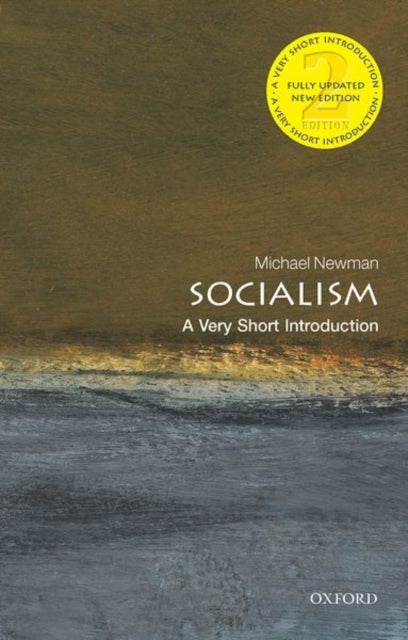
MichaelNewman
Socialism: A Very Short Introduction
Socialism: A Very Short Introduction
💎 Earn 35 Points (£0.35) on this item.
YOU SAVE £2.92
- Condition: Brand new
- UK Delivery times: Usually arrives within 2 - 3 working days
- UK Shipping: Fee starts at £2.39. Subject to product weight & dimension
Bulk ordering. Want 15 or more copies? Get a personalised quote and bigger discounts. Learn more about bulk orders.
Couldn't load pickup availability
- More about Socialism: A Very Short Introduction
Socialism is a diverse doctrine with a central core of interconnected values and goals, including a critique of capitalism, an optimistic view of human beings, and the belief that it is possible to establish societies based on egalitarianism, social solidarity, and cooperation. This Very Short Introduction considers the major theories in socialism and explores its historical evolution from the French Revolution to the present day, drawing on case studies such as Cuba, Sweden, and Bolivia to consider attempts to implement socialism in practice. Newman argues that socialism remains ultimately relevant in today's world.
Format: Paperback / softback
Length: 200 pages
Publication date: 24 September 2020
Publisher: Oxford University Press
Socialism is a complex and multifaceted ideology that has undergone significant evolution throughout history. It encompasses a range of economic and social systems that aim to create a more equitable and just society. While socialism has been associated with various political movements and ideologies, it is generally characterized by its belief in the collective ownership and control of the means of production, as well as the provision of social welfare programs and services for all members of society.
One of the key theories of socialism is Marxism, which was developed by Karl Marx in the 19th century. Marxism argues that capitalism is a system that exploits workers and creates a hierarchical social structure that perpetuates inequality and poverty. According to Marx, the only way to overcome this system is through a socialist revolution, which will involve the overthrow of the ruling class and the establishment of a classless society.
Another theory of socialism is anarchism, which emphasizes individual freedom and self-management. Anarchists believe that society should be organized without the use of government or other forms of coercion, and that individuals should be free to engage in any economic or social activity that they choose. Anarchism has been associated with various movements, including the labor movement, the feminist movement, and the environmental movement.
Socialism has a rich historical legacy, dating back to the French Revolution in the 18th century. During this time, socialists such as Jean-Jacques Rousseau and Thomas Paine advocated for a more equitable society that would prioritize the needs of the people over the interests of the elite. In the 19th century, socialism became a more organized movement, with the formation of socialist parties and organizations in Europe and the United States.
In the 20th century, socialism experienced significant growth and influence. During the Great Depression, many people turned to socialism as a solution to the economic crisis, and socialist governments were established in several countries, including the Soviet Union and Cuba. However, the collapse of the Soviet Union in 1991 marked the end of the era of socialist dominance in the world.
Despite this, socialism remains a popular ideology in many parts of the world. There are numerous socialist parties and organizations, and socialist ideas continue to be debated and discussed in academic and political circles. Some proponents of socialism argue that it is a more sustainable and equitable economic system that can address the challenges of climate change and inequality. Others argue that socialism is a flawed ideology that is based on outdated theories and that it has failed to deliver on its promises in the past.
One of the key challenges facing socialism in the 21st century is the rise of capitalism. In many parts of the world, capitalism has become the dominant economic system, and it is characterized by private ownership of the means of production, free markets, and individual freedom. Capitalism has been successful in delivering economic growth and prosperity, but it has also been criticized for its negative impact on the environment, inequality, and social cohesion.
Socialists argue that capitalism is inherently exploitative and that it creates a hierarchical social structure that perpetuates inequality and poverty. They argue that capitalism is also responsible for the environmental crisis, which is caused by the overproduction and consumption of goods and services that are harmful to the planet. Socialists believe that socialism is a more sustainable and equitable economic system that can address these challenges.
However, implementing socialism in practice can be difficult. Socialists argue that it requires a significant shift in power and resources away from the private sector and towards the public sector. This can involve the nationalization of industries, the creation of public ownership of land and resources, and the implementation of social welfare programs and services. However, these measures can be resisted by powerful interests groups and political elites who benefit from the current system of capitalism.
Another challenge facing socialism in the 21st century is the rise of populism and nationalism. In many parts of the world, people are becoming increasingly skeptical of traditional political institutions and are turning to more extreme and authoritarian forms of government. Populism and nationalism are often associated with anti-immigration policies, anti-globalization policies, and a rejection of social welfare programs and services. These policies can undermine the social and economic stability of society and can create divisions and tensions between different groups.
Despite these challenges, socialism remains a relevant and important ideology in the 21st century. There are numerous examples of socialist movements and organizations that are working to create a more equitable and just society. For example, the Bernie Sanders campaign in the United States, which advocated for a more progressive tax system, universal healthcare, and free college education, was heavily influenced by socialist ideas. There are also numerous socialist parties and organizations in Europe, including the Socialist Party in France and the Scottish National Party in Scotland.
In conclusion, socialism is a complex and multifaceted ideology that has undergone significant evolution throughout history. It encompasses a range of economic and social systems that aim to create a more equitable and just society. While socialism has been associated with various political movements and ideologies, it is generally characterized by its belief in the collective ownership and control of the means of production, as well as the provision of social welfare programs and services for all members of society. Socialism has a rich historical legacy, dating back to the French Revolution in the 18th century, and it has experienced significant growth and influence in the 20th century. However, implementing socialism in practice can be difficult, and it faces challenges from capitalism, populism, and nationalism. Despite these challenges, socialism remains a relevant and important ideology in the 21st century, and there are numerous examples of socialist movements and organizations that are working to create a more equitable and just society.
Weight: 180g
Dimension: 113 x 173 x 13 (mm)
ISBN-13: 9780198836421
Edition number: 2 Revised edition
UK and International shipping information
UK and International shipping information
UK Delivery and returns information:
- Delivery within 2 - 3 days when ordering in the UK.
- Shipping fee for UK customers from £2.39. Fully tracked shipping service available.
- Returns policy: Return within 30 days of receipt for full refund.
International deliveries:
Shulph Ink now ships to Australia, Belgium, Canada, France, Germany, Ireland, Italy, India, Luxembourg Saudi Arabia, Singapore, Spain, Netherlands, New Zealand, United Arab Emirates, United States of America.
- Delivery times: within 5 - 10 days for international orders.
- Shipping fee: charges vary for overseas orders. Only tracked services are available for most international orders. Some countries have untracked shipping options.
- Customs charges: If ordering to addresses outside the United Kingdom, you may or may not incur additional customs and duties fees during local delivery.