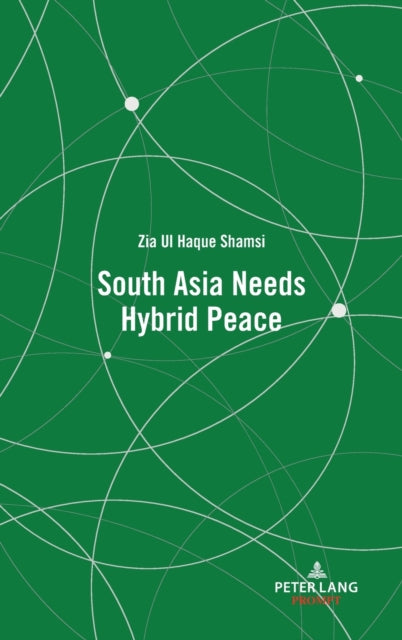
Zia Ul Haque Shamsi
South Asia Needs Hybrid Peace
South Asia Needs Hybrid Peace
💎 Earn 157 Points (£1.57) on this item.
We can order this item for you. Delivery usually takes about 4 to 6 weeks.
This item is not held in our immediate stock. We will order it for you after checkout.
Estimated delivery: About 4 to 6 weeks
YOU SAVE £4.09
- Condition: Brand new
- UK Delivery times: Usually arrives within 2 - 3 working days
- UK Shipping: Fee starts at £2.39. Subject to product weight & dimension
Bulk ordering. Want 15 or more copies? Get a personalised quote and bigger discounts. Learn more about bulk orders.
Couldn't load pickup availability
- More about South Asia Needs Hybrid Peace
This book explores the possibilities of Hybrid Peace in South Asia. Under the paradigm of Hybrid Peace, the book discusses the possibilities of resolution of major disputes between India and Pakistan, especially the Kashmir issue; enduring peace in Afghanistan; and revitalization of SAARC.
Format: Hardback
Length: 98 pages
Publication date: 28 December 2021
Publisher: Peter Lang Publishing Inc
Strategically positioned in South Asia, the region boasts breathtaking topography, abundant natural resources, and a hardworking human population. However, despite these remarkable features, the nearly two billion people in this sub-region continue to lag in development due to unnecessary wars and conflicts. The current state of South Asia is primarily a consequence of the enduring rivalry between India and Pakistan, which has spanned over seven decades and four decades of continuous wars and conflicts in Afghanistan. It is crucial to recognize that the region urgently requires a Hybrid Peace to prevent the catastrophic consequences of another major conflict between nuclear neighbors and the resurgence of terrorism across the globe.
The historical background of the rivalry between India and Pakistan is complex and multifaceted. It is rooted in territorial disputes, religious differences, and geopolitical tensions. The partition of India in 1947, which led to the creation of Pakistan, created deep divisions and animosity between the two countries. Over the years, the rivalry has escalated into several wars, including the 1971 Indo-Pakistani War, the 1999 Kargil War, and the ongoing conflict in Afghanistan.
The ongoing rivalry between India and Pakistan has had far-reaching consequences for South Asia and the world. It has perpetuated instability, fueled terrorism, and hindered economic development. The conflict in Afghanistan has been particularly devastating, as it has resulted in the displacement of millions of people, the rise of the Taliban, and the continued presence of foreign troops. The war has also contributed to the spread of extremism and terrorism in the region, posing a significant threat to global security.
In addition to the direct impact on South Asia, the rivalry between India and Pakistan has broader implications for the international community. It has strained relations between India and its neighbors, including China, the United States, and Russia. The conflict has also created a regional power imbalance, as Pakistan has become a proxy state for certain foreign powers, further complicating regional dynamics.
To address the challenges posed by the rivalry between India and Pakistan, it is essential to promote a Hybrid Peace. This approach involves a combination of military, diplomatic, and economic measures to address the underlying causes of the conflict and promote stability and development in the region.
Military measures should include efforts to reduce tensions and prevent the outbreak of hostilities. This can be achieved through dialogue, confidence-building measures, and the establishment of mechanisms for dispute resolution. Diplomatic measures should focus on building trust and promoting cooperation between India and Pakistan. This can be achieved through bilateral negotiations, regional diplomacy, and the involvement of international actors. Economic measures should aim to promote economic development and create opportunities for people in the region. This can be achieved through investment in infrastructure, trade, and tourism.
In addition to these measures, it is important to address the underlying social and political issues that contribute to the rivalry between India and Pakistan. This can be achieved through education, poverty alleviation, and the promotion of democratic values. It is also important to promote regional cooperation and integration, as it can help to reduce tensions and promote stability.
The rivalry between India and Pakistan is a complex and multifaceted issue that requires a comprehensive and sustained effort to address. By promoting a Hybrid Peace, we can help to prevent the catastrophic consequences of another major conflict and promote stability and development in South Asia and the world.
In conclusion, South Asia is strategically located with amazing topography, enormous natural resources, extremely hardworking human resources, and is home to some of the oldest religions and civilizations. Yet despite all the blessed features, the nearly two billion people are left behind on every account of development due to unnecessary wars and conflicts. The present state of this sub-region is primarily a result of the enduring rivalry between India and Pakistan that spans over seven decades and four decades of continued wars and conflicts in Afghanistan. Therefore, it is necessary to understand that South Asia Needs Hybrid Peace more than ever before to avoid catastrophic outcomes of another major conflict between nuclear neighbours and the resurgence of terrorism around the globe.
Weight: 252g
Dimension: 225 x 150 (mm)
ISBN-13: 9781433194221
Edition number: New ed
UK and International shipping information
UK and International shipping information
UK Delivery and returns information:
- Delivery within 2 - 3 days when ordering in the UK.
- Shipping fee for UK customers from £2.39. Fully tracked shipping service available.
- Returns policy: Return within 30 days of receipt for full refund.
International deliveries:
Shulph Ink now ships to Australia, Belgium, Canada, France, Germany, Ireland, Italy, India, Luxembourg Saudi Arabia, Singapore, Spain, Netherlands, New Zealand, United Arab Emirates, United States of America.
- Delivery times: within 5 - 10 days for international orders.
- Shipping fee: charges vary for overseas orders. Only tracked services are available for most international orders. Some countries have untracked shipping options.
- Customs charges: If ordering to addresses outside the United Kingdom, you may or may not incur additional customs and duties fees during local delivery.