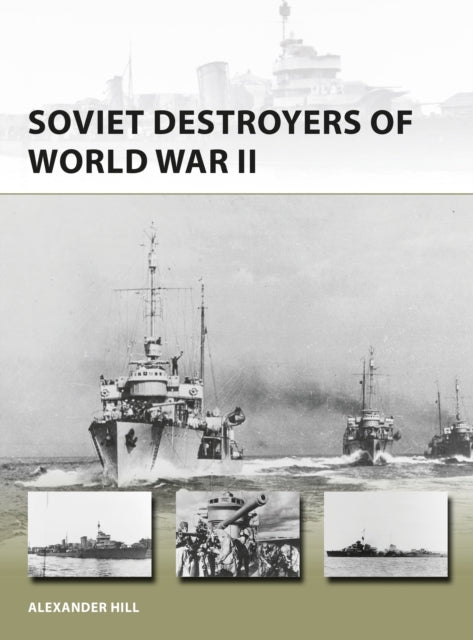
Dr Alexander Hill
Soviet Destroyers of World War II
Soviet Destroyers of World War II
💎 Earn 49 Points (£0.49) on this item.
YOU SAVE £3.03
- Condition: Brand new
- UK Delivery times: Usually arrives within 2 - 3 working days
- UK Shipping: Fee starts at £2.39. Subject to product weight & dimension
Bulk ordering. Want 15 or more copies? Get a personalised quote and bigger discounts. Learn more about bulk orders.
Couldn't load pickup availability
- More about Soviet Destroyers of World War II
The Soviet Navy faced the German onslaught in 1941 with a mixture of modern and antiquated warships, including destroyers that escorted convoys, fought battles, and provided fire support for Soviet troops. This guide covers the forgotten destroyers of the Soviet Navy from the pre-war period to the Leningrad class and the unique Tashkent.
\n Format: Paperback / softback
\n Length: 48 pages
\n Publication date: 22 March 2018
\n Publisher: Bloomsbury Publishing PLC
\n
The Soviet Navy, which confronted the German onslaught in 1941, boasted a diverse fleet that included a mix of modern warships, often built with foreign technical assistance, as well as antiquated warships from the Tsarist era that had been modernized for the conflict. While some Soviet naval vessels saw limited involvement in the war against Finland in 1939-1940, the main action unfolded after the German invasion. These destroyers played crucial roles in escorting convoys, engaging in battles against other destroyers, and confronting the deadly threat posed by attacking aircraft. They also provided vital fire support for Soviet troops on the ground.
The Soviet Navy's destroyer fleet during World War II encompassed a wide range of classes, from the Gnevny class of the pre-war period to the specialist destroyer leaders of the Leningrad class and the unique Tashkent. These destroyers were designed to fulfill various roles, including anti-aircraft warfare, anti-submarine warfare, and surface combat. Some of the notable Soviet destroyers of World War II include the Gnevny class, which was the first Soviet destroyer class and saw extensive service during the war. The Gnevny class was characterized by its speed, maneuverability, and armament, which included a variety of guns and torpedoes.
Another notable Soviet destroyer class was the Kirov class, which was designed to counter the threat posed by German battleships. The Kirov class featured a powerful main battery and a robust armor scheme, making it a formidable opponent in combat. The Leningrad class, on the other hand, was designed as a specialist destroyer leader and was equipped with advanced radar and anti-aircraft systems. The Tashkent class was unique in its design, featuring a combination of diesel and nuclear power, making it a highly maneuverable and stealthy destroyer.
In addition to these classes, the Soviet Navy also operated a number of other destroyer types, including the Project 941 ("Sarych") class, which was designed as a fast and stealthy anti-submarine destroyer. The Project 941 class was equipped with a range of sensors and weapons, including torpedoes and depth charges, and was capable of operating in both shallow and deep water.
Overall, the Soviet Navy's destroyer fleet played a critical role in the war against Germany and contributed to the Soviet Union's eventual victory. These destroyers were designed to be versatile and capable of performing a wide range of tasks, and their contributions to the war effort were significant.
The Soviet Navy, which confronted the German onslaught in 1941, boasted a diverse fleet that included a mix of modern warships, often built with foreign technical assistance, as well as antiquated warships from the Tsarist era that had been modernized for the conflict. While some Soviet naval vessels saw limited involvement in the war against Finland in 1939-1940, the main action unfolded after the German invasion. These destroyers played crucial roles in escorting convoys, engaging in battles against other destroyers, and confronting the deadly threat posed by attacking aircraft. They also provided vital fire support for Soviet troops on the ground.
The Soviet Navy's destroyer fleet during World War II encompassed a wide range of classes, from the Gnevny class of the pre-war period to the specialist destroyer leaders of the Leningrad class and the unique Tashkent. These destroyers were designed to fulfill various roles, including anti-aircraft warfare, anti-submarine warfare, and surface combat. Some of the notable Soviet destroyers of World War II include the Gnevny class, which was the first Soviet destroyer class and saw extensive service during the war. The Gnevny class was characterized by its speed, maneuverability, and armament, which included a variety of guns and torpedoes.
Another notable Soviet destroyer class was the Kirov class, which was designed to counter the threat posed by German battleships. The Kirov class featured a powerful main battery and a robust armor scheme, making it a formidable opponent in combat. The Leningrad class, on the other hand, was designed as a specialist destroyer leader and was equipped with advanced radar and anti-aircraft systems. The Tashkent class was unique in its design, featuring a combination of diesel and nuclear power, making it a highly maneuverable and stealthy destroyer.
In addition to these classes, the Soviet Navy also operated a number of other destroyer types, including the Project 941 ("Sarych") class, which was designed as a fast and stealthy anti-submarine destroyer. The Project 941 class was equipped with a range of sensors and weapons, including torpedoes and depth charges, and was capable of operating in both shallow and deep water.
Overall, the Soviet Navy's destroyer fleet played a critical role in the war against Germany and contributed to the Soviet Union's eventual victory. These destroyers were designed to be versatile and capable of performing a wide range of tasks, and their contributions to the war effort were significant.
The Gnevny class, which was the first Soviet destroyer class and saw extensive service during the war, was characterized by its speed, maneuverability, and armament, which included a variety of guns and torpedoes. The Kirov class, which was designed to counter the threat posed by German battleships, featured a powerful main battery and a robust armor scheme, making it a formidable opponent in combat. The Leningrad class, on the other hand, was designed as a specialist destroyer leader and was equipped with advanced radar and anti-aircraft systems. The Tashkent class was unique in its design, featuring a combination of diesel and nuclear power, making it a highly maneuverable and stealthy destroyer.
In addition to these classes, the Soviet Navy also operated a number of other destroyer types, including the Project 941 ("Sarych") class, which was designed as a fast and stealthy anti-submarine destroyer. The Project 941 class was equipped with a range of sensors and weapons, including torpedoes and depth charges, and was capable of operating in both shallow and deep water.
Overall, the Soviet Navy's destroyer fleet played a critical role in the war against water against Germany and contributed to the Soviet Union's eventual victory. These destroyers were designed to be versatile and capable of performing a wide range of tasks, and their contributions to the war effort were significant.
\n Weight: 168g\n
Dimension: 243 x 184 x 4 (mm)\n
ISBN-13: 9781472822567\n \n
UK and International shipping information
UK and International shipping information
UK Delivery and returns information:
- Delivery within 2 - 3 days when ordering in the UK.
- Shipping fee for UK customers from £2.39. Fully tracked shipping service available.
- Returns policy: Return within 30 days of receipt for full refund.
International deliveries:
Shulph Ink now ships to Australia, Belgium, Canada, France, Germany, Ireland, Italy, India, Luxembourg Saudi Arabia, Singapore, Spain, Netherlands, New Zealand, United Arab Emirates, United States of America.
- Delivery times: within 5 - 10 days for international orders.
- Shipping fee: charges vary for overseas orders. Only tracked services are available for most international orders. Some countries have untracked shipping options.
- Customs charges: If ordering to addresses outside the United Kingdom, you may or may not incur additional customs and duties fees during local delivery.