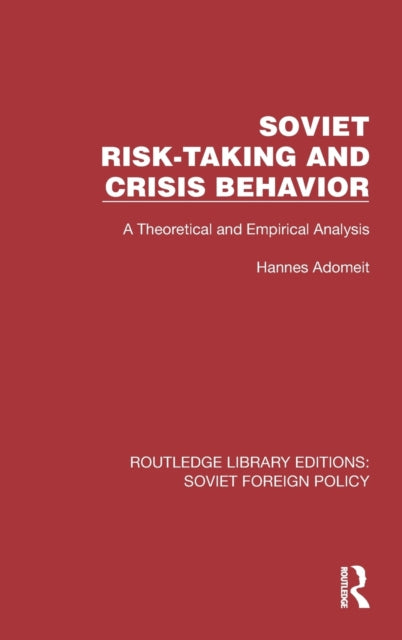
Hannes Adomeit
Soviet Risk-Taking and Crisis Behavior: A Theoretical and Empirical Analysis
Soviet Risk-Taking and Crisis Behavior: A Theoretical and Empirical Analysis
💎 Earn 775 Points (£7.75) on this item.
We can order this item for you. Delivery usually takes about 4 to 6 weeks.
This item is not held in our immediate stock. We will order it for you after checkout.
Estimated delivery: About 4 to 6 weeks
- Condition: Brand new
- UK Delivery times: Usually arrives within 2 - 3 working days
- UK Shipping: Fee starts at £2.39. Subject to product weight & dimension
Bulk ordering. Want 15 or more copies? Get a personalised quote and bigger discounts. Learn more about bulk orders.
Couldn't load pickup availability
- More about Soviet Risk-Taking and Crisis Behavior: A Theoretical and Empirical Analysis
Soviet Risk-Taking and Crisis Behavior, published in 1982, explores Soviet leaders' willingness to take risks in international relations, analyzing the concept of risk, its measurement, and its relation to crisis dynamics. It examines Soviet behavior in the Berlin crises of 1948 and 1961 and compares policy and leadership actions.
Format: Hardback
Length: 376 pages
Publication date: 28 December 2022
Publisher: Taylor & Francis Ltd
Soviet Risk-Taking and Crisis Behavior, originally released in 1982, delves into the intriguing inquiry of when and under what circumstances Soviet leaders were willing to embrace risks in international relations. The book's first section establishes a clear definition of risk and explores its analytical significance in foreign policy, its measurement, and its connection to the dynamics of crises. In the second section, a comprehensive analysis is presented, examining Soviet behavior during the Berlin crises of 1948 and 1961. The third and final section compares Soviet policies in these two crises, analyzing the actions of the two different leadership teams and their impact on Soviet behavior in other geographical areas.
The book's central theme revolves around understanding the decision-making processes and risk-taking behaviors of Soviet leaders in their interactions with the international community. By examining these crises, the author seeks to shed light on the factors that influenced Soviet foreign policy decisions and the strategies employed by the Soviet government to navigate complex and challenging situations.
The first section of the book provides a comprehensive theoretical framework for analyzing risk in international relations. The author defines risk as the potential for negative outcomes or losses resulting from uncertain or unpredictable events. They argue that risk is an inherent aspect of international politics and that it cannot be eliminated entirely. However, the author also stresses the importance of managing risk effectively to minimize its negative consequences.
The book then explores the various factors that influence Soviet leaders' decision-making processes when dealing with risk. These factors include political, economic, and strategic considerations, as well as the cultural and historical context in which the Soviet Union operated. The author argues that Soviet leaders were often driven by a desire to assert their power and influence in the international arena, which led them to take risks in pursuit of their goals.
The second section of the book focuses on the Berlin crises of 1948 and 1961, which were critical moments in Soviet-West relations. The author provides a detailed analysis of these crises, examining the actions and decisions made by Soviet leaders during these periods. They identify the key factors that led to the crises, such as the Cold War tensions, the expansion of communism, and the ideological differences between the Soviet Union and the Western powers.
The third section of the book compares Soviet policy in these two crises and explores the actions of the two different leadership teams. The author argues that the policies adopted by Soviet leaders during the Berlin crises were influenced by a range of factors, including the personality traits of the leaders, the political context, and the international environment. They also note that the crises had different outcomes, with the 1948 crisis resulting in a Soviet victory and the 1961 crisis leading to a Soviet defeat and the establishment of the Berlin Wall.
The final section of the book compares Soviet policy in the Berlin crises with Soviet behavior in other geographical areas. The author argues that the Berlin crises were unique in terms of their intensity and complexity, but that they reflected broader patterns of Soviet behavior in other regions. They identify the factors that contributed to Soviet behavior in these other areas, such as the Soviet Union's expansionist tendencies, the competition with the United States for influence in the developing world, and the need to maintain a strong military presence to protect its interests.
Overall, Soviet Risk-Taking and Crisis Behavior is a valuable contribution to the study of Soviet foreign policy and international relations. The book provides a comprehensive analysis of Soviet risk-taking behavior and offers insights into the decision-making the making processes of Soviet leaders. By examining these critical moments in Soviet-West relations, the author sheds the complexities and challenges of managing risk in a complex and interconnected.
Soviet Risk-Taking and Crisis Behavior, originally released in 1982, delves into the intriguing inquiry of when and under what circumstances Soviet leaders were willing to embrace risks in international relations. The book's first section establishes a clear definition of risk and explores its analytical significance in foreign policy, its measurement, and its connection to the dynamics of crises. In the second section, a comprehensive analysis is presented, examining Soviet behavior during the Berlin crises of 1948 and 1961. The third and final section compares Soviet policies in these two crises, analyzing the actions of the two different leadership teams and their impact on Soviet behavior in other geographical areas.
The book's central theme compares Soviet risk-taking behavior and crisis management in international relations. The book's first section establishes a clear definition. The author defines risk as the potential for negative outcomes or losses resulting from uncertain or unpredictable events. They argue that risk is an inherent aspect of international politics and that it cannot be eliminated entirely. However, the author also stresses the importance of managing risk effectively to minimize its negative consequences.
The book then explores the various factors that influence Soviet leaders. The author argues that Soviet leaders were often driven by a desire to assert their power and influence in the international arena, which led them to take risks in pursuit of their goals.
The second section of the book focuses on the Berlin crises of 1948 and 1961, which were critical moments in Soviet-West relations. The author provides a detailed analysis of these crises, examining the actions and decisions made by Soviet leaders during these periods. They identify the key factors that led to the crises, such as the Cold War tensions, the expansion of communism, and the ideological differences between the Soviet Union and the Western powers.
The third section of the book compares Soviet policy in these two crises and explores the actions of the two different leadership teams. The author argues that the policies adopted by Soviet leaders during the Berlin crises were influenced by a range of factors, including the personality traits of the leaders, the political context, and the international environment. They also note that the crises had different outcomes, with the 1948 crisis resulting in a Soviet victory and the 1961 crisis leading to a Soviet defeat and the establishment of the Berlin Wall.
The final section of the book compares Soviet policy in the Berlin crises with Soviet behavior in other geographical areas. The author argues that the Berlin crises were unique in terms of their intensity and complexity, but that they reflected broader the broader patterns of Soviet behavior in other regions. They identify the factors that contributed to Soviet behavior in these other areas, such as the Soviet Union's expansionist tendencies, the competition with the United States for influence in the developing world, and the need to maintain a strong military presence to protect its interests.
Overall, Soviet Risk-Taking and Crisis Behavior is a valuable contribution to the study of Soviet foreign policy and international relations. The book provides a comprehensive analysis of Soviet risk-taking behavior and offers insights into the decision-making processes of Soviet leaders. By examining these critical moments in Soviet-West relations, the author sheds the complexities and challenges of managing risk in a complex and ever-changing world.
Weight: 875g
Dimension: 234 x 156 (mm)
ISBN-13: 9781032335810
This item can be found in:
UK and International shipping information
UK and International shipping information
UK Delivery and returns information:
- Delivery within 2 - 3 days when ordering in the UK.
- Shipping fee for UK customers from £2.39. Fully tracked shipping service available.
- Returns policy: Return within 30 days of receipt for full refund.
International deliveries:
Shulph Ink now ships to Australia, Belgium, Canada, France, Germany, Ireland, Italy, India, Luxembourg Saudi Arabia, Singapore, Spain, Netherlands, New Zealand, United Arab Emirates, United States of America.
- Delivery times: within 5 - 10 days for international orders.
- Shipping fee: charges vary for overseas orders. Only tracked services are available for most international orders. Some countries have untracked shipping options.
- Customs charges: If ordering to addresses outside the United Kingdom, you may or may not incur additional customs and duties fees during local delivery.