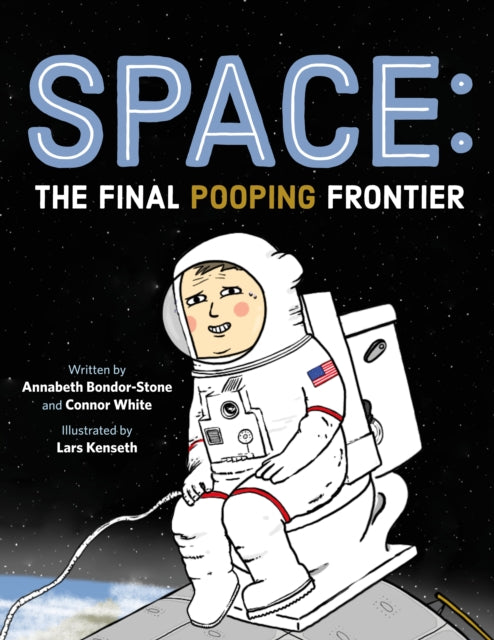
Annabeth Bondor-Stone and Connor White
Space: The Final Pooping Frontier
Space: The Final Pooping Frontier
💎 Earn 60 Points (£0.60) on this item.
YOU SAVE £4.97
- Condition: Brand new
- UK Delivery times: Usually arrives within 2 - 3 working days
- UK Shipping: Fee starts at £2.39. Subject to product weight & dimension
Bulk ordering. Want 15 or more copies? Get a personalised quote and bigger discounts. Learn more about bulk orders.
Couldn't load pickup availability
- More about Space: The Final Pooping Frontier
Everybody poops, even astronauts in space. The history of pooping in space is a scientific journey, from the early NASA missions to the innovative Space Poop Challenge design competition. It highlights the challenges of waste management in space and the need for innovative solutions.
Format: Hardback
Length: 40 pages
Publication date: 01 August 2024
Publisher: St Martin's Press
Everybody poops, and when you're hurtling through space with zero gravity and zero privacy, what's an astronaut to do? Go boldly! This scientific history of pooping in space takes us on a journey from the earliest NASA missions to the innovative results of their recent Space Poop Challenge design competition. We'll explore the evolution of pooping on the final frontier, uncover fascinating facts, and learn why waste management in space is so challenging.
NASA's early missions faced significant challenges when it came to dealing with human waste. In the 1960s, astronauts used a system called "wet wipes" to clean themselves after using the bathroom. However, these wipes were not effective in space, and they often left behind residue that could clog the spacecraft's plumbing.
To address this issue, NASA developed a new system called "dry wipes." These wipes were made of a special material that could be used to clean the astronauts' bodies and the spacecraft's surfaces. They were also designed to be biodegradable, so they would not leave behind any harmful chemicals in space.
However, even with dry wipes, NASA faced challenges with waste management. The waste had to be stored in a special container, and it had to be transported back to Earth for disposal. This was a costly and time-consuming process, and it posed a risk to the astronauts' health and safety.
In the 1980s, NASA began to explore the use of composting in space. Composting is a process that breaks down organic matter into nutrient-rich soil. It can be done in a variety of settings, including on Earth and in space. NASA's composting system was designed to be compact and lightweight, and it could be used to process waste from the International Space Station.
However, the composting system had its own challenges. The waste had to be processed in a controlled environment, and it had to be monitored to ensure that it was not contaminated. Additionally, the waste had to be transported back to Earth for disposal.
In the 1990s, NASA began to explore the use of vacuum toilets in space. Vacuum toilets are a type of toilet that uses a vacuum to suck waste into a holding tank. They are more efficient than traditional toilets, and they can be used in a variety of settings, including on Earth and in space.
NASA's vacuum toilet system was designed to be compact and lightweight, and it could be used to process waste from the International Space Station. However, the system had its own challenges. The waste had to be processed in a controlled environment, and it had to be monitored to ensure that it was not contaminated. Additionally, the waste had to be transported back to Earth for disposal.
In the 2000s, NASA began to explore the use of space-based waste management systems. These systems are designed to process waste in space and to transport it back to Earth for disposal. They include systems such as the SpaceX Dragon spacecraft, which is designed to transport waste from the International Space Station back to Earth.
NASA's space-based waste management systems have been successful in reducing the amount of waste that is produced in space. However, they have also faced challenges. For example, the SpaceX Dragon spacecraft has had to deal with a number of technical issues, including a fire that occurred during a test flight in 2016.
Despite these challenges, NASA continues to explore the use of space-based waste management systems. In the future, we may see the development of new technologies that will make it easier to deal with waste management in space. For example, we may see the development of systems that can process waste in space and convert it into energy.
In conclusion, the history of pooping in space is a fascinating story of innovation and challenge. From the earliest NASA missions to the innovative results of their recent Space Poop Challenge design competition, we have seen the evolution of pooping on the final frontier. While there have been significant challenges with waste management in space, NASA continues to explore new technologies that will make it easier to deal with waste management in the future.
Weight: 300g
Dimension: 279 x 216 (mm)
ISBN-13: 9781250222886
This item can be found in:
UK and International shipping information
UK and International shipping information
UK Delivery and returns information:
- Delivery within 2 - 3 days when ordering in the UK.
- Shipping fee for UK customers from £2.39. Fully tracked shipping service available.
- Returns policy: Return within 30 days of receipt for full refund.
International deliveries:
Shulph Ink now ships to Australia, Belgium, Canada, France, Germany, Ireland, Italy, India, Luxembourg Saudi Arabia, Singapore, Spain, Netherlands, New Zealand, United Arab Emirates, United States of America.
- Delivery times: within 5 - 10 days for international orders.
- Shipping fee: charges vary for overseas orders. Only tracked services are available for most international orders. Some countries have untracked shipping options.
- Customs charges: If ordering to addresses outside the United Kingdom, you may or may not incur additional customs and duties fees during local delivery.