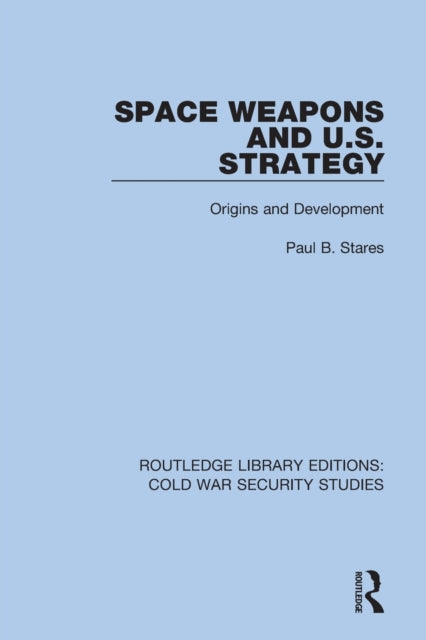
Paul B. Stares
Space Weapons and U.S. Strategy: Origins and Development
Space Weapons and U.S. Strategy: Origins and Development
💎 Earn 184 Points (£1.84) on this item.
We can order this item for you. Delivery usually takes about 4 to 6 weeks.
This item is not held in our immediate stock. We will order it for you after checkout.
Estimated delivery: About 4 to 6 weeks
YOU SAVE £2.19
- Condition: Brand new
- UK Delivery times: Usually arrives within 2 - 3 working days
- UK Shipping: Fee starts at £3.89. Subject to product weight & dimension
Bulk ordering. Want 15 or more copies? Get a personalised quote and bigger discounts. Learn more about bulk orders.
Couldn't load pickup availability
- More about Space Weapons and U.S. Strategy: Origins and Development
This book, first published in 1985, examines the factors that have shaped the militarization of space and explains why for over 25 years space did not become the scene of an arms race, but why this began to change in the late 1970s.
Format: Paperback / softback
Length: 332 pages
Publication date: 15 June 2022
Publisher: Taylor & Francis Ltd
This book, originally published in 1985, delves into the intricate factors that have contributed to the militarization of space. Through a comprehensive examination of the determinants of U.S. policy, it sheds light on the remarkable fact that for over 25 years, space remained largely free from the escalation of an arms race. However, in the late 1970s, a significant shift occurred, marking the beginning of a new era in space exploration. Despite this, both superpowers, the United States and the Soviet Union, developed limited anti-satellite capabilities during the 1960s, which are also explored in detail within the pages of this book.
The militarization of space has been a topic of significant interest and debate for many years. On the one hand, some argue that the development of space technology and the expansion of human presence in space are inevitable and will lead to increased cooperation and peaceful uses of space. On the other hand, others are concerned that the militarization of space could lead to the proliferation of weapons, the escalation of conflict, and the disruption of the peaceful uses of space.
One of the key factors that have shaped the militarization of space is the strategic importance of space for military purposes. Space is used for a wide range of military activities, including surveillance, communication, navigation, and missile defense. The ability to control and exploit space resources can give a military advantage over its adversaries, and this has led to the development of space-based weapons and defense systems.
Another factor that has contributed to the militarization of space is the competition between superpowers. The Cold War between the United States and the Soviet Union was a period of intense geopolitical competition, and space was seen as a critical component of this competition. Both superpowers developed advanced space technology and capabilities, and they competed for dominance in space.
The development of satellite technology has also played a significant role in the militarization of space. Satellites are used for a wide range of purposes, including communication, navigation, surveillance, and weather forecasting. They can also be used for military purposes, such as launching missiles or deploying surveillance drones.
The militarization of space has raised concerns among many countries and organizations. The United Nations has established a number of conventions and agreements to regulate the use of space and prevent the militarization of space. However, there are still concerns that these agreements are not being fully implemented and that the militarization of space is continuing to occur.
In conclusion, the militarization of space has been a complex and multifaceted issue that has been shaped by a range of factors, including strategic importance, competition between superpowers, and the development of satellite technology. While the militarization of space has led to the development of important space-based capabilities, it has also raised concerns about the potential for conflict and the disruption of peaceful uses of space. It is important for governments, organizations, and individuals to work together to ensure that the militarization of space is conducted in a responsible and peaceful manner.
Weight: 621g
Dimension: 234 x 156 (mm)
ISBN-13: 9780367557997
UK and International shipping information
UK and International shipping information
We deliver throughout the United Kingdom and to 128 countries and territories worldwide, including the United States, Australia, Canada, Germany, Spain and France.