Shulph Ink
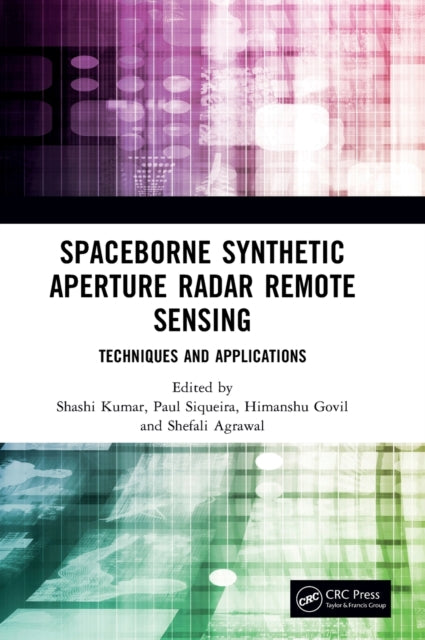
Spaceborne Synthetic Aperture Radar Remote Sensing: Techniques and Applications
Spaceborne Synthetic Aperture Radar Remote Sensing: Techniques and Applications
💎 Earn 811 Points (£8.11) on this item.
We can order this item for you. Delivery usually takes about 4 to 6 weeks.
This item is not held in our immediate stock. We will order it for you after checkout.
Estimated delivery: About 4 to 6 weeks
YOU SAVE £9.63
- Condition: Brand new
- UK Delivery times: Usually arrives within 2 - 3 working days
- UK Shipping: Fee starts at £3.89. Subject to product weight & dimension
Bulk ordering. Want 15 or more copies? Get a personalised quote and bigger discounts. Learn more about bulk orders.
Couldn't load pickup availability
- More about Spaceborne Synthetic Aperture Radar Remote Sensing: Techniques and Applications
Synthetic Aperture Radar (SAR) remote sensing is a powerful tool for earth observation, with applications in solid earth, ecosystem, and cryosphere imaging, and biomass and snow parameter retrieval.
Format: Hardback
Length: 418 pages
Publication date: 31 March 2023
Publisher: Taylor & Francis Ltd
Synthetic Aperture Radar (SAR) is a remote sensing technique that employs electromagnetic radiation to capture detailed images of the Earth's surface. It operates by sending microwave pulses to the Earth's surface and then receiving the reflected signals, which are used to create high-resolution images. SAR has a wide range of applications, including earth observation, environmental monitoring, and disaster response.
Spaceborne SAR sensors are used to collect SAR data from space. These sensors are typically mounted on satellites or other spacecraft and can cover large areas of the Earth's surface in a single scan. SAR remote sensing has many applications in earth observation, including mapping and monitoring of land use, vegetation, and water resources. It can also be used to detect and monitor natural disasters such as earthquakes, floods, and wildfires.
SAR data can be used to image extra-terrestrial bodies, such as planets and moons. This technique is called interferometric SAR (InSAR) and can provide detailed information about the surface features of these bodies. InSAR is particularly useful for studying the geology and topography of Mars and other planets in our solar system.
PolSAR and PolInSAR are two types of SAR that are used to retrieve information about forest aboveground biomass. PolSAR uses polarized microwave radiation to measure the vertical distribution of biomass in trees and other vegetation. PolInSAR uses both polarized and non-polarized microwave radiation to measure the horizontal distribution of biomass in trees and other vegetation.
InSAR and PolSAR are also used to retrieve information about snow parameters, such as snow depth and snow density. These techniques can be used to monitor snow cover and snowpack, which are important for predicting weather patterns and water resources.
Overall, SAR remote sensing is a powerful tool that has many applications in earth observation and other fields. It provides high-resolution images of the Earth's surface and can be used to monitor and analyze a wide range of environmental phenomena. As technology continues to advance, SAR will likely play an increasingly important role in our ability to understand and manage the Earth's resources.
Synthetic Aperture Radar (SAR) is a remote sensing technique that employs electromagnetic radiation to capture detailed images of the Earth's surface. It operates by sending microwave pulses to the Earth's surface and then receiving the reflected signals, which are used to create high-resolution images. SAR has a wide range of applications, including earth observation, environmental monitoring, and disaster response.
Spaceborne SAR sensors are used to collect SAR data from space. These sensors are typically mounted on satellites or other spacecraft and can cover large areas of the Earth's surface in a single scan. SAR remote sensing has many applications in earth observation, including mapping and monitoring of land use, vegetation, and water resources. It can also be used to detect and monitor natural disasters such as earthquakes, floods, and wildfires.
SAR data can be used to image extra-terrestrial bodies, such as planets and moons. This technique is called interferometric SAR (InSAR) and can provide detailed information about the surface features of these bodies. InSAR is particularly useful for studying the geology and topography of Mars and other planets in our solar system.
PolSAR and PolInSAR are two types of SAR that are used to retrieve information about forest aboveground biomass. PolSAR uses polarized microwave radiation to measure the vertical distribution of biomass in trees and other vegetation. PolInSAR uses both polarized and non-polarized microwave radiation to measure the horizontal distribution of biomass in trees and other vegetation.
InSAR and PolSAR are also used to retrieve information about snow parameters, such as snow depth and snow density. These techniques can be used to monitor snow cover and snowpack, which are important for predicting weather patterns and water resources.
Overall, SAR remote sensing is a powerful tool that has many applications in earth observation and other fields. It provides high-resolution images of the Earth's surface and can be used to monitor and analyze a wide range of environmental phenomena. As technology continues to advance, SAR will likely play an increasingly important role in our ability to understand and manage the Earth's resources.
Dimension: 254 x 178 (mm)
ISBN-13: 9781032069050
UK and International shipping information
UK and International shipping information
We deliver throughout the United Kingdom and to 128 countries and territories worldwide, including the United States, Australia, Canada, Germany, Spain and France.