Koldo, Lecturer in Law and the Director of the Human Rights Centre Clinic, University of Essex Casla
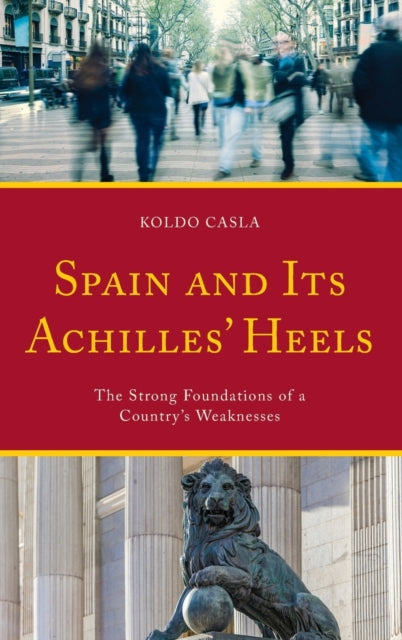
Spain and Its Achilles' Heels: The Strong Foundations of a Country's Weaknesses
Spain and Its Achilles' Heels: The Strong Foundations of a Country's Weaknesses
💎 Earn 477 Points (£4.77) on this item.
We can order this item for you. Delivery usually takes about 4 to 6 weeks.
This item is not held in our immediate stock. We will order it for you after checkout.
Estimated delivery: About 4 to 6 weeks
- Condition: Brand new
- UK Delivery times: Usually arrives within 2 - 3 working days
- UK Shipping: Fee starts at £2.39. Subject to product weight & dimension
Bulk ordering. Want 15 or more copies? Get a personalised quote and bigger discounts. Learn more about bulk orders.
Couldn't load pickup availability
- More about Spain and Its Achilles' Heels: The Strong Foundations of a Country's Weaknesses
This book tracks the historical roots of the political tensions that make Spain the captivating yet troubled country that it is today.
Format: Hardback
Length: 218 pages
Publication date: 11 November 2021
Publisher: Rowman & Littlefield
In late 2019, the exhumation of Francisco Franco from the Valley of the Fallen sparked widespread interest and debate. This event occurred after decades of controversy surrounding his legacy and the role he played in Spanish history. Here are some key questions to consider regarding Franco's exhumation:
Why was Franco exhumed from the Valley of the Fallen in late 2019?
The decision to exhum Franco's remains from the Valley of the Fallen was made by the Spanish government in response to a petition signed by over 100,000 citizens, including many descendants of victims of Franco's regime. The petition called for the removal of Franco's remains from the Valley, which is considered a symbol of the Francoist dictatorship. The exhumation was also seen as a way to address the historical injustices committed during the Francoist era and to promote reconciliation and healing in Spain.
How is it that he was there in the first place?
Franco was interred in the Valley of the Fallen after his death in 1975. The decision to bury him there was made by the Spanish government, which at the time was led by his loyalist supporters. The Valley was designed as a memorial to Spanish soldiers who died in the Spanish Civil War and the Second World War. Franco's burial there was seen as a way to honor his role in Spanish history and to celebrate his legacy.
Why did Catalonia erupt suddenly in October 2017?
The eruption of the Catalan independence movement in October 2017 was triggered by a controversial referendum on independence from Spain. The referendum was held despite the Spanish government's opposition and resulted in a majority of Catalan voters supporting independence. The Spanish government responded by imposing direct rule on Catalonia and arresting several Catalan leaders. The eruption of the movement highlighted the deep divisions between Catalonia and the rest of Spain, particularly over issues such as language, culture, and political representation.
Why don't you hear so much about the Basque Country anymore?
The Basque Country has historically been a region of strong separatist sentiment and has been the site of several violent incidents in the past. However, in recent years, the focus of Spanish politics has shifted away from the Basque Country. This may be due to a variety of factors, including the successful resolution of the Basque conflict, the rise of other regional movements, and the broader political climate in Spain.
How did Podemos gather momentum so quickly in 2014-15, and why did half of that support vanish five years later?
Podemos, a left-wing political party, emerged in Spain in 2014 as a response to the economic crisis and the political establishment. The party gained significant momentum in the 2015 general election, winning over 10% of the vote and becoming the third-largest political party in Spain. However, in the years following the election, Podemos faced a number of challenges, including internal divisions and a loss of support among some of its original supporters. The party's popularity has also been affected by the broader political climate in Spain, which has become more polarized and conservative.
Isn't it counterintuitive that a Catholic-majority country also has the most LGBT-friendly society in the world?
Spain has a long history of religious conservatism and has been criticized for its treatment of LGBTQ+ individuals in the past. However, in recent years, Spain has become increasingly progressive and inclusive, with a growing number of cities and regions passing laws to protect the rights of LGBTQ+ individuals. Spain is also home to one of the largest LGBTQ+ communities in the world, with a significant presence in the arts, culture, and politics. The country's reputation as a LGBT-friendly society is a reflection of its commitment to social justice and equality.
In conclusion, the exhumation of Francisco Franco, the eruption of the Catalan independence movement, the decline of the Basque Country in Spanish politics, the rise and fall of Podemos, and the country's reputation as a LGBT-friendly society are all significant events in recent Spanish politics. These events reflect the deep divisions and complex issues that continue to shape Spanish society today. Understanding these events requires a nuanced and critical approach, which considers the historical, social, and political context in which they occurred.
Weight: 540g
Dimension: 228 x 160 x 20 (mm)
ISBN-13: 9781538164587
This item can be found in:
UK and International shipping information
UK and International shipping information
UK Delivery and returns information:
- Delivery within 2 - 3 days when ordering in the UK.
- Shipping fee for UK customers from £2.39. Fully tracked shipping service available.
- Returns policy: Return within 30 days of receipt for full refund.
International deliveries:
Shulph Ink now ships to Australia, Belgium, Canada, France, Germany, Ireland, Italy, India, Luxembourg Saudi Arabia, Singapore, Spain, Netherlands, New Zealand, United Arab Emirates, United States of America.
- Delivery times: within 5 - 10 days for international orders.
- Shipping fee: charges vary for overseas orders. Only tracked services are available for most international orders. Some countries have untracked shipping options.
- Customs charges: If ordering to addresses outside the United Kingdom, you may or may not incur additional customs and duties fees during local delivery.