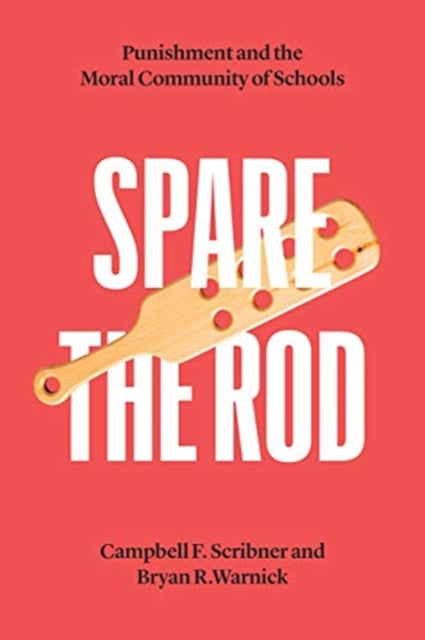
Campbell F. Scribner,Bryan R. Warnick
Spare the Rod: Punishment and the Moral Community of Schools
Spare the Rod: Punishment and the Moral Community of Schools
💎 Earn 114 Points (£1.14) on this item.
YOU SAVE £1.15
- Condition: Brand new
- UK Delivery times: Usually arrives within 2 - 3 working days
- UK Shipping: Fee starts at £2.39. Subject to product weight & dimension
Bulk ordering. Want 15 or more copies? Get a personalised quote and bigger discounts. Learn more about bulk orders.
Couldn't load pickup availability
- More about Spare the Rod: Punishment and the Moral Community of Schools
Spare the Rod explores the history and philosophy of discipline in schools, arguing that it has become increasingly integrated with prison and policing, disregarding the unique status of schools as spaces of moral growth and community oversight. The authors suggest an approach to discipline that aligns with the moral community of schools.
Format: Paperback / softback
Length: 168 pages
Publication date: 11 May 2021
Publisher: The University of Chicago Press
In their book "Spare the Rod", historian Campbell F. Scribner and philosopher Bryan R. Warnick delve into the history and philosophy of punishment and discipline practices in American schools. To explore this controversial subject, they begin by asking fundamental questions about the meaning and purposes of discipline and punishment. They examine how these concepts have evolved over time and consider what they reveal about our assumptions about education. The authors then explore the justifications for punishing or disciplining students in public schools. They question whether educators are ever justified in using such methods and whether discipline and punishment are essential for moral education. If punishment is deemed necessary, they argue for ethical guidelines to ensure that it is fair, proportionate, and in line with the principles of respect and rehabilitation.
As schools have become increasingly bureaucratic over the past century, the authors argue, formalizing disciplinary systems and shifting from physical punishments to spatial or structural punishments such as in-school suspension have led to the integration of school discipline with prisons and policing. This integration, known as the "school-to-prison pipeline," disregards the unique status of schools as spaces of moral growth and community oversight and is incompatible with the developmental environment of education. The authors propose an approach to discipline and punishment that aligns with the moral community that schools could and should be.
They argue that schools should focus on promoting positive behavior and creating a supportive learning environment that fosters the social, emotional, and academic development of students. This approach involves building strong relationships between students, teachers, and parents and providing comprehensive support services that address the underlying issues that may lead to disruptive behavior. Punishment should be used as a last resort and only when necessary to protect the safety and well-being of all students.
The authors also emphasize the importance of addressing the root members of the community. They argue that schools should work closely with local law enforcement agencies, social services, and community organizations to address the root causes of crime and violence, such as poverty, inequality, and lack of access to education and resources. By addressing these underlying issues, schools can help break the cycle of poverty and promote social justice.
In conclusion, "Spare the Rod" offers a critical examination of the history and philosophy of punishment and discipline practices in American schools. The authors argue that the current approach to discipline is flawed and incompatible with the goals of education. They propose an alternative approach that emphasizes positive behavior, support, and community engagement to promote the well-being and success of all students. By adopting this approach, schools can help create a more just and equitable society.
Weight: 262g
Dimension: 152 x 228 x 15 (mm)
ISBN-13: 9780226785707
This item can be found in:
UK and International shipping information
UK and International shipping information
UK Delivery and returns information:
- Delivery within 2 - 3 days when ordering in the UK.
- Shipping fee for UK customers from £2.39. Fully tracked shipping service available.
- Returns policy: Return within 30 days of receipt for full refund.
International deliveries:
Shulph Ink now ships to Australia, Belgium, Canada, France, Germany, Ireland, Italy, India, Luxembourg Saudi Arabia, Singapore, Spain, Netherlands, New Zealand, United Arab Emirates, United States of America.
- Delivery times: within 5 - 10 days for international orders.
- Shipping fee: charges vary for overseas orders. Only tracked services are available for most international orders. Some countries have untracked shipping options.
- Customs charges: If ordering to addresses outside the United Kingdom, you may or may not incur additional customs and duties fees during local delivery.