Tessa Dwyer
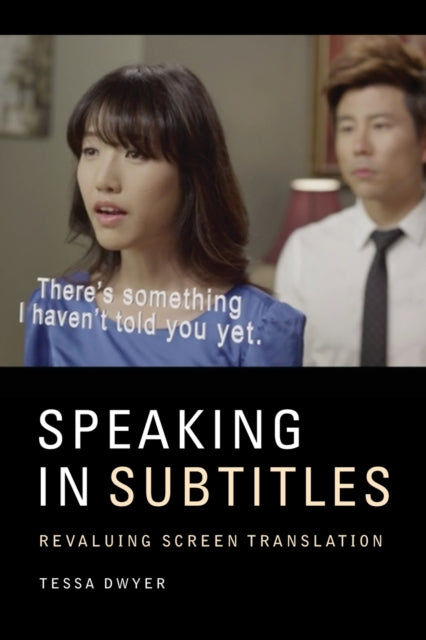
Speaking in Subtitles: Revaluing Screen Translation
Speaking in Subtitles: Revaluing Screen Translation
💎 Earn 99 Points (£0.99) on this item.
YOU SAVE £6.06
- Condition: Brand new
- UK Delivery times: Usually arrives within 2 - 3 working days
- UK Shipping: Fee starts at £2.39. Subject to product weight & dimension
Bulk ordering. Want 15 or more copies? Get a personalised quote and bigger discounts. Learn more about bulk orders.
Couldn't load pickup availability
- More about Speaking in Subtitles: Revaluing Screen Translation
Speaking in Subtitles argues that translation is essential to screen media's global storytelling, examining a range of examples from silent era intertitling to contemporary crowdsourced subtitling.
Format: Paperback / softback
Length: 208 pages
Publication date: 30 November 2018
Publisher: Edinburgh University Press
Over 6000 different languages are used in the world today, but the conventions of media speak are far from universal and the complexities of translation are rarely acknowledged by the industry, audiences, or scholars. Redressing this neglect, Speaking in Subtitles argues that the specific contingencies of translation are vital to screen media's global storytelling. Looking at a range of examples, from silent era intertitling to contemporary crowdsourced subtitling, and from avant-garde dubbing to the increasing practice of fansubbing, Tessa Dwyer proposes that screen media itself is a fundamentally translational field.
The world is home to over 6000 different languages, each with its own unique linguistic and cultural heritage. However, the conventions of media speak are far from universal, and the complexities of translation are often overlooked by the industry, audiences, and scholars. Speaking in Subtitles seeks to address this neglect by exploring the specific contingencies of translation in screen media's global storytelling.
The book examines a range of examples, from silent era intertitling to contemporary crowdsourced subtitling, and from avant-garde dubbing to the increasing practice of fansubbing. Tessa Dwyer argues that screen media itself is a fundamentally translational field, and that the specific challenges and opportunities of translation play a crucial role in shaping the way that stories are told and received across different cultures.
One of the key arguments of Speaking in Subtitles is that translation is not just a matter of conveying meaning from one language to another, but also of creating new meanings and interpretations. This is particularly true in the context of screen media, where visual and auditory elements play a significant role in conveying meaning. Translation can help to bridge cultural gaps and create a more inclusive and diverse media landscape, but it can also be a source of tension and conflict.
Dwyer provides a number of examples to illustrate these points. For example, she discusses the challenges of intertitling silent era films, where the lack of dialogue and visual cues made it difficult to convey the story to a global audience. She also explores the ways in which crowdsourced subtitling has become a popular form of translation, allowing individuals to contribute to the translation of films and TV shows from around the world.
Fansubbing, which involves the translation of anime and other Japanese media, is another example of the translational nature of screen media. Fansubbers often work to create high-quality translations that are faithful to the original source material, but they also often add their own cultural and linguistic nuances to the translation. This can lead to debates about the authenticity of the translation and the impact it has on the original work.
Despite the challenges and complexities of translation, Dwyer argues that it is essential to the future of screen media. She suggests that the industry should invest more in training and resources for translators, and that audiences should be more aware of the importance of translation in the media they consume. She also suggests that scholars should engage more with the study of translation in screen media, and that this research should be used to inform the development of new technologies and practices.
In conclusion, Speaking in Subtitles is a valuable contribution to the study of translation in screen media. It argues that the specific contingencies of translation are vital to screen media's global storytelling, and that the industry, audiences, and scholars should be more aware of the importance of translation in the media they consume. By exploring a range of examples, Dwyer provides a compelling case for the need to invest more in training and resources for translators, and for audiences to be more aware of the importance of translation in the media they consume.
Weight: 374g
Dimension: 157 x 234 x 12 (mm)
ISBN-13: 9781474440998
UK and International shipping information
UK and International shipping information
UK Delivery and returns information:
- Delivery within 2 - 3 days when ordering in the UK.
- Shipping fee for UK customers from £2.39. Fully tracked shipping service available.
- Returns policy: Return within 30 days of receipt for full refund.
International deliveries:
Shulph Ink now ships to Australia, Belgium, Canada, France, Germany, Ireland, Italy, India, Luxembourg Saudi Arabia, Singapore, Spain, Netherlands, New Zealand, United Arab Emirates, United States of America.
- Delivery times: within 5 - 10 days for international orders.
- Shipping fee: charges vary for overseas orders. Only tracked services are available for most international orders. Some countries have untracked shipping options.
- Customs charges: If ordering to addresses outside the United Kingdom, you may or may not incur additional customs and duties fees during local delivery.