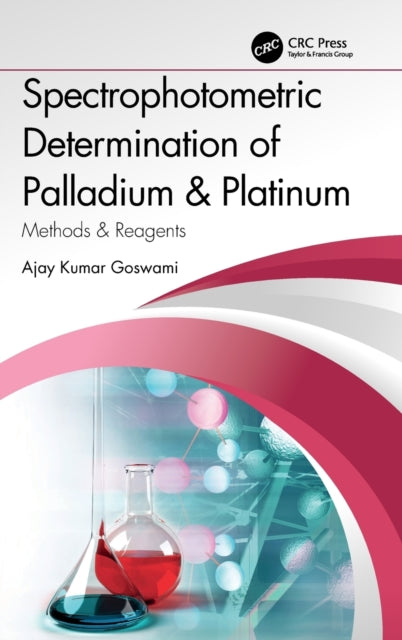
Ajay Kumar Goswami
Spectrophotometric Determination of Palladium & Platinum: Methods & Reagents
Spectrophotometric Determination of Palladium & Platinum: Methods & Reagents
💎 Earn 490 Points (£4.90) on this item.
We can order this item for you. Delivery usually takes about 4 to 6 weeks.
This item is not held in our immediate stock. We will order it for you after checkout.
Estimated delivery: About 4 to 6 weeks
YOU SAVE £5.83
- Condition: Brand new
- UK Delivery times: Usually arrives within 2 - 3 working days
- UK Shipping: Fee starts at £2.39. Subject to product weight & dimension
Bulk ordering. Want 15 or more copies? Get a personalised quote and bigger discounts. Learn more about bulk orders.
Couldn't load pickup availability
- More about Spectrophotometric Determination of Palladium & Platinum: Methods & Reagents
Spectrophotometry is a powerful tool for the determination of palladium and platinum in various samples, and recently developed methods have improved the accuracy and sensitivity of the analysis. The methods are organized based on the reagents used, making it easy for researchers to find the most suitable method for their specific needs.
Format: Hardback
Length: 118 pages
Publication date: 28 March 2023
Publisher: Taylor & Francis Ltd
Spectrophotometry has recently been employed to develop several methods for the determination of palladium and platinum in a single source. These methods offer several advantages, including the ability to analyze complex samples with high sensitivity and precision, as well as the potential for automation and miniaturization.
One of the most commonly used methods for palladium and platinum determination using spectrophotometry is the colorimetric method. In this method, the sample is dissolved in a suitable solvent, and the resulting solution is then exposed to a wavelength of light that causes the metal to absorb a specific color. The intensity of this color is then measured using a spectrophotometer, and the concentration of the metal is calculated based on the absorbance value.
Another method that has been developed for palladium and platinum determination is the atomic absorption spectroscopy method. In this method, the sample is vaporized and the vapor is passed through a hollow cathode lamp, which emits a beam of light that is absorbed by the metal atoms in the sample. The intensity of this absorption is then measured using a spectrophotometer, and the concentration of the metal is calculated based on the absorbance value.
Both the colorimetric and atomic absorption spectroscopy methods have been used to analyze a wide range of samples, including environmental samples, industrial waste, and biological samples. They have been shown to be highly effective in determining the concentration of palladium and platinum in these samples with high sensitivity and precision.
In addition to these methods, spectrophotometry has also been used to develop methods for the determination of palladium and platinum in complex samples. For example, some methods have been developed that use multiple wavelengths of light to analyze the sample, which allows for the separation of the metal from other components in the sample.
Overall, spectrophotometry has played an important role in the development of methods for the determination of palladium and platinum in a single source. These methods offer several advantages, including the ability to analyze complex samples with high sensitivity and precision, as well as the potential for automation and miniaturization. As research in this field continues, it is likely that new and improved methods will be developed that will further enhance the capabilities of spectrophotometry in the analysis of metals.
Spectrophotometry has recently been employed to develop several methods for the determination of palladium and platinum in a single source. These methods offer several advantages, including the ability to analyze complex samples with high sensitivity and precision, as well as the potential for automation and miniaturization.
One of the most commonly used methods for palladium and platinum determination using spectrophotometry is the colorimetric method. In this method, the sample is dissolved in a suitable solvent, and the resulting solution is then exposed to a wavelength of light that causes the metal to absorb a specific color. The intensity of this color is then measured using a spectrophotometer, and the concentration of the metal is calculated based on the absorbance value.
Another method that has been developed for palladium and platinum determination is the atomic absorption spectroscopy method. In this method, the sample is vaporized and the vapor is passed through a hollow cathode lamp, which emits a beam of light that is absorbed by the metal atoms in the sample. The intensity of this absorption is then measured using a spectrophotometer, and the concentration of the metal is calculated based on the absorbance value.
Both the colorimetric and atomic absorption spectroscopy methods have been used to analyze a wide range of samples, including environmental samples, industrial waste, and biological samples. They have been shown to be highly effective in determining the concentration of palladium and platinum in these samples with high sensitivity and precision.
In addition to these methods, spectrophotometry has also been used to develop methods for the determination of palladium and platinum in complex samples. For example, some methods have been developed that use multiple wavelengths of light to analyze the sample, which allows for the separation of the metal from other components in the sample.
Overall, spectrophotometry has played an important role in the development of methods for the determination of palladium and platinum in a single source. These methods offer several advantages, including the ability to analyze complex samples with high sensitivity and precision, as well as the potential for automation and miniaturization. As research in this field continues, it is likely that new and improved methods will be developed that will further enhance the capabilities of spectrophotometry in the analysis of metals.
Weight: 318g
Dimension: 158 x 236 x 14 (mm)
ISBN-13: 9781032232447
This item can be found in:
UK and International shipping information
UK and International shipping information
UK Delivery and returns information:
- Delivery within 2 - 3 days when ordering in the UK.
- Shipping fee for UK customers from £2.39. Fully tracked shipping service available.
- Returns policy: Return within 30 days of receipt for full refund.
International deliveries:
Shulph Ink now ships to Australia, Belgium, Canada, France, Germany, Ireland, Italy, India, Luxembourg Saudi Arabia, Singapore, Spain, Netherlands, New Zealand, United Arab Emirates, United States of America.
- Delivery times: within 5 - 10 days for international orders.
- Shipping fee: charges vary for overseas orders. Only tracked services are available for most international orders. Some countries have untracked shipping options.
- Customs charges: If ordering to addresses outside the United Kingdom, you may or may not incur additional customs and duties fees during local delivery.