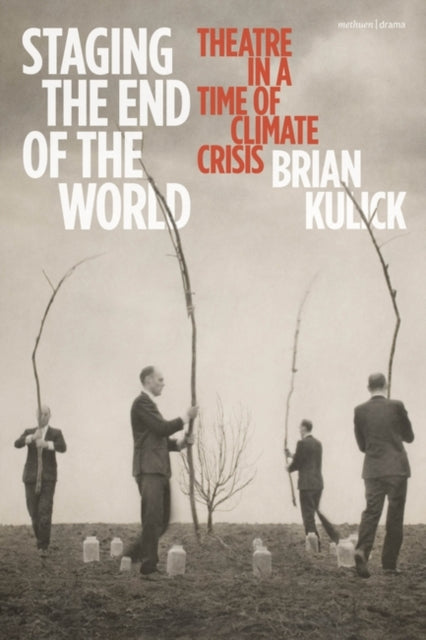
BrianKulick
Staging the End of the World: Theatre in a Time of Climate Crisis
Staging the End of the World: Theatre in a Time of Climate Crisis
💎 Earn 111 Points (£1.11) on this item.
- Condition: Brand new
- UK Delivery times: Usually arrives within 2 - 3 working days
- UK Shipping: Fee starts at £2.39. Subject to product weight & dimension
Bulk ordering. Want 15 or more copies? Get a personalised quote and bigger discounts. Learn more about bulk orders.
Couldn't load pickup availability
- More about Staging the End of the World: Theatre in a Time of Climate Crisis
The book explores the end of the world through the eyes of theatre, dividing it into four historical phases: the Ancients, the Age of Belief, the Moderns, and the potential end now. It combines insights from playwrights with contemporary thinkers to address the climate crisis and explore humanity's potential for collective continuance.
Format: Paperback / softback
Length: 280 pages
Publication date: 26 January 2023
Publisher: Bloomsbury Publishing PLC
Theatre has been a powerful medium for exploring the end of the world, depicting a wide range of catastrophic events throughout history. From the fall of empires to floods, doomsdays, shipwrecks, earthquakes, plagues, environmental degradations, warfare, nuclear annihilation, and the catastrophic effects of climate change, theatre has staged it all. This book aims to provide a comprehensive history of the end of the world as seen through the eyes of theatre, using a wide range of plays alongside contemporary thinkers to guide and galvanize readers in grappling with the climate crisis.
Kulick divides the litany of theatrical cataclysms into four distinct historical phases: the Ancients, including Euripides and Bhasa, the legendary Sanskrit dramatist; the Age of Belief, with the anonymous authors of the medieval mystery cycles, Shakespeare, and Pushkin; the Moderns, with Ibsen, Chekhov, Brecht, Beckett, and Bond; and, finally, the way the world might end now, encompassing Caryl Churchill, Tony Kushner, and Anne Washburn.
In tandem with the insights gleaned from these playwrights, the book draws upon the work of contemporary scientists, ecologists, and ethicists to further tease out the philosophical implications of such plays and their relevance to our own troubled times. Kulick shows how each of these ages and their respective authors have something essential to say, not only about humanity's potential end but also about the possibility for our collective continuance.
The Ancients:
The Ancients, including Euripides and Bhasa, were some of the earliest playwrights to explore the end of the world. Euripides, in his play "The Bacchae," depicted the wrath of the gods and the destruction of the world as a result of human hubris. Bhasa, in his play "Vijaya," depicted the end of the world as a result of a catastrophic flood.
The Age of Belief:
The Age of Belief, which spanned from the Middle Ages to the Renaissance, was characterized by a belief in the supernatural and the power of fate. The anonymous authors of the medieval mystery cycles, such as the "Chronicles, " "Sir Gawain and the Green Knight," and "Piers Plowman," depicted the end of the world as a result of apocalyptic events, such as the coming of the end of the world, the rise of the Antichrist, and the Last Judgment.
Shakespeare and Pushkin:
Shakespeare and Pushkin were two of the most influential playwrights of the Age of Belief. Shakespeare's play "Macbeth" depicted the end of the world as a result of the ambition of a Scottish nobleman, who was driven to commit murder in order to gain power and control. Pushkin's play "The Queen of Spades" depicted the end of the world as a result of a game of cards, in which a young woman loses her fortune and her sanity.
The Moderns:
The Moderns, who emerged in the late 18th and early 19th centuries, were characterized by a focus on realism and social critique. Ibsen, Chekhov, Brecht, Beckett, and Bond were some of the most influential playwrights of this era. Ibsen's play "Hedda Gabler" depicted the end of the world as a result of the repression of women and the stifling of individualism. Chekhov's play "The Seagull" depicted the end of the world as a result of the failure of a family to connect with each other. Brecht's play "Mother Courage and Her Children" depicted the end of the world as a result of war and the destruction of society. Beckett's play "Endgame" depicted the end of the world as a result of the failure of communication and the breakdown of society. Bond's play "The Sea" depicted the end of the world as a result of the destruction of the environment.
The Way the World Might End Now:
The Way the World Might End Now, which encompasses the works of Caryl Churchill, Tony Kushner, and Anne Washburn, reflects the contemporary concerns about the climate crisis. Churchill's play "The Climate of Fear" depicts the end of the world as a result of the catastrophic effects of climate change, such as rising sea levels, extreme weather events, and food shortages. Kushner's play "The Iceman Cometh" depicts the end of the world as a result of the collapse of society and the loss of hope. Washburn's play "The Great Comet" depicts the end of the world as a result of a comet's impact on Earth.
Conclusion:
In conclusion, this book provides a comprehensive history of the end of the world as seen through the eyes of theatre, using a wide range of plays alongside contemporary thinkers to guide and galvanize readers in grappling with the climate crisis. Kulick's division of the litany of theatrical cataclysms into four distinct historical phases allows for a deeper understanding of the different ways in which the end of the world has been depicted over time. The insights gleaned from these plays and the work of contemporary thinkers provide a powerful tool for understanding the potential consequences of our actions and the importance of collective action in addressing the climate crisis.
Weight: 438g
Dimension: 156 x 234 x 17 (mm)
ISBN-13: 9781350309951
This item can be found in:
UK and International shipping information
UK and International shipping information
UK Delivery and returns information:
- Delivery within 2 - 3 days when ordering in the UK.
- Shipping fee for UK customers from £2.39. Fully tracked shipping service available.
- Returns policy: Return within 30 days of receipt for full refund.
International deliveries:
Shulph Ink now ships to Australia, Belgium, Canada, France, Germany, Ireland, Italy, India, Luxembourg Saudi Arabia, Singapore, Spain, Netherlands, New Zealand, United Arab Emirates, United States of America.
- Delivery times: within 5 - 10 days for international orders.
- Shipping fee: charges vary for overseas orders. Only tracked services are available for most international orders. Some countries have untracked shipping options.
- Customs charges: If ordering to addresses outside the United Kingdom, you may or may not incur additional customs and duties fees during local delivery.