Thomas K. Adamson
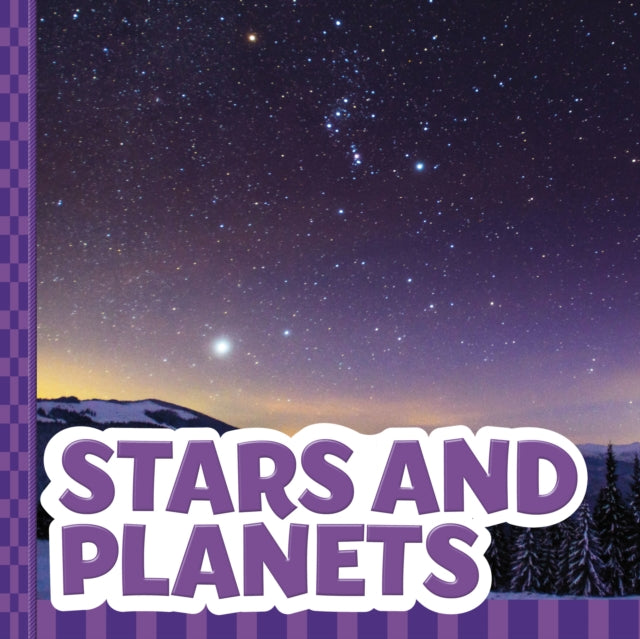
Stars and Planets
Stars and Planets
YOU SAVE £3.07
- Condition: Brand new
- UK Delivery times: Usually arrives within 2 - 3 working days
- UK Shipping: Fee starts at £3.89. Subject to product weight & dimension
Bulk ordering. Want 15 or more copies? Get a personalised quote and bigger discounts. Learn more about bulk orders.
Couldn't load pickup availability
- More about Stars and Planets
Stars are celestial objects that emit light and heat, while planets are large, celestial bodies that orbit around stars. Some stars are brighter than others due to their size, age, and composition. We can see some planets from Earth with the naked eye, while others require telescopes to observe. This title provides an introduction to the science behind stars and planets.
Format: Hardback
Length: 24 pages
Publication date: 19 January 2023
Publisher: Capstone Global Library Ltd
Stars are celestial objects composed primarily of hydrogen and helium, which are formed through the gravitational collapse of gas clouds. They vary in size, color, and temperature, with the hottest stars being blue and the coolest stars being red. Stars are the primary sources of energy for many planets in our solar system, including Earth.
Planets are large, celestial bodies that orbit around stars. They come in a variety of sizes, shapes, and compositions, ranging from gas giants like Jupiter to small, rocky planets like Mercury. Planets are also classified based on their distance from the sun, with the inner planets being closer to the sun than the outer planets.
The brightness of stars is determined by a variety of factors, including their size, temperature, and distance from the Earth. The closer a star is to the Earth, the brighter it appears to us. The hottest stars, which are blue, are the most luminous and can be seen from far away.
There are many planets in our solar system that are visible to the naked eye from Earth. These include the planets Mercury, Venus, Mars, Jupiter, Saturn, Uranus, and Neptune. In addition, there are many other planets that are too far away to be seen with the naked eye, but can be observed with telescopes or other instruments.
Stars and planets are fascinating objects that have captivated human imagination for centuries. By understanding the science behind them, we can gain a deeper appreciation for the universe and our place in it.
Stars, celestial entities composed predominantly of hydrogen and helium, emerge through the gravitational collapse of gas clouds. These celestial bodies exhibit a wide range of sizes, colors, and temperatures, with the hottest stars displaying a blue hue and the coolest stars exhibiting a red tinge. Stars serve as the primary energy sources for numerous planets in our solar system, including our home planet, Earth.
Planets, vast celestial bodies that orbit around stars, encompass a diverse array of sizes, shapes, and compositions. They range from colossal gas giants like Jupiter to diminutive, rocky planets like Mercury. Planets are further categorized based on their distance from the sun, with the inner planets situated closer to the sun than the outer planets.
The luminosity of stars is influenced by a multitude of factors, including their size, temperature, and distance from Earth. The closer a star is to our planet, the brighter it appears to us. The most luminous stars, characterized by their blue hue, are capable of being observed from vast distances.
Our solar system boasts a multitude of planets that are observable to the naked eye from Earth. These include the planets Mercury, Venus, Mars, Jupiter, Saturn, Uranus, and Neptune. Furthermore, there exist numerous other planets that are too far away to be discerned with the unaided eye, yet can be observed through the use of telescopes or other instruments.
Stars and planets, captivating objects that have fascinated human beings for centuries, continue to hold our attention and inspire our curiosity. By delving into the science behind them, we gain a deeper understanding of the universe and our place within it.
Weight: 234g
Dimension: 209 x 207 x 12 (mm)
ISBN-13: 9781398247956
UK and International shipping information
UK and International shipping information
We deliver throughout the United Kingdom and to 128 countries and territories worldwide, including the United States, Australia, Canada, Germany, Spain and France.